CNC Machine Cutting Wood: Mass Timber Joinery Case Study
Explore how a 5-axis CNC machine cutting wood transforms mass timber joinery. Real-world case study on ROI, tooling, and CLT processing metrics.
The Shift to 5-Axis Automation in Structural Timber
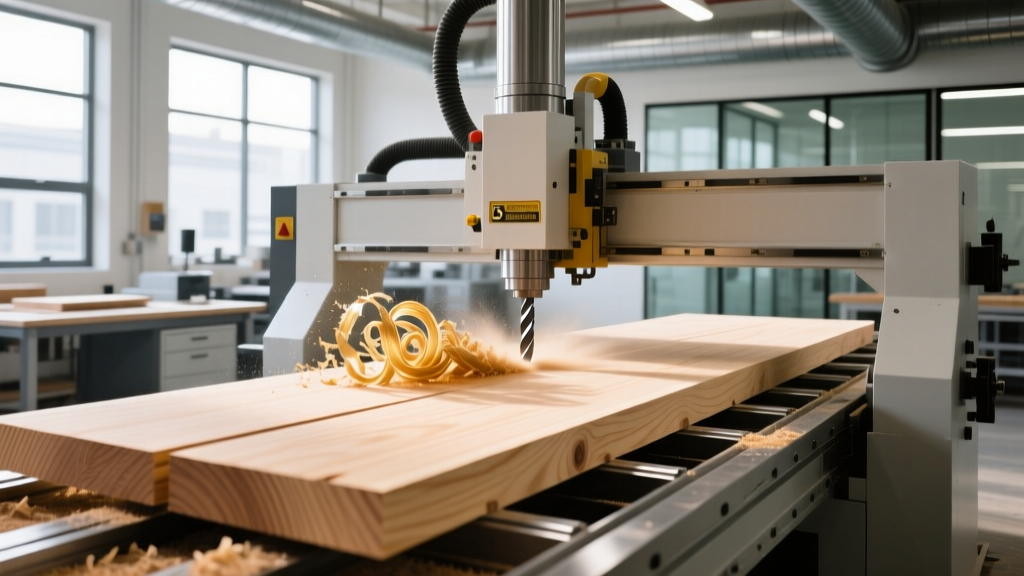
The mass timber construction sector has fundamentally altered the economics of commercial woodworking. Cross-laminated timber (CLT), glued laminated timber (Glulam), and nail-laminated timber (NLT) require connection tolerances that manual layout and cutting simply cannot achieve at production speeds. When evaluating a 5-axis CNC machine cutting wood for structural applications, facility managers are not just looking at router tables; they are investing in heavy-duty, multi-functional timber processing centers capable of milling, drilling, and sawing beams up to 60 feet long and 48 inches deep.
This case study examines the operational transition of a mid-sized Pacific Northwest mass timber fabricator that upgraded from manual bandsaw joinery to a fully automated 5-axis CNC timber processing line in early 2026. The objective was to reduce cycle times on complex steel-to-timber concealed connections while mitigating the severe labor shortage of skilled timber framers.
Facility Profile & Capital Expenditure- Facility Size: 22,000 sq. ft. (dedicated 8,000 sq. ft. for CNC cell)
- Primary Machinery: Hundegger K2i 5-Axis Timber Joinery Machine
- Base Machine Cost: $745,000
- Ancillary Equipment: $135,000 (Infeed/outfeed vacuum lifters and roller conveyors)
- Dust Extraction System: $110,000 (ATEX-compliant centralized cyclone)
- Total Cell Investment: ~$990,000
Software Stack: Bridging BIM and G-Code
The most common failure point in automated woodworking is the disconnect between architectural design and machine toolpaths. A standard CNC machine cutting wood for cabinetry relies on Mastercam or VCarve, but mass timber requires specialized parametric CAD/CAM environments. The fabricator in this study utilized SEMA Experience alongside Dietrich's software.
These platforms import IFC (Industry Foundation Classes) files directly from Revit or Tekla Structures. The software automatically identifies structural nodes, generates the necessary mortise-and-tenon joinery, calculates shrinkage compensation for green vs. kiln-dried lumber, and outputs the proprietary BTL (BauTimber Language) or MPD code required by the CNC controller. This eliminated 14 hours of manual shop drawing translation per 10,000 board-foot project.
Tooling Matrix: Engineered Wood vs. Solid Sawn
Cutting engineered wood products introduces severe abrasion challenges. The phenol-resorcinol-formaldehyde (PRF) and melamine-urea-formaldehyde (MUF) resins used in Glulam and CLT act like sandpaper on standard carbide tooling. Transitioning to Polycrystalline Diamond (PCD) tooling was mandatory for this facility.
| Material Type | Primary Tooling Requirement | Spindle Speed (RPM) | Feed Rate (m/min) | Expected Tool Life |
|---|---|---|---|---|
| Solid Sawn Douglas Fir | Tungsten Carbide (TCT) Router & Saw | 12,000 - 15,000 | 15 - 25 | 40 - 60 hours |
| Glulam (PRF Resin) | PCD-Tipped Saw Blades & Drill Blocks | 8,000 - 10,000 | 20 - 30 | 120+ hours (resharpenable) |
| CLT (Cross-Grain Layers) | Compression Spiral Up/Down Cutters | 14,000 - 16,000 | 10 - 15 | 80 hours (prevents tear-out) |
Financial Impact: A premium solid carbide 20mm router bit costs approximately $85 and yields roughly 8 hours of clean cutting in Glulam before chipping. A comparable PCD-tipped bit from Leitz or AKE costs $480 but delivers over 120 hours of runtime and can be resharpened up to three times, reducing cost-per-foot of cut by 68%.
Critical Edge Case: Dust Extraction and NFPA 664 Compliance
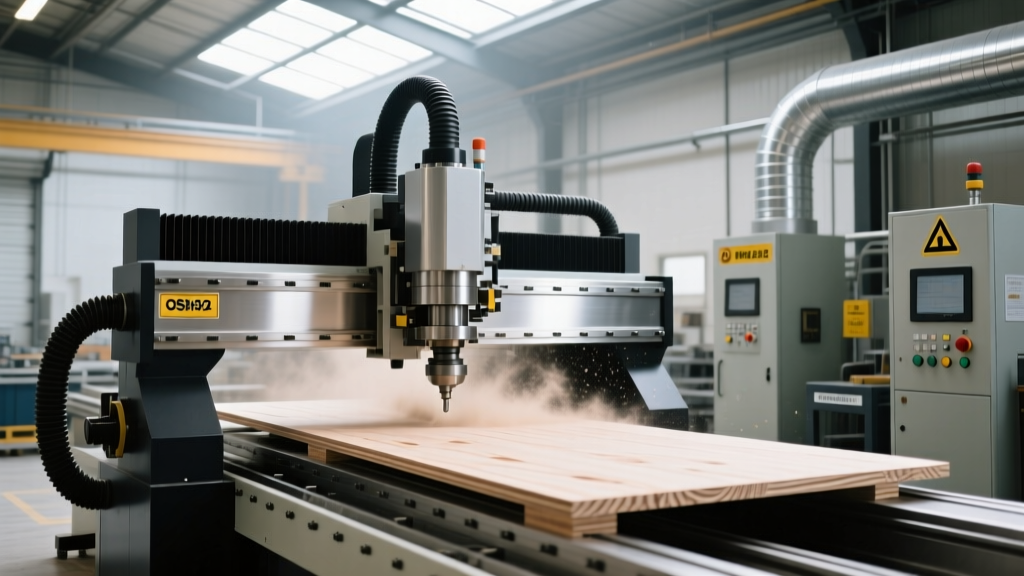
When a heavy-duty CNC machine cutting wood operates at 18,000 RPM, it generates massive volumes of fine particulate. Wood dust is highly combustible, and facility managers must strictly adhere to fire safety codes. According to the NFPA 664 standard for wood processing facilities, dust collection systems must be engineered to prevent deflagration.
Combustible Dust Hazard Warning:Wood dust typically carries a Kst (dust explosion index) value between 100 and 200 bar·m/s, classifying it as an St1 explosion hazard. The facility had to install explosion venting panels on the exterior silo and integrate a spark detection and extinguishing system (e.g., GreCon) in the main ductwork, 15 feet upstream of the cyclone. Failing to implement this can result in catastrophic silo explosions and severe OSHA fines. For broader context on workplace hazards, refer to the OSHA combustible dust guidelines.
To maintain proper capture velocity at the CNC's 5-axis hood, the extraction system was engineered to pull 4,800 CFM. Crucially, the ductwork was sized to maintain a minimum transport velocity of 4,500 FPM (feet per minute). Any drop below 4,000 FPM allows heavy timber shavings and dense Glulam dust to settle in the horizontal duct runs, creating a severe fire hazard and restricting airflow.
Clamping Mechanics: Vacuum vs. Pneumatic
Standard nested-based manufacturing CNCs rely on vacuum pods to hold sheet goods. This approach fails entirely in mass timber. CLT is highly porous, and the end-grain of Glulam beams leaks vacuum pressure instantly. Furthermore, structural beams weighing 2,000 to 8,000 lbs generate immense lateral cutting forces that vacuum friction cannot resist.
The case study facility utilizes a hybrid mechanical clamping system. The infeed conveyor positions the beam against a heavy-duty steel stop, while hydraulic clamps secure the timber laterally. For 5-axis contouring where the clamps might intersect the toolpath, the machine employs automated, software-driven clamp repositioning. The CNC controller pauses the spindle, moves the pneumatic clamps to a safe zone verified by the CAM software, and resumes cutting without losing the zero-point datum.
Production Metrics and ROI Realities
The true value of industrial CNC automation is measured in throughput and labor reallocation. Below are the benchmarked metrics comparing the previous manual layout/floor-assembly method against the 5-axis CNC cell for a standard commercial timber frame project (approx. 4,500 structural connections).
- Cycle Time (Standard King Post w/ 4 Mortises & 8 Drills): Reduced from 48 minutes (manual) to 6.5 minutes (CNC).
- Material Waste: Decreased by 14%. The CAM software's nesting algorithm optimizes beam cutting lists, utilizing offcuts for smaller bracketry and gussets.
- Connection Tolerance: Achieved +/- 0.5mm consistently, compared to +/- 3mm manually. This eliminated the need for on-site shimming and steel bracket re-drilling during erection.
- Labor Shift: The facility transitioned 4 senior carpenters from physically cutting joints to quality control and complex assembly, while training 2 junior operators to run the CNC infeed and software nesting.
"The bottleneck in mass timber is rarely the pressing of the panels or the gluing of the beams; it is the machining of the connections. Automating the joinery doesn't just speed up the shop—it prevents catastrophic delays on the job site when steel connectors don't align with timber mortises." — Director of Operations, Pacific Northwest Mass Timber Fabricator
Strategic Takeaways for Facility Expansions
For manufacturing directors evaluating a CNC machine cutting wood at an architectural scale in 2026, the machinery is only half the battle. The physical infrastructure of the facility must be prepared to support the immense static and dynamic loads of timber processing centers.
1. Subfloor and Foundation Engineering
A machine like the Hundegger K2i or Weinmann WBS 120 weighs between 12,000 and 18,000 lbs, with a gantry that accelerates rapidly. A standard 4-inch commercial concrete slab will deflect and crack under this dynamic load, causing the gantry to twist and ruining cutting tolerances. Facilities must pour a minimum 6-inch reinforced slab with a rebar grid, laser-screeded to a flatness tolerance of 1/8-inch over 10 feet. Anchor bolts must be epoxied into the cured concrete, not cast in place, to ensure precise alignment.
2. Crane and Rigging Integration
Timber CNCs require overhead clearance for both the machine's Z-axis travel and the facility's bridge crane. Ensure the crane's hook height provides a minimum of 4 feet of clearance above the CNC's maximum beam loading height. Vacuum lifters rated for 6,000 lbs are recommended over traditional nylon slings, as slings can damage the precision-milled edges of CLT panels and Glulam beams during loading.
3. Software and BIM Training
Do not underestimate the learning curve of timber-specific CAM software. Budget for 80 to 120 hours of specialized training for your lead programmer. The ability to write custom macros in SEMA or Dietrich's for non-standard steel-to-wood connection plates is what separates a profitable mass timber fabricator from one that constantly requires manual secondary operations.
For further reading on the structural capabilities and manufacturing standards of engineered wood products, the WoodWorks Mass Timber resources provide extensive technical data sheets and connection detailing guides that directly inform CNC toolpath strategies.