CNC Machine for Plywood: OSHA Dust & VOC Safety Compliance
Ensure your CNC machine for plywood meets OSHA and NFPA standards. Learn exact CFM requirements, VOC limits, and dust mitigation protocols.
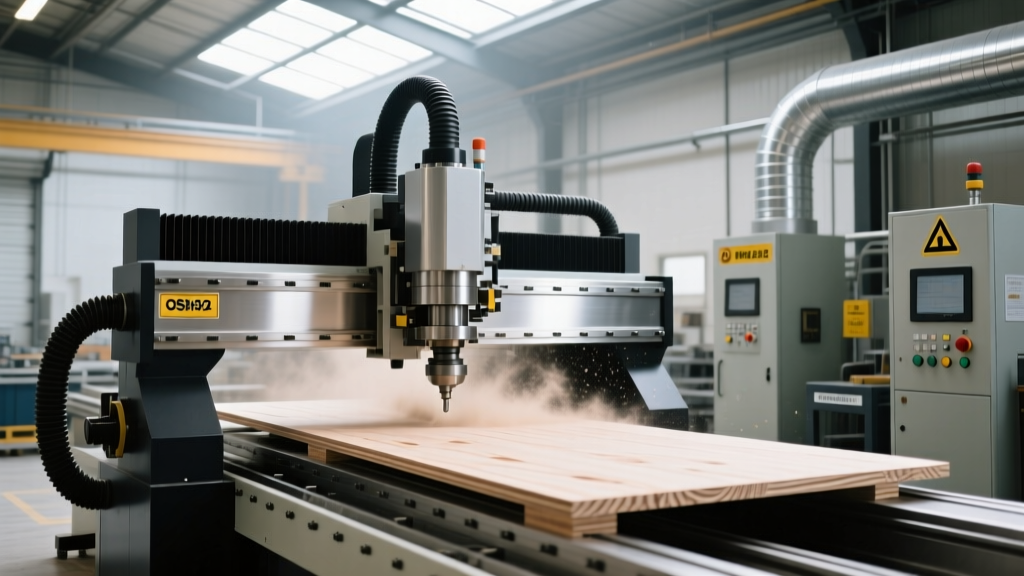
Routing plywood on a CNC presents a dual hazard profile distinct from solid wood machining: combustible fine particulate and vaporized adhesive off-gassing. When a 15,000 RPM spindle shears through urea-formaldehyde (UF) bonded panels, it aerosolizes carcinogenic volatile organic compounds (VOCs) alongside sub-100-micron wood dust. Operating a CNC machine for plywood in a commercial or industrial facility requires strict adherence to OSHA respiratory standards, NFPA 664 combustible dust protocols, and specific machine-guarding engineering controls. Failure to implement these systems results in severe respiratory liabilities, catastrophic explosion risks, and heavy regulatory fines.
The Adhesive Hazard: Formaldehyde and VOC Compliance
Unlike solid hardwood, plywood relies on synthetic resins to bind its veneers. The most common adhesive in interior-grade and standard commercial plywood is urea-formaldehyde (UF). When the CNC router bit generates friction and heat, it breaks down these resins, releasing free formaldehyde gas into the operator’s breathing zone.
Under OSHA’s General Industry Standards (29 CFR 1910.1048), the Permissible Exposure Limit (PEL) for formaldehyde is strictly capped at 0.75 parts per million (ppm) as an 8-hour Time-Weighted Average (TWA), with a Short-Term Exposure Limit (STEL) of 2 ppm. Standard shop ventilation is entirely insufficient to maintain these levels during nested-based manufacturing (NBM) on a 4x8 CNC bed.
⚠️ Critical Warning: MDF-Core and Particleboard-Core PlywoodsMachining plywood with an MDF or particleboard core exponentially increases formaldehyde off-gassing and fine dust generation. If your production schedule includes MDF-core architectural panels, your Local Exhaust Ventilation (LEV) system must be upgraded to include activated carbon secondary filtration to capture vaporized VOCs that bypass standard PTFE membrane dust filters.
Engineering Controls for VOC Mitigation
To maintain OSHA compliance without relying solely on Personal Protective Equipment (PPE), facilities must enclose the CNC machine for plywood. A fully enclosed polycarbonate cabin with negative pressure routing is the gold standard. The enclosure must be tied directly to the LEV system, ensuring that when the access doors are opened, an air curtain or interlocked exhaust surge prevents VOC escape into the shop environment.
Combustible Dust and NFPA 664 Engineering Controls
Plywood routing generates massive volumes of fine particulate. According to the NFPA 664 Standard for the Prevention of Fires and Explosions in Wood Processing and Woodworking Facilities, wood dust is classified as combustible if its particle size is 500 microns or smaller. Plywood machining, particularly when using compression spirals for clean edge finishing, produces high concentrations of dust in the 10 to 50-micron range. This fine dust has a high Kst value (deflagration index), making it highly explosive when suspended in air.
Capturing this dust at the source requires precise Local Exhaust Ventilation (LEV) design. The OSHA Wood Dust Hazard guidelines and industry best practices dictate that ductwork velocity must never drop below 4,000 Feet Per Minute (FPM) to keep heavy wood particulate suspended and prevent duct accumulation, which serves as fuel for secondary explosions.
Dust Collection Sizing Matrix for Plywood CNC Routers
Undersized dust collectors are a primary citation target during OSHA and fire marshal inspections. Below are the minimum engineering requirements for standard plywood CNC configurations:
| CNC Bed Size | Spindle HP | Main Duct Diameter | Required CFM (@ 4000 FPM) | Filter Media Requirement |
|---|---|---|---|---|
| 4x4 (e.g., ShopBot Desktop MAX) | 1.5 - 3 HP | 4 inches | 850 CFM | Standard Cellulose |
| 4x8 (e.g., MultiCam 3000) | 5 - 10 HP | 6 inches | 1,900 CFM | PTFE Membrane |
| 5x10 (Industrial NBM) | 12 - 15 HP | 8 inches | 3,500 CFM | PTFE + Fire Retardant |
For facilities running 4x8 or larger machines, a Donaldson Torit or equivalent industrial cyclone collector with a rotary airlock is mandatory. The PTFE (polytetrafluoroethylene) membrane filter is non-negotiable for plywood; standard cellulose filters blind rapidly when exposed to the fine, resinous dust generated by cutting plywood laminates.
Mechanical Guarding and Vacuum Table Fail-Safes
Beyond respiratory and fire hazards, the mechanical forces involved in cutting sheet goods present severe kinetic risks. Plywood sheets are heavy (a 3/4-inch 4x8 sheet of Baltic Birch weighs approximately 70 lbs). If the vacuum hold-down fails during a heavy roughing pass, the sheet can lift, catch the spindle, and launch across the facility.
Vacuum Monitoring and Interlocks
Modern CNC machines for plywood must be equipped with intelligent vacuum generation systems, such as the Schmalz VCBL series. These systems integrate pressure switches directly into the machine’s PLC. If the vacuum pressure at the spoilboard drops below the critical threshold (typically 0.6 bar or -17 inHg for porous MDF spoilboards), the safety relay must instantly trigger a feed-hold and spindle stop. Relying on the operator to notice a lifting sheet is a violation of basic machine guarding principles.
Perimeter Safeguarding via Laser Scanners
Physical fencing with interlocked gates is standard, but it impedes the rapid loading of heavy plywood sheets via forklifts or overhead cranes. To maintain compliance while optimizing material flow, leading facilities utilize horizontal safety laser scanners, such as the SICK microScan3 Core. Mounted at ankle and waist height, these scanners create configurable warning and protective fields. If an operator steps into the protective zone while the spindle is active, the machine executes a Category 0 or Category 1 stop (depending on the spindle braking capability) without requiring physical barriers that block material access.
Spoilboard Maintenance and Bleeder Board Protocols
The MDF spoilboard is a critical safety component, not just a consumable. As the CNC router repeatedly cuts into the spoilboard, the vacuum zones become cross-contaminated, reducing holding force and increasing the risk of part ejection.
“A deeply scored spoilboard compromises the vacuum seal, forcing the pump to work continuously at maximum duty cycle. This not only risks part kickback but leads to premature vacuum pump failure and excessive thermal buildup in the pump housing, creating an ignition source for accumulated wood dust.”
Actionable Protocol: Implement a strict fly-cutting schedule. The spoilboard must be surfaced (fly-cut) every 40 to 60 hours of spindle runtime, removing no more than 0.020 inches per pass. Once the spoilboard thickness reaches 0.5 inches (from an original 0.75 inches), it must be replaced entirely to maintain structural rigidity and vacuum integrity.
2026 Facility Compliance Audit Checklist
Shop managers and safety officers should execute the following audit checklist quarterly to ensure the CNC machine for plywood remains compliant with evolving OSHA enforcement priorities and NFPA standards.
- LEV Velocity Verification: Use a hot-wire anemometer to measure duct velocity at the furthest capture hood. Verify it remains ≥ 4,000 FPM.
- Filter Differential Pressure: Check the magnehelic gauge on the dust collector. If differential pressure exceeds 6 inches of water column, initiate the pulse-jet cleaning cycle or replace the PTFE cartridges.
- Formaldehyde Air Monitoring: Deploy passive dosimeter badges (e.g., 3M 3520) on the CNC operator and the nearest adjacent workstation for an 8-hour shift. Send to a certified lab to verify TWA remains below 0.75 ppm.
- Vacuum Interlock Test: Manually bleed the vacuum table pressure using a test valve while the spindle is running in air. Confirm the PLC triggers an E-stop within 200 milliseconds.
- Explosion Venting Inspection: If the dust collector is located indoors, verify that the explosion vent panels are unobstructed and that the ductwork features properly rated isolation valves (e.g., CARZ flapper valves) to prevent deflagration propagation back to the CNC enclosure.
- PPE Verification: Ensure operators are fitted with half-mask respirators (e.g., 3M 6200) equipped with dual-purpose P100/OV (Organic Vapor) cartridges to protect against both fine particulate and formaldehyde off-gassing.
By treating the CNC machine for plywood as a complex chemical and kinetic hazard system rather than a simple cutting tool, facilities can eliminate catastrophic risks, pass rigorous insurance audits, and protect their workforce from long-term occupational illnesses.