CNC Machine Cutting Metal: Milling vs. Laser vs. Plasma vs. Waterjet
Compare CNC machine cutting metal methods. Analyze milling, fiber laser, plasma, and waterjet for tolerances, edge quality, and part costs.
The Core Contenders in Metal Fabrication
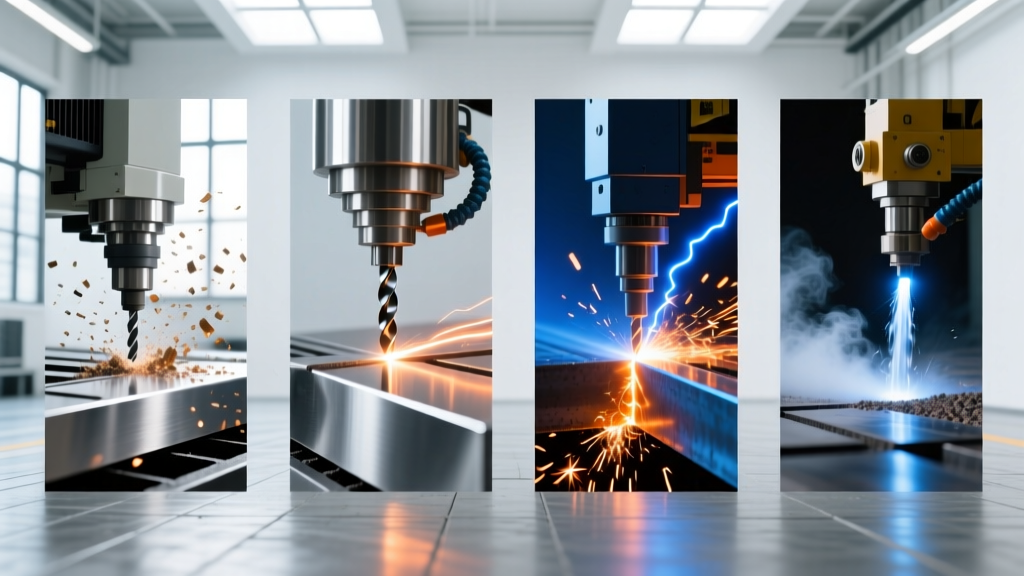
The phrase 'CNC machine cutting metal' broadly encompasses four distinct manufacturing processes: CNC milling, fiber laser cutting, CNC plasma, and abrasive waterjet. While all four utilize computer numerical control to achieve automated precision, their underlying physics—mechanical shear versus thermal ablation versus high-pressure erosion—dictate entirely different use cases. Selecting the wrong process for a specific alloy or thickness can result in catastrophic edge quality degradation, excessive consumable costs, or severe thermal distortion.
Quick Decision Framework:- CNC Milling: Choose for 3D contouring, tight tolerances (±0.0005"), and threaded holes.
- Fiber Laser: Choose for high-volume 2D sheet metal (up to 1" thick) requiring speed and clean edges.
- CNC Plasma: Choose for thick plate (1" to 3") structural steel where edge squareness is secondary to speed and cost.
- Waterjet: Choose for thick, heat-sensitive alloys (titanium, tool steel) where the Heat Affected Zone (HAZ) must be eliminated.
Head-to-Head Technical Matrix
Before analyzing specific machine models and operational costs, it is critical to understand the physical limitations of each technology. The following matrix outlines the baseline capabilities for mild steel and aluminum processing.
| Process | Max Practical Thickness | Positional Tolerance | Kerf Width | Heat Affected Zone (HAZ) |
|---|---|---|---|---|
| CNC Milling | Solid Billet (Z-axis limited) | ±0.0005" | Tool Diameter | None (Mechanical) |
| 6kW - 12kW Fiber Laser | 1.25" (Mild Steel) | ±0.004" | 0.008" - 0.020" | Moderate to High |
| High-Definition Plasma | 3.0" (Mild Steel) | ±0.020" | 0.100" - 0.150" | High |
| Abrasive Waterjet | 6.0"+ (Any Material) | ±0.005" | 0.030" - 0.050" | None (Cold Process) |
CNC Milling: Precision and 3D Contouring
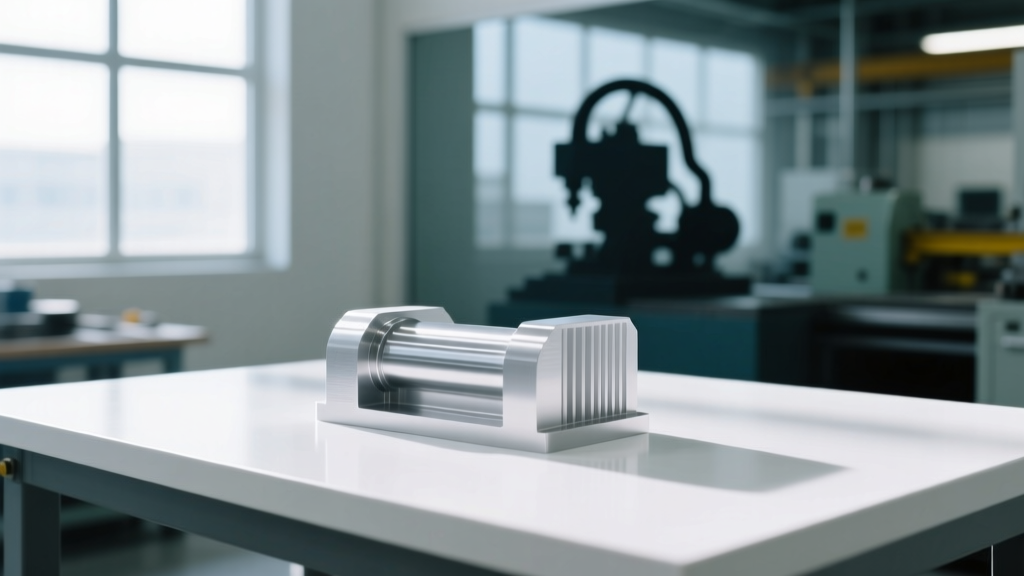
CNC milling remains the undisputed king of 3D metal removal. Unlike thermal processes that only cut 2D profiles through a fixed thickness, a vertical machining center (VMC) like the Haas VF-2SS can sculpt complex 3D aerodynamic profiles, machine precise bearing seats, and tap threaded holes in a single setup.
Tooling and Speed Specifics
The efficiency of milling is entirely dependent on toolpath strategies and spindle RPM. When machining 6061-T6 aluminum, modern shops utilize High-Speed Machining (HSM) with trochoidal milling paths. Using a 1/2" 3-flute carbide endmill (such as the Kennametal Harvi series) on a 12,000 RPM spindle, operators can safely push feed rates to 400-500 IPM (inches per minute) with a 0.050" radial depth of cut. This maximizes the material removal rate (MRR) while keeping cutting temperatures low enough to prevent aluminum from welding to the tool flutes.
Failure Mode Alert: Work Hardening in Stainless SteelWhen milling 304 or 316 stainless steel, a common catastrophic failure mode is work hardening. If the tool feed rate drops too low, or if the tool dwells in the cut, the stainless steel rapidly hardens at the shear zone, destroying carbide tooling in seconds. Always maintain a positive chip load (minimum 0.002" per tooth) and use through-spindle coolant (TSC) at 300 PSI to evacuate chips and prevent recutting.
Fiber Laser: Speed and Sheet Metal Dominance
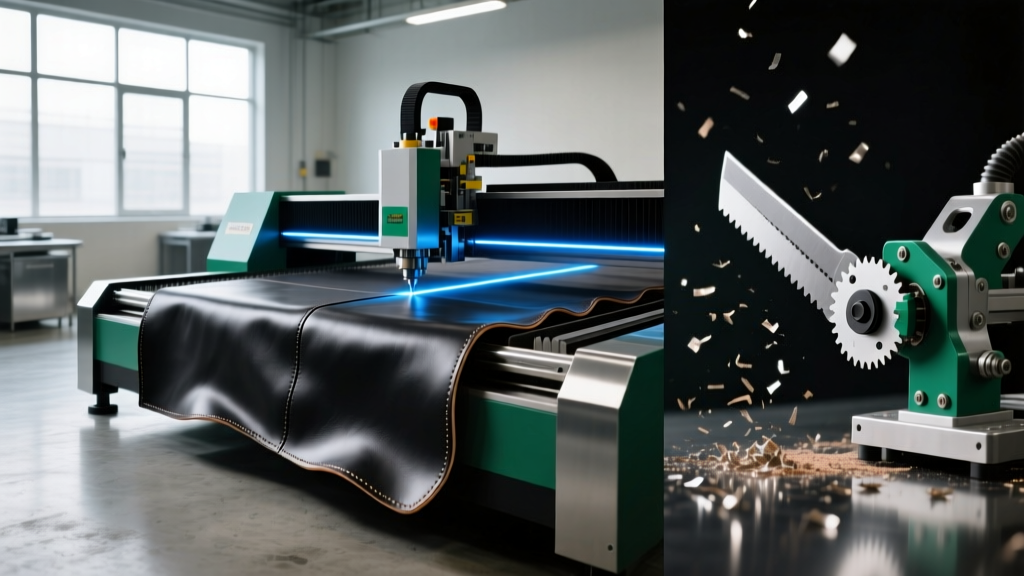
For 2D profile cutting of sheet and plate metal, fiber lasers have completely displaced CO2 lasers and turret punches in modern fabrication. A 6kW IPG Photonics fiber laser source can cut 1/4" mild steel at speeds exceeding 200 IPM, making it exponentially faster than milling for bracket and enclosure manufacturing.
The Assist Gas Variable
The secret to laser edge quality lies in the assist gas. When cutting mild steel, operators use high-pressure oxygen (O2). The oxygen creates an exothermic reaction, essentially burning the metal and allowing the laser to cut thicker plates with lower wattage. However, O2 leaves an oxidized, rough edge that requires secondary grinding before powder coating.
To achieve a pristine, oxide-free edge on stainless steel or aluminum, shops must switch to high-pressure Nitrogen (N2). Because N2 is an inert gas that merely blows molten metal out of the kerf, it requires significantly more laser power and gas volume. Cutting 1/8" stainless steel with N2 might cost $0.15 per foot in gas alone, but it eliminates the $2.00 per foot cost of manual edge deburring and prep work.
CNC Plasma vs. Abrasive Waterjet: The Thick Plate Alternatives
When material thickness exceeds the practical limits of fiber lasers (typically 1" for steel), manufacturers must choose between CNC plasma and abrasive waterjet. According to Hypertherm's plasma technology guidelines, high-definition plasma systems like the XPR300 with X-Definition consumables can slice through 1.25" steel at over 100 IPM. However, plasma inherently leaves a 3-to-5-degree bevel on the cut edge and creates a wide HAZ, which can warp thin webs on structural I-beams.
Conversely, abrasive waterjet cutting uses a supersonic stream of water mixed with 80-mesh garnet abrasive to erode metal. Waterjets cut entirely cold, meaning there is zero HAZ and no thermal distortion. This makes waterjet the mandatory choice for cutting pre-hardened tool steel (like D2 or A2) or aerospace titanium, where thermal alteration of the metallurgy would cause part failure.
The Waterjet Taper Reality
Waterjet is not without geometric flaws. Because the abrasive stream loses kinetic energy as it penetrates deeper into the material, it cuts a wider kerf at the top than at the bottom. On a 4" thick titanium block, this kerf taper can result in a 0.015" dimensional discrepancy between the top and bottom surfaces. Advanced CNC waterjets mitigate this by utilizing 5-axis cutting heads that physically tilt the nozzle to compensate for the taper, but this adds significant machine cost and programming complexity.
The Cost-to-Part Decision Framework
Capital equipment and hourly shop rates dictate which process yields the lowest cost-per-part. Below is a realistic breakdown of 2026 operational economics for a mid-sized job shop:
- CNC Milling (3-Axis VMC): Machine cost: $90,000 - $150,000. Shop rate: $90 - $130/hour. Consumables (endmills, inserts, coolant): $8/hour. Best for low-volume, high-complexity 3D parts.
- Fiber Laser (6kW): Machine cost: $350,000 - $500,000. Shop rate: $140 - $200/hour. Consumables (nozzles, lenses, gases): $25/hour. Best for high-volume 2D nesting where material utilization is optimized via CAD software.
- CNC Plasma: Machine cost: $80,000 - $150,000. Shop rate: $75 - $110/hour. Consumables (electrodes, nozzles, shields): $15/hour. Best for heavy structural fabrication where AWS D1.1 welding standards allow for as-cut plasma edges.
- Abrasive Waterjet: Machine cost: $200,000 - $350,000. Shop rate: $160 - $250/hour. Consumables (garnet abrasive, mixing tubes, orifice jewels): $40/hour. Garnet alone costs roughly $0.50/lb, and a thick-plate cut can consume 2 lbs per minute. Best for heat-sensitive, thick materials.
Real-World Edge Cases and Material Nuances
Theoretical capabilities often fail when encountering real-world metallurgy. Consider the challenge of cutting 16-gauge (0.059") galvanized steel. A fiber laser will cut it rapidly, but the vaporized zinc coating creates a highly reflective plasma plume that can bounce back into the laser's cutting head, destroying the protective window and focusing lens in seconds. Modern lasers utilize capacitive height sensing and specialized pierce routines to mitigate this, but it remains a high-risk operation.
Similarly, when CNC milling copper alloys like C110 (pure copper), the material's extreme ductility and high thermal conductivity make it notoriously difficult. Standard carbide endmills will smear the copper rather than shear it, leading to built-up edge (BUE). Machinists must switch to uncoated, highly polished carbide tools with sharp, positive rake angles, and flood the cut with heavy oil rather than water-soluble coolant to prevent the copper from sticking to the tool.
Ultimately, there is no universal 'best' CNC machine for cutting metal. The optimal choice requires a rigorous analysis of the part's geometry, the alloy's thermal properties, the required edge finish, and the production volume. By mapping these variables against the technical matrices and cost frameworks outlined above, manufacturing engineers can eliminate costly trial-and-error and select the exact process required for the job.