Best CNC Leather Cutting Machine Options for 2026 Production
Compare top CNC leather cutting machines for 2026. Explore oscillating knife vs. laser tech, pricing tiers, and nesting software for high-yield production.
Why Automated Leather Cutting Requires Specialized CNC Architecture
Transitioning from manual die-cutting or clicker presses to a CNC leather cutting machine is not merely an upgrade in speed; it is a fundamental shift in material yield and operational scalability. While standard CNC routers can technically cut soft goods, leather presents unique mechanical challenges. Genuine hides possess irregular geometries, natural scarring, and varying thicknesses, while synthetic rolls demand continuous tension management. A standard 3-axis spindle router will fray edges, melt synthetics, and fail to navigate around natural defects.
For 2026 production environments, the industry standard has firmly consolidated around high-frequency oscillating knife technology paired with AI-assisted CCD vision systems. This guide dissects the exact specifications, pricing tiers, and software ecosystems required to specify the right CNC leather cutting machine for your specific material throughput.
Core Cutting Technologies: Oscillating Knife vs. Laser vs. Ultrasonic
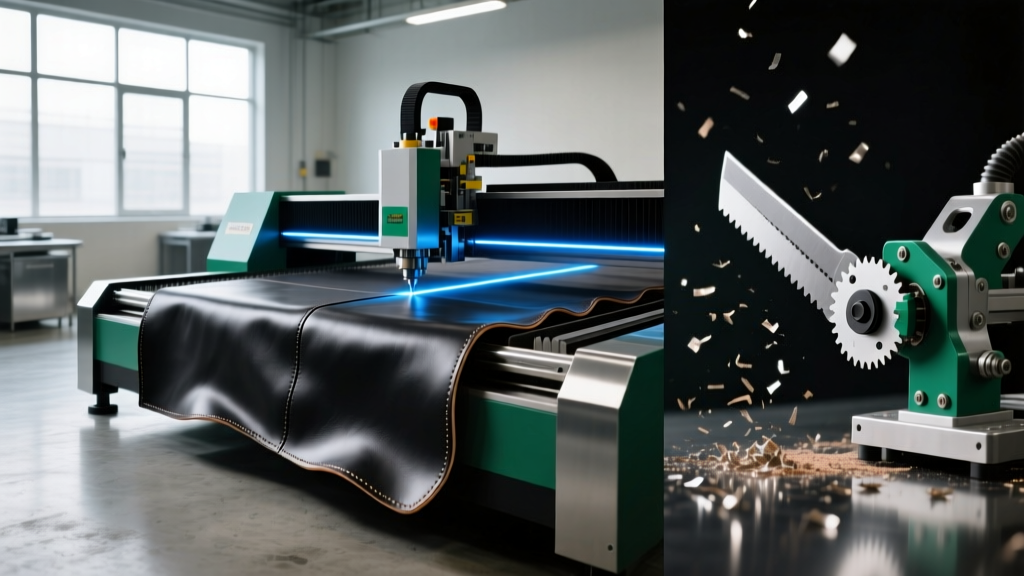
Selecting the wrong cutting head will result in ruined inventory and rejected batches. Below is the technical breakdown of the three primary cutting methods applied to leather in modern manufacturing.
| Technology | Best Application | Edge Quality | Primary Limitation |
|---|---|---|---|
| High-Freq Oscillating Knife | Genuine leather, heavy suede, multi-ply synthetics | Clean, uncompressed, ready for stitching | Blade wear on high-silica tanned hides; requires tangential axis for sharp corners |
| CO2 Laser | Thin PU/PVC synthetics, lacework, perforation | Sealed edge (prevents fraying) | Thermal burning on genuine leather; leaves a charred, odorous edge requiring secondary cleaning |
| Ultrasonic | Technical textiles, aerospace composites | Fused edge | Ineffective on thick, dense genuine leather; high energy consumption |
The Genuine vs. Synthetic Divide: Specifying Your Bed Type
The most critical purchasing mistake in this category is buying a machine configured for synthetic roll-goods when your primary material is genuine animal hide. Your material source dictates the bed architecture.
Scenario A: Genuine Leather (Flatbed + CCD Vision)
Genuine leather hides are asymmetric and riddled with natural defects (tick bites, brand marks, stretch marks). A CNC leather cutting machine designed for genuine leather must feature a static flatbed with a high-vacuum hold-down system and an overhead CCD camera array. The camera scans the hide, maps the defects, and the nesting software dynamically arranges the pattern pieces around the flaws. Look for systems utilizing AI-driven defect recognition, which can differentiate between a cosmetic scar (acceptable for non-visible areas) and a structural tear (must be avoided).
Scenario B: Synthetic Leather (Conveyor + Edge Guiding)
PU and PVC synthetic leathers arrive in uniform 50 to 100-meter rolls. These require a continuous conveyor bed with an automatic roll feeder and edge-guiding sensors. The machine cuts, the conveyor advances, and the camera scans the next section. Specifying a flatbed machine for synthetic rolls will bottleneck your production with manual loading and unloading cycles.
2026 Pricing Tiers and Brand Matrix
Capital expenditure for CNC leather cutting systems varies wildly based on the origin of manufacture, software licensing, and automation level. Below is the current market landscape for industrial-grade units.
Tier 1: Import / Entry-Level Production ($18,000 – $35,000)
- Representative Brands: Jinan Style, OREE, Hanteng.
- Specs: 1300x2500mm flatbed, basic DSP controllers, single oscillating knife, standard vacuum pump (often undersized at 5.5kW).
- The Reality: These machines cut adequately but struggle with vacuum hold-down on highly porous or thin leathers. The included nesting software is often rudimentary, yielding 5-10% less material efficiency than premium alternatives. Expect to spend an additional $8,000+ on third-party software like SigmaNEST to make the machine profitable.
Tier 2: Mid-Market / Reliable Workhorses ($45,000 – $85,000)
- Representative Brands: Atom (Italy), Kutec, OMAC.
- Specs: Robust extruded aluminum beds, high-flow vacuum systems (1500+ m³/h), integrated CCD vision for basic defect mapping, tangential knife heads.
- The Reality: This is the sweet spot for mid-sized upholstery and footwear manufacturers. Atom, for instance, offers exceptional mechanical rigidity, ensuring the oscillating knife does not deflect when cutting dense, multi-layered leather stacks.
Tier 3: Premium / High-Volume Automation ($120,000 – $250,000+)
- Representative Brands: Zünd (Switzerland), Kuris (Germany), Atom (Top-tier lines).
- Specs: Modular architecture, dual-head simultaneous cutting, AI-powered multi-camera defect recognition, automated hide-offloading, proprietary enterprise software.
- The Reality: Zünd's G3 series dominates the automotive and luxury fashion sectors. The premium is justified by the software ecosystem and the 24/7 uptime reliability. The ROI is achieved through material savings; a 2% increase in hide yield on premium automotive leather pays for the machine premium in under 14 months.
Software and Nesting: Where the Actual ROI Lives
The physical CNC leather cutting machine is only half the equation. The nesting software dictates your material yield. Manual nesting by experienced operators typically achieves a 72% to 76% material yield. Automated CNC nesting with basic algorithms reaches 78%. However, modern AI-assisted nesting software, such as SigmaNEST or proprietary OEM solutions like Zünd Cut Center, routinely achieves 84% to 88% yield on irregular hides.
Calculate Your ROI Before Buying: If your facility processes $500,000 in genuine leather annually, improving your yield from 75% (manual) to 85% (automated CNC) saves $50,000 in raw material costs per year. Factor in the elimination of physical die manufacturing costs (which can run $200-$500 per die), and the payback period for a $75,000 mid-tier machine drops to roughly 12 to 16 months.Critical Maintenance and Edge Cases
Leather cutting generates fine, abrasive dust that is heavily laden with tanning chemicals (chromium salts in wet-blue leather). This dust destroys standard linear guides and ball screws.
- Sealing: Ensure the machine features IP54-rated bellows covers on all X and Y-axis linear guides. Open rack-and-pinion systems will fail within 18 months in a high-volume tannery environment.
- Blade Management: Standard steel blades will dull after 400-600 meters of cutting leather. Upgrade to Tungsten Carbide blades with Titanium Nitride (TiN) coating to extend blade life to 1,500+ meters. Ensure the machine has an automatic blade depth adjustment feature to prevent cutting into the conveyor belt or sacrificial cutting mat.
- Vacuum Maintenance: Leather dust clogs vacuum filters rapidly. Specify a machine with an external, cyclone-style dust extraction unit rather than relying on the internal vacuum pump filters.
Pre-Purchase Facility Checklist
Before signing a purchase order, verify your facility can support the machine's operational requirements:
- Power Supply: Industrial oscillating machines with high-flow vacuum pumps require 3-phase, 380V/400V power. A standard 15kW vacuum pump will trip standard single-phase breakers.
- Compressed Air: Tangential knife heads and pneumatic material clamps require a clean, dry air supply. You must install an inline desiccant dryer; moisture in the air lines will rust the internal pneumatic cylinders of the cutting head.
- Footprint and Clearance: Do not just measure the machine bed. A 1300x2500mm machine with a conveyor feeder and offloading table requires a minimum operational footprint of 4000x6000mm to allow for hide staging and operator movement.
Specifying a CNC leather cutting machine requires looking past the cutting speed metrics and focusing on material handling, vision-system accuracy, and software-driven yield optimization. By matching the bed type to your specific leather source and investing heavily in the nesting software ecosystem, you transform a capital expense into a highly predictable, yield-maximizing production asset.