Operator Training Guide: Optimizing Your CNC Machine for Plastic
Master operator training for your CNC machine for plastic. Learn speeds, feeds, tooling, and workholding best practices for acrylic, Delrin, and PC.
The Thermal Conductivity Bottleneck in Polymer Machining
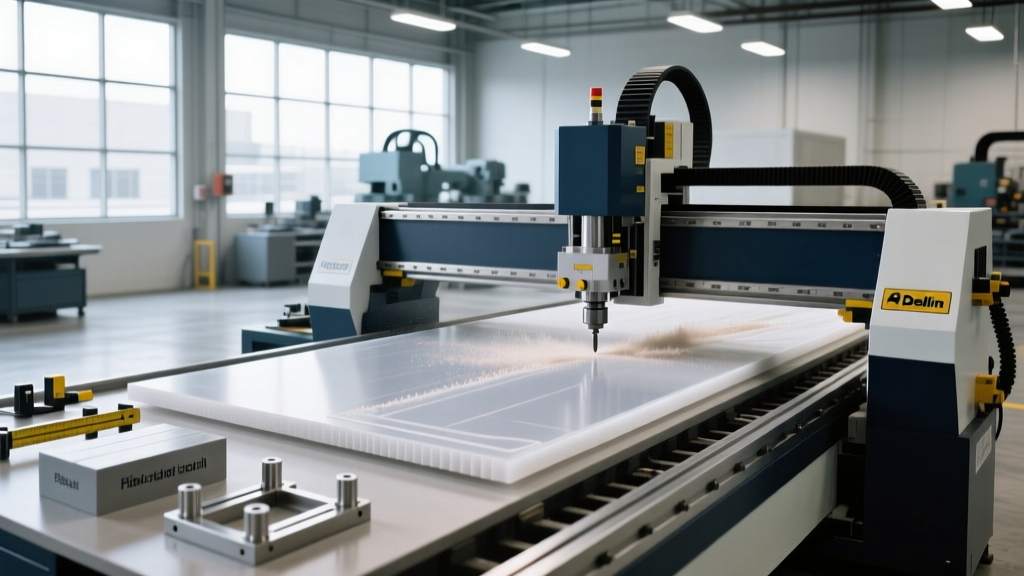
Training operators to run a CNC machine for plastic requires a fundamental paradigm shift from metalworking. The primary adversary in polymer machining is not tool wear, but thermal management. Metals typically possess a thermal conductivity between 15 and 50 W/m·K, allowing heat to dissipate rapidly into the chip. Most engineering and commodity plastics, however, act as thermal insulators with conductivity ratings between 0.1 and 0.5 W/m·K.
Because heat cannot escape into the workpiece or the chip efficiently, it concentrates at the cutting edge. If operators apply metal-machining logic—such as slow speeds and heavy depths of cut—the friction will instantly melt the polymer, causing chip re-welding, tool seizure, and catastrophic surface finish degradation. Effective training must center on aggressive chip evacuation and specialized cutting geometries.
⚠️ Critical Failure Mode: Chip Re-WeldingWhen cutting Cast Acrylic (PMMA) or Delrin (POM), insufficient feed rates cause the cutter to rub rather than shear. The localized heat melts the plastic, which then cools and fuses to the flute of the end mill. Within minutes, the tool becomes a blunt cylinder, generating massive friction and eventually snapping. Operator Rule: If you see a glazed, melted edge on the chip rather than a sharp, fragmented curl, your feed rate is too low or your tool is rubbing.
Tooling Matrix: Matching Geometry to Polymer
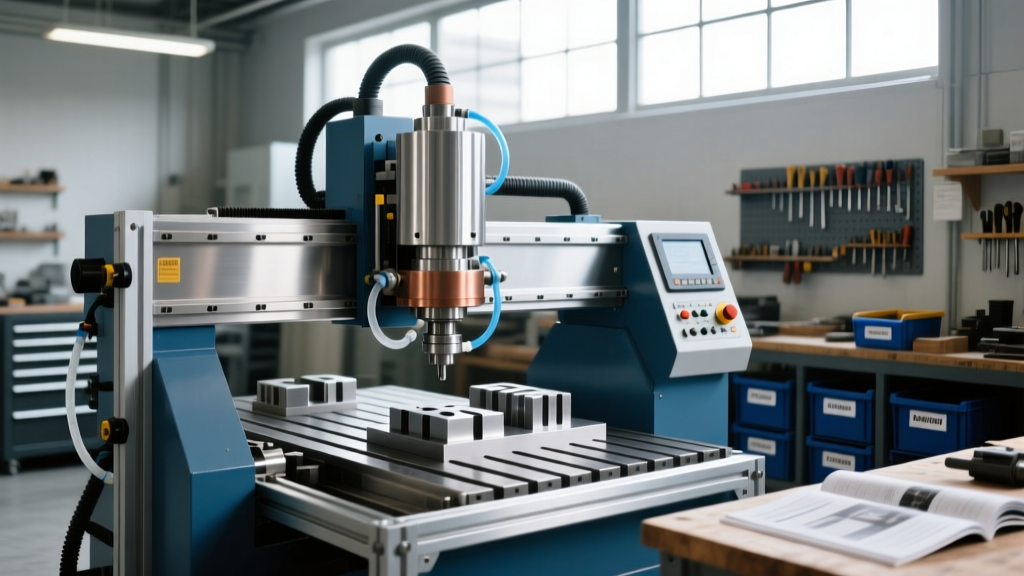
Standard 3-flute or 4-flute carbide end mills designed for aluminum or steel will clog immediately when cutting plastics. The flutes lack the volume required to clear the stringy, expansive chips generated by polymers. Tooling experts at Harvey Tool and routing specialists at LMT Onsrud emphasize that edge preparation and flute volume are the most critical variables.
| Material | Optimal Tool Type | Flute Count | Coating / Edge Prep | Helix Angle |
|---|---|---|---|---|
| Cast Acrylic (PMMA) | O-Flute Carbide | 1 | Uncoated, Mirror Polished | High (45°+) |
| Delrin (POM) | Upcut Spiral | 2 or 3 | ZrN (Zirconium Nitride) | Standard (35°) |
| Polycarbonate (PC) | Straight Flute / Low Helix | 2 | Uncoated, Slightly Honed | Low (15°-25°) |
| PTFE (Teflon) | High Helix Upcut | 2 | Uncoated, Razor Sharp | High (45°+) |
| PEEK | Compression / Diamond | 2 | CVD Diamond Coated | Variable |
Operator Insight on Polycarbonate: PC is notoriously prone to 'tool grab' due to its high tensile strength and elasticity. Using a razor-sharp, high-helix upcut bit will cause the tool to aggressively pull into the material, potentially shattering the workpiece or snapping the cutter. A slightly honed edge on a low-helix tool reduces this aggressive biting action, ensuring a controlled shear.
Speeds, Feeds, and the Chip Evacuation Mandate
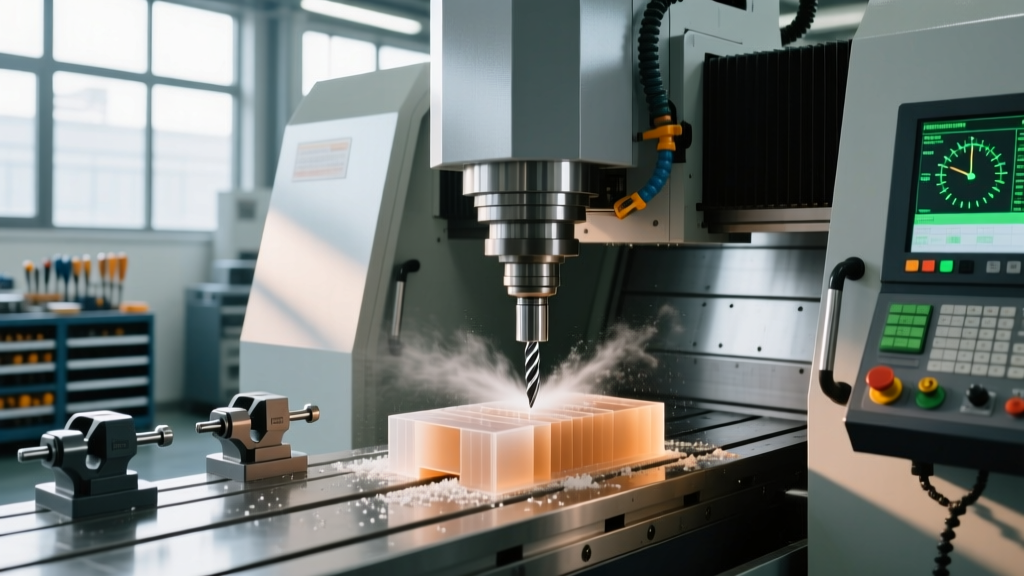
The golden rule for running a CNC machine for plastic is high speed, high feed, and light depth of cut. You must generate enough centrifugal force and forward momentum to throw the chip out of the cutting zone before it can cool and adhere to the tool.
Baseline Parameters for 1/4-inch (6.35mm) Diameter End Mills
- Cast Acrylic (PMMA): 18,000 RPM | 120 IPM (Inches Per Minute) | 0.050" Depth of Cut (DOC) | 0.025" Stepover.
- Delrin (POM): 14,000 RPM | 150 IPM | 0.100" DOC | 0.050" Stepover.
- Polycarbonate (PC): 10,000 RPM | 80 IPM | 0.050" DOC | 0.025" Stepover.
- HDPE / UHMW: 12,000 RPM | 180 IPM | 0.150" DOC | 0.050" Stepover.
When roughing, operators should utilize trochoidal milling (dynamic milling) paths. This maintains a constant, light radial engagement (stepover) while allowing the machine to sustain high linear feed rates, keeping the cutting edge cool and preventing the tool from becoming buried in the slot.
The Climb Milling Mandate:
Always program climb milling (down milling) for plastics. Conventional milling pushes the chip ahead of the cutter, causing the tool to rub against the workpiece and generate immense friction. Climb milling directs the chip upward and away from the cutting zone, leveraging the high-helix geometry of the tool to evacuate heat.
Workholding: Preventing Stress Cracking and Chatter
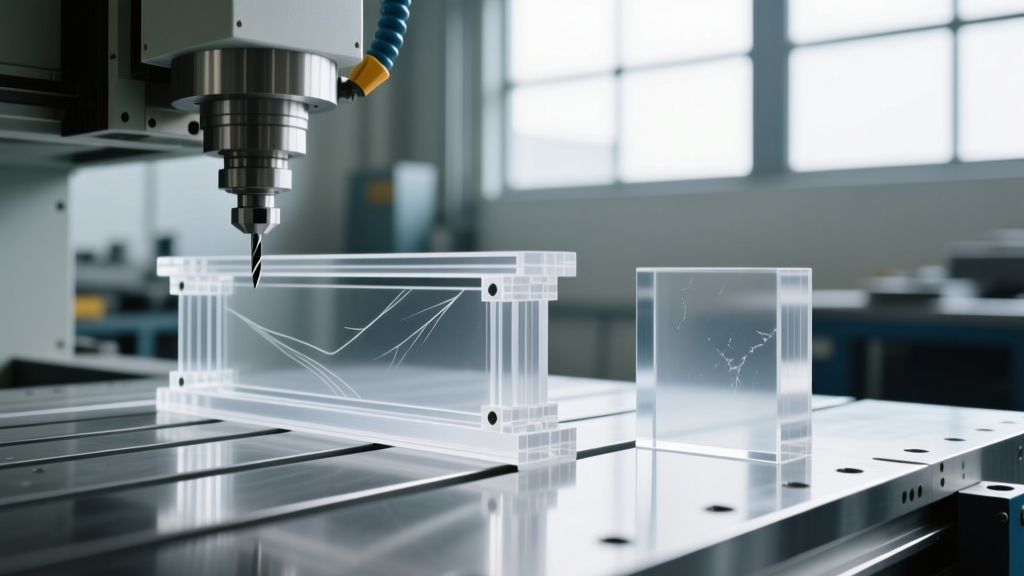
Plastics lack the mass and rigidity of metals, making them highly susceptible to chatter. Furthermore, mechanical clamping can introduce internal stresses that result in delayed stress cracking—especially in Acrylic and Polycarbonate—hours or days after the part is removed from the machine.
Vacuum Table Protocols
For sheet plastics (under 0.500" thick), vacuum workholding is mandatory. Operators must ensure the vacuum system pulls a minimum of 22 inHg (inches of mercury) for roughing operations, and ideally 28+ inHg for finishing. Use a sacrificial MDF board with 0.010" deep fly-cut surfacing to ensure a perfect seal. Apply edge sealing tape (painter's tape) around the perimeter of the workpiece to prevent vacuum bleed.
Mechanical Clamping Best Practices
When machining thick blocks or 3D contours where vacuum is impossible:
- Never use hardened steel toe clamps directly on the plastic. The point-load will crush the polymer matrix.
- Use custom-machined soft jaws. Machine aluminum or Delrin soft jaws to match the exact profile of the part's clamping surface, distributing the force evenly.
- Utilize nylon-tipped set screws in your vise or fixture to grip the material without inducing micro-fractures.
- Double-sided tape: For small, intricate parts, 3M 467MP adhesive transfer tape provides exceptional shear strength. Apply it to both the spoil board and the workpiece, and use a light mist of isopropyl alcohol to activate the bond before pressing them together.
Coolant Protocols: Air, MQL, and the Polycarbonate Ban
The instinct to use flood coolant to manage heat is a critical error in polymer machining. Standard water-soluble flood coolants can cause thermal shock, leading to micro-crazing and catastrophic stress cracking in Polycarbonate and Acrylic. Furthermore, flood coolant leaves a residue that requires secondary cleaning operations.
💡 Approved Cooling Methods by Material- Acrylic & Delrin: High-pressure compressed air (minimum 80 PSI) directed via through-spindle or adjustable loc-line nozzles. The air blast cools the tool and physically blows the chips out of the pocket.
- PEEK & Nylon: Minimum Quantity Lubrication (MQL) using a plant-based, biodegradable cutting fluid. These engineering plastics run hotter and benefit from the micro-droplet lubrication to reduce friction without saturating the material.
- Polycarbonate: Strictly compressed air. Never apply liquid coolants, alcohols, or petroleum-based lubricants, as they will chemically attack the polymer chains and induce immediate stress fractures.
Post-Machining Annealing for Engineering Plastics
For high-performance applications utilizing PEEK, PTFE, or Cast Nylon, the machining process itself introduces residual mechanical stress. If the part is destined for tight-tolerance assemblies or high-temperature environments, operators must include an annealing protocol in the manufacturing routing.
Annealing involves heating the machined plastic part in a convection oven to a temperature just below its Glass Transition Temperature (Tg) or Heat Deflection Temperature (HDT), holding it for a calculated duration, and cooling it slowly. For example, machined PEEK components should be heated to 150°C (302°F), held for 2 hours per inch of thickness, and cooled at a rate no faster than 10°C per hour. Skipping this step will result in parts that warp or go out of tolerance once deployed in the field.