Cost Guide: Railroads Skylights CNC Plastic Machining 2026
Detailed 2026 cost analysis for railroads skylights CNC plastic machining. Compare polycarbonate vs acrylic material costs, tooling, and cycle times.
Material Selection & Raw Stock Costs for Transit Glazing
When evaluating the total cost of railroads skylights CNC plastic machining, procurement teams and manufacturing engineers must look beyond basic resin pricing. Railroad passenger cars, locomotives, and transit vehicles require glazing that meets stringent impact resistance and optical clarity standards. In 2026, the market for transit-grade plastics is dominated by UV-stabilized, flame-retardant Polycarbonate (PC) and specialized Poly(methyl methacrylate) (PMMA/Acrylic) blends.
For exterior lower-level skylights and observation cupolas, uncoated acrylic is largely obsolete due to Federal Railroad Administration (FRA) impact requirements. Instead, manufacturers rely on hard-coated polycarbonate sheets, such as Covestro Makrolon AR (Abrasion Resistant) or Plaskolite Optix. These materials feature a proprietary silicone hard coat that prevents hazing from track debris and UV degradation.
2026 Raw Material Pricing Matrix
| Material Grade | Thickness | Avg. Cost per Sq Ft (2026) | 4x8 Sheet Cost | Primary Use Case |
|---|---|---|---|---|
| Makrolon AR (UV/AR Coated PC) | 12mm (0.50") | $22.50 - $26.00 | $720 - $832 | Exterior lower-level skylights, dome windows |
| Makrolon FR (Flame Retardant PC) | 12mm (0.50") | $18.00 - $21.00 | $576 - $672 | Interior transit lighting diffusers, upper cupolas |
| Optix-Skygard (Transit Acrylic) | 12mm (0.50") | $11.50 - $14.00 | $368 - $448 | Non-impact interior skylights, decorative domes |
| PETG (Glycol-modified PET) | 6mm (0.25") | $6.00 - $8.50 | $192 - $272 | Prototyping, temporary interior covers |
Nesting & Yield Economics: A standard 48" x 96" sheet yields four 48" x 24" skylight blanks. However, CNC vacuum pod workholding requires a 0.5" perimeter sacrificial border, reducing practical nesting efficiency to roughly 82%. Expect to absorb 18% material waste as kerf and clamping margin. At $720 per sheet of Makrolon AR, the raw material cost per skylight blank is approximately $180 before machining.
CNC Router Tooling & Cycle Time Economics
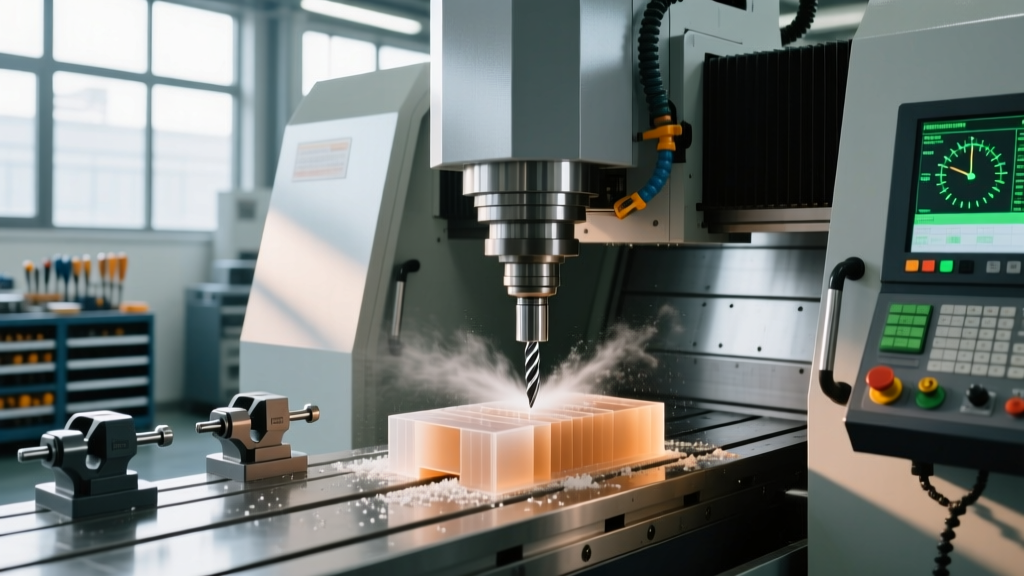
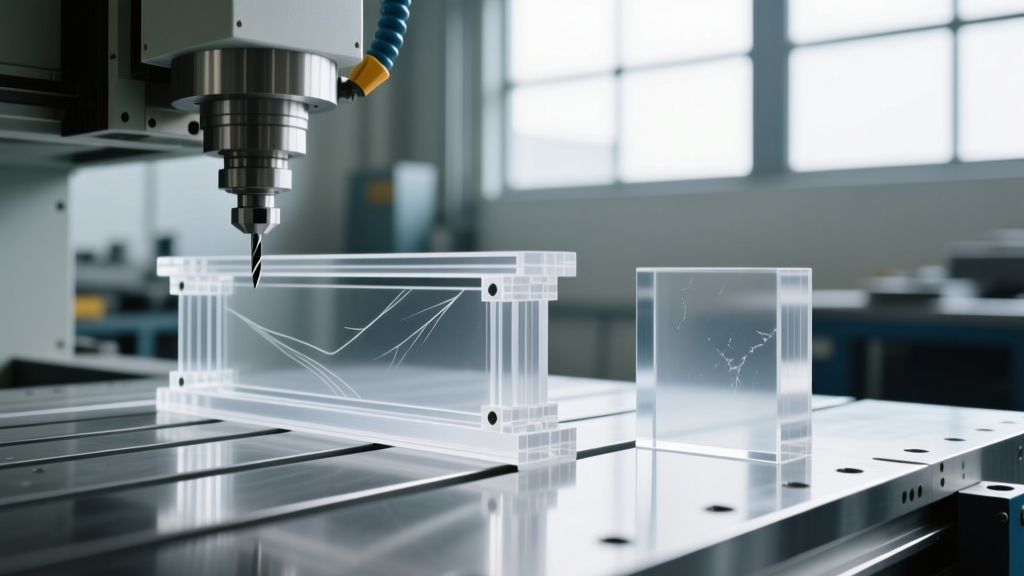
Machining hard-coated polycarbonate presents unique thermal challenges. Unlike metals, plastics do not dissipate heat well. If the CNC router bit dwells too long in the cut, the polycarbonate melts and re-welds behind the tool, ruining the optical edge. Conversely, aggressive feed rates on coated materials will chip the UV/AR hard coat, causing delamination that fails quality control.
Optimized CNC Parameters for 12mm Polycarbonate
- Roughing Pass: 1/2" single-flute O-flute carbide upcut bit (e.g., Onsrud 63-700 series). Depth of Cut (DOC): 0.25". Spindle: 18,000 RPM. Feed Rate: 180 IPM.
- Finishing Pass: 1/4" diamond-coated compression bit. DOC: 0.05" (cleanup pass). Spindle: 22,000 RPM. Feed Rate: 120 IPM.
- Drilling (Mounting Flanges): Brad-point carbide drill bits with polished flutes. Peck-drilling cycle mandatory (0.1" retract every 0.25" depth) to clear stringy chips.
Tooling Cost Amortization
Standard carbide router bits cost $45-$80 but degrade quickly when cutting abrasive UV-coated polycarbonate, lasting only 15-20 linear feet of cutting. For a 500-unit production run, upgrading to Chemical Vapor Deposition (CVD) diamond-coated bits ($250-$350 each) is financially mandatory. Diamond bits maintain a razor edge for over 200 linear feet, reducing tooling cost per part from $14.50 down to $2.80, while simultaneously eliminating edge-chipping rejects.
At an average shop rate of $135/hour for a 5-axis CNC router equipped with automated tool changers and vacuum workholding, a complete skylight profile (perimeter routing, 45-degree chamfered edges, and 16 mounting holes) takes approximately 38 minutes. This translates to $85.50 in direct machine time per unit.
Secondary Operations & Optical Finishing
CNC routing leaves micro-machining lines on the edges of the skylight. For railroad applications where light refraction and aesthetic clarity are paramount, secondary edge finishing is a non-negotiable budget line item.
- CNC Diamond Drag Polishing ($25/unit): Using a specialized PCD (Polycrystalline Diamond) drag tool at low RPM to burnish the edge to near-optical clarity directly on the router bed.
- Flame Polishing ($18/unit): Passing a controlled oxy-hydrogen flame over the routed edges. Warning: Flame polishing is highly effective for acrylic but can induce micro-crazing and stress fractures in polycarbonate if the dwell time exceeds 1.5 seconds per inch. It is generally avoided for FRA-compliant PC skylights.
- Hard-Coat Edge Touch-Up ($35/unit): Because routing cuts through the factory-applied UV/AR coating, the exposed edges must be manually wiped with a secondary UV-curable clear coat to prevent moisture ingress and edge yellowing.
NFPA 130 & FRA Compliance Overhead
Budgeting for transit components requires factoring in regulatory compliance. The American Public Transportation Association (APTA) and FRA mandate strict adherence to ASTM D635 and NFPA 130 standards for flame, smoke, and toxicity (FST) ratings in passenger rail environments.
"Procurement teams frequently overlook the documentation tax. Sourcing raw polycarbonate is only half the battle; you must budget for third-party batch testing to certify that the CNC machining process and secondary edge coatings have not altered the baseline FST ratings of the transit glazing."
Allocate $4,500 - $6,000 per production batch for independent lab FST certification. When amortized over a 500-unit run, this adds $9 to $12 per skylight to the final budget.
Step-by-Step Budget Planning for a 500-Unit Run
To synthesize these variables, here is the exact unit-cost breakdown for manufacturing 500 exterior-grade, 48" x 24" x 12mm polycarbonate railroad skylights in 2026.
Unit Cost Accumulation
| Cost Center | Calculation Basis | Cost Per Unit |
|---|---|---|
| Raw Material (Makrolon AR) | $720/sheet ÷ 4 parts (82% yield) | $180.00 |
| CNC Machine Time | 38 mins @ $135/hr | $85.50 |
| Tooling Wear (Diamond Bits) | Amortized over 200 linear ft | $2.80 |
| Edge Finishing (PCD Drag + UV Coat) | Labor + Consumables | $42.00 |
| Quality Control & FST Amortization | Batch testing ÷ 500 units | $11.00 |
| Packaging (A-Frame & Foam) | Custom transit crates | $28.00 |
| Total Landed Cost | Before Overhead & Margin | $349.30 |
Phase 1: Prototyping & CAM Validation
Do not skip the dry-run phase. Polycarbonate sheet thickness tolerances can vary by ±0.015" across a single 4x8 sheet. If your CNC Z-axis zeroing is not calibrated with a laser tool-setter, this variance will result in uneven chamfer widths on the skylight mounting flanges, leading to assembly rejection on the railcar roof. Budget 12 hours of machine time ($1,620) strictly for CAM optimization, vacuum pod leak testing, and chip-evacuation validation.
Phase 2: Production Scaling
Once parameters are locked, transition to a twin-pod vacuum table setup. By alternating pods (machining Pod A while the operator unloads and loads Pod B), you eliminate 12 minutes of non-cutting spindle time per part, dropping the effective cycle cost by 18%. This operational shift is the primary lever for protecting profit margins in high-volume transit manufacturing.