2026 Technology Trends in Precision CNC Metal Machining
Explore 2026 innovations in precision CNC metal machining, from AI-driven toolpath optimization to sub-micron 5-axis metrology and hybrid manufacturing.
The landscape of precision CNC metal machining has fundamentally shifted from purely mechanical rigidity to a synthesis of nanometer-scale hardware, AI-driven edge computing, and hybrid additive-subtractive workflows. In 2026, achieving sub-micron tolerances in hardened steels and aerospace superalloys is no longer a matter of simply buying a more expensive spindle; it requires integrating thermal compensation algorithms, high-pressure fluid dynamics, and digital twin metrology. This guide dissects the specific technologies redefining precision metal removal and provides actionable frameworks for machine shops looking to upgrade their capabilities.
2026 Precision Benchmark Data
- Standard Aerospace Tolerance Shift: Moved from ±0.0005" to ±0.0002" (5µm) for critical turbine blade roots.
- Surface Finish Expectations: Ra 0.1 µm directly off the machine without secondary polishing for optical mold steels.
- Spindle Thermal Growth Limit: < 1.5 µm over a 24-hour continuous cycle using active chiller loops.
The Hardware Baseline: Hydrostatics and Nanometer Metrology
Achieving true sub-micron precision in metals like 17-4 PH stainless or Ti-6Al-4V requires eliminating stick-slip friction at ultra-low feed rates. Traditional recirculating ball bearings and linear guideways introduce micro-vibrations during axis reversals. The 2026 standard for ultra-precision CNC metal machining relies heavily on hydrostatic guideways, which separate moving components with a pressurized film of oil, providing infinite stiffness and zero mechanical friction.
Machines such as the Kern Micro HD utilize hydrostatic drives paired with exposed linear encoders like the Heidenhain LIP 6000 series. These encoders offer a resolution of 0.5 nanometers, allowing the control loop to correct for thermal expansion in real-time. When machining deep micro-cavities in hardened tool steel (60+ HRC), this hardware combination prevents the 'scallop' marks typically left by axis reversal hesitation, yielding mirror-finish surfaces directly from the end mill.
AI-Augmented Toolpaths and Edge Computing
While hardware provides the physical capability for precision, software dictates the actual toolpath execution. According to recent industry analyses on smart manufacturing adoption, the integration of AI at the edge—processing data directly on the CNC controller rather than in the cloud—has reduced scrap rates in high-mix metal machining by up to 18%. By leveraging platforms like Deloitte's outlined digital twin frameworks, modern shops simulate not just the geometry, but the harmonic vibrations and thermal deflection of the entire machine-tool-workpiece system.
Comparison Matrix: Traditional CAM vs. AI-Edge Optimized Machining
| Metric | Traditional CAM (2022-2024 Era) | AI-Edge Optimized (2026 Standard) |
|---|---|---|
| Toolpath Generation Time | 45-90 minutes for complex 5-axis impellers | 12-15 minutes via generative AI algorithms |
| Air-Cutting Percentage | 15% - 25% of total cycle time | < 4% (dynamically optimized retracts) |
| Tool Wear Prediction | Reactive (based on spindle load alarms) | Predictive (harmonic frequency analysis) |
| Scrap Rate (First Article) | 8% - 12% | < 2% |
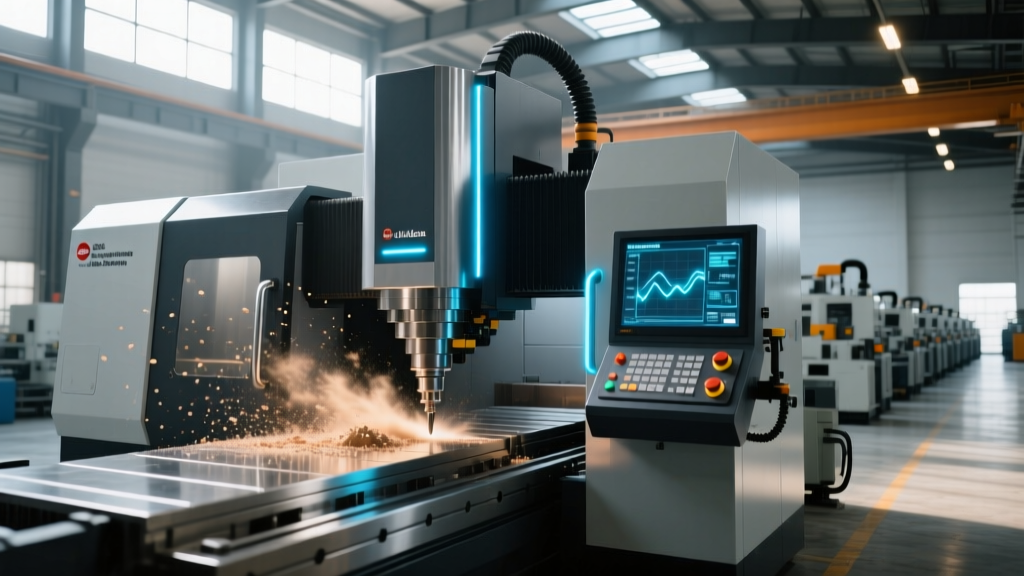
Controllers like the Siemens Sinumerik ONE now feature integrated AI modules that monitor spindle load harmonics at 10,000 Hz. If the AI detects the specific high-frequency chatter signature associated with a worn carbide corner radius on an Inconel part, it automatically adjusts the feed rate and spindle speed to move the cutting frequency out of the resonant zone, saving both the tool and the workpiece without operator intervention. For deeper insights into interoperability standards for these smart controllers, the NIST Advanced Manufacturing Portal provides extensive documentation on MTConnect and OPC-UA integration protocols.
Hybrid Additive-Subtractive Metal Workflows
Precision CNC metal machining is no longer strictly subtractive. Directed Energy Deposition (DED) hybrid machines, such as the Mazak INTEGREX i-AM series, combine laser metal deposition with 5-axis milling in a single enclosure. This is transformative for repairing high-value aerospace components or adding complex cooling channels to forged blanks.
Cost & ROI Analysis for Hybrid Cells:A standard 5-axis CNC mill capable of aerospace tolerances costs between $450,000 and $650,000. Adding a hybrid DED laser head and powder delivery system pushes the capital expenditure to $1.2M - $1.6M. However, for shops repairing titanium turbine blades, the ROI is typically realized within 14 months. The ability to add 2mm of Ti-6Al-4V material via laser and immediately machine it to a ±0.0005" tolerance eliminates the need to forge, heat-treat, and rough-machine entirely new replacement parts.
Advanced Fluid Dynamics: 1000-Bar Coolant and Cryogenics
When precision machining ISO S materials (superalloys like Inconel 718 and Waspaloy), heat is the primary enemy of both dimensional accuracy and tool life. Traditional flood coolant (7-15 bar) simply boils upon contact with the cutting zone, creating a vapor barrier that insulates the tool. The 2026 standard mandates ultra-high-pressure (UHP) coolant systems operating at 150 bar (2,175 psi) to 1,000 bar (14,500 psi).
As detailed in the Sandvik Coromant technical knowledge base, directing a 1,000 bar jet of coolant precisely at the shear zone through specialized nozzles (like the CoroTurn 111 HP) forces the chip to break immediately and cools the cutting edge before crater wear can initiate. For shops pushing the absolute limits of precision in hardened steels, liquid nitrogen (LN2) cryogenic cooling delivered through the spindle and tool is becoming the preferred method. LN2 drops the cutting zone temperature to -320°F (-196°C), effectively freezing the workpiece microstructure and eliminating thermal expansion errors during finishing passes.
Strategic Implementation Framework for Machine Shops
Upgrading to 2026 precision standards requires a phased approach to avoid capital misallocation. Use the following decision framework to prioritize investments based on your specific metal machining bottlenecks.
Phase 1: Metrology and Environmental Control
Before purchasing a $500,000 ultra-precision CNC, audit your facility. Sub-micron machining requires ambient temperature control within ±1°C (±1.8°F). Invest in Renishaw Equator gauging systems or Zeiss O-Inspect CMMs for on-machine or near-machine automated metrology. If the room temperature fluctuates by 3°C, the thermal expansion of a 200mm aluminum part alone will exceed your machine's positioning accuracy.
Phase 2: High-Pressure Tooling Integration
If your primary bottleneck is tool life and surface finish in exotic alloys, do not buy a new machine immediately. Retrofit your existing CNC lathes and mills with 150-bar high-pressure coolant pumps and specialized indexable toolholders with internal coolant channels. This $15,000 - $25,000 investment often yields a 40% increase in tool life and allows for 20% higher feed rates in titanium.
Phase 3: AI and Digital Twin Adoption
Once hardware and environmental baselines are secured, upgrade your CAM infrastructure. Transition to software that supports machine-specific digital twins. Simulating the exact kinematics, mass, and stiffness of your specific CNC model allows the CAM system to calculate optimal toolpaths that account for machine deflection, ensuring the final machined metal part matches the CAD model at the micron level.