CNC Milling Machine Wood Shop: 2026 Cost & Budget Guide
Plan your 2026 budget for a CNC milling machine wood shop. Compare CAPEX, hidden costs, tooling, and ROI frameworks for hobbyist to industrial setups.
Capital Expenditure (CAPEX) Tiers for Wood CNC Routers
Allocating capital for a CNC milling machine wood facility requires separating marketing hype from mechanical reality. The initial invoice for the gantry, spindle, and controller is typically only 40% to 60% of the total first-year expenditure. To build an accurate 2026 budget, shop owners must categorize investments by production volume, material throughput, and structural requirements.
Tier 1: Entry-Level & Prototype Shops (Under $6,000)
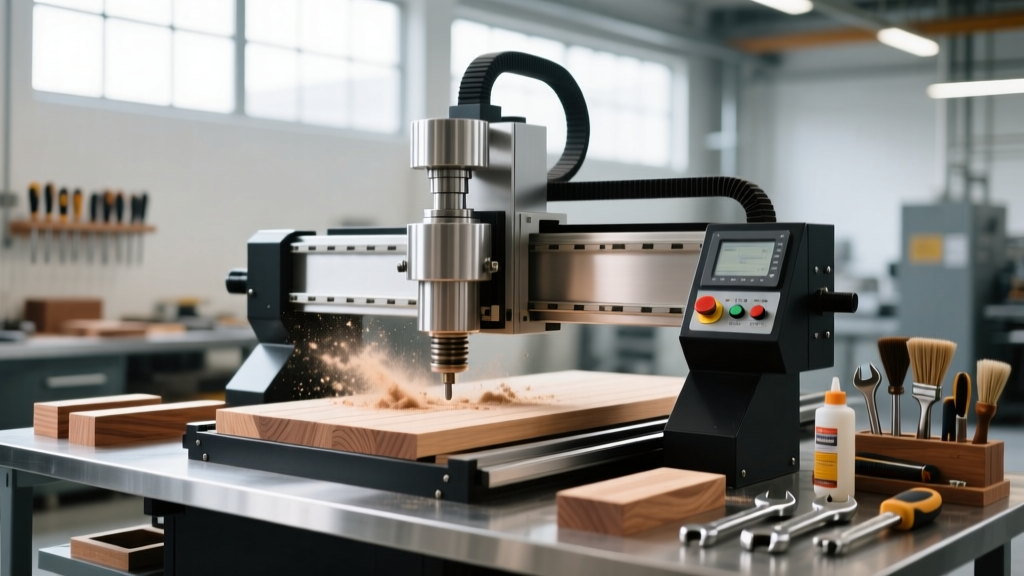
For custom sign makers, luthiers, and prototype developers, desktop or benchtop routers dominate this tier. Machines like the Carbide 3D Shapeoko 5 XXL (retailing around $2,499) or the Inventables X-Carve Pro offer rigid aluminum extrusions and NEMA 23 stepper motors. However, the budget must account for critical upgrades. The stock wasteboard must be replaced with a 3/4-inch MDF spoilboard surfaced with a fly cutter to ensure parallel Z-axis cuts. Furthermore, these machines utilize trim routers (like the Makita RT0701C) which lack the torque for deep-profile 3D carving in hardwoods like walnut or maple, limiting users to shallow passes and softer materials.
Tier 2: Prosumer & Custom Cabinet Shops ($15,000 - $45,000)
This tier bridges the gap between hobbyist rigs and factory floor production. A ShopBot Desktop MAX or a 4x8-foot CAMaster Panther introduces industrial-grade components: rack-and-pinion drives, 3HP to 5HP air-cooled spindles (such as the HSD ES929), and heavy-duty steel gantries. At this level, budget planning must shift toward facility preparation. These machines require 220V single-phase power drops, dedicated 20-amp circuits, and physical floor space exceeding the machine footprint by at least 3 feet on all sides for material loading and maintenance access.
Tier 3: Industrial High-Volume Production ($75,000+)
Facilities processing nested-based cabinet parts or high-volume architectural millwork require 5x10 or larger tables equipped with Automatic Tool Changers (ATC) and pod-and-rail systems. European manufacturers like Homag (Centateq series) and SCM Group dominate this space. The CAPEX here includes the machine ($60,000+), a 25HP rotary vane vacuum pump ($8,000+), and specialized software integration. As of 2026, supply chain stabilizations have reduced lead times for European spindles, but the cost of industrial-grade regenerative vacuum blowers has increased by roughly 12% due to motor material costs.
⚠️ Facility Warning: Combustible Dust ComplianceCommercial wood CNC operations generate fine particulate matter that poses severe deflagration risks. Under NFPA 664 standards, facilities generating more than a specific volume of wood dust must install explosion-proof dust collection systems with abort gates and spark detection. Budget an additional $12,000 to $25,000 for a compliant cyclone dust collector (e.g., Clear Vue CV-1800 with ATEX-compliant rotary valves) if operating in a commercial zone.
Comprehensive Cost Breakdown Matrix
The following table outlines the true first-year setup costs across different operational scales, highlighting how peripheral equipment often eclipses the base machine price.
| Component Category | Hobbyist / Prototype | Prosumer / Cabinet Shop | Industrial Production |
|---|---|---|---|
| Base Machine | $2,000 - $4,000 | $15,000 - $35,000 | $65,000 - $120,000+ |
| Spindle / Router | $150 (Trim Router) | $2,500 (3HP-5HP Air) | $6,000+ (10HP Liquid ATC) |
| Hold-Down System | $100 (T-Track Clamps) | $2,500 (Venturi / Small Pump) | $9,500 (25HP Becker Blower) |
| Dust Collection | $300 (Shop-Vac + Cyclone) | $3,500 (2HP Cyclone w/ Piping) | $22,000+ (Explosion-Proof) |
| CAM Software | $0 - $250 (Carbide Create) | $699 (Vectric VCarve Pro) | $5,000+ (Mastercam / AlphaCAM) |
| Initial Tooling Kit | $150 (1/4" shank bits) | $800 (1/2" compression, V-bits) | $2,500+ (HSK63F toolholders + bits) |
| Estimated Total | $2,700 - $4,800 | $24,999 - $47,499 | $110,000 - $163,000+ |
Operational Expenditure (OPEX): The Hidden Budget Killers
Beyond the initial purchase, the ongoing cost of consumables and maintenance dictates the profitability of a CNC milling machine wood operation. Failing to budget for OPEX is the primary reason small CNC shops experience negative cash flow in their first year.
1. Tooling Wear and Collet Degradation
Wood is an abrasive material, particularly engineered sheet goods like MDF and melamine-faced particleboard. Standard high-speed steel (HSS) bits will dull within minutes when cutting MDF. Shops must budget for solid carbide compression bits (such as the Onsrud 60-100 series), which cost between $35 and $65 per bit. A production shop cutting 50 sheets of melamine a week will burn through 3 to 4 compression bits weekly, resulting in an annualized tooling cost exceeding $6,000. Additionally, ER25 and ER32 collets stretch and lose clamping force over time; they must be replaced every 400 to 600 hours of run time to prevent tool pull-out and catastrophic gantry crashes.
2. Vacuum Hold-Down Power Consumption
While T-track clamps are free to operate, they require manual labor and restrict the router's toolpath. Upgrading to a universal vacuum table powered by a regenerative blower allows for instant nested-based manufacturing (NBM). However, a 15HP to 25HP vacuum pump draws massive electrical current. Running a 20HP Becker vacuum pump for an 8-hour shift can consume upwards of 120 kWh. At an average commercial rate of $0.14 per kWh, the vacuum system alone adds $16.80 per day, or roughly $4,300 annually, to the electrical overhead.
3. Software Subscriptions and Post-Processor Updates
While entry-level software like Easel or Carbide Create is free or low-cost, professional shops rely on Vectric VCarve Pro ($699 perpetual) or Mastercam Router (subscription or high-ticket perpetual). Furthermore, if you upgrade your CNC controller (e.g., moving from a Mach3 to a Syntec or Fanuc control), you must purchase new post-processors to translate G-code correctly. Custom post-processors from certified dealers typically cost between $300 and $800 each.
"The most expensive component in a wood CNC shop isn't the spindle; it's the air. If your vacuum table isn't properly zoned and your spoilboard isn't re-surfaced and sealed with dedicated spoilboard sealant, you will bleed CFM, force your vacuum pump to run at 100% duty cycle, and experience part-shifting that ruins $500 sheets of hardwood plywood."
— Industrial CNC Applications Engineer
ROI Framework: Calculating Your True Machine Hourly Rate
To accurately quote custom wood CNC jobs and ensure profitability, shop owners must calculate a precise Machine Hourly Rate (MHR). Relying on generic industry averages leads to underpricing. Use this 4-step framework to determine your 2026 baseline rate:
- Calculate Depreciation: Divide the total CAPEX (Machine + Vacuum + Dust Collection) by the expected lifespan in hours. Example: A $45,000 prosumer setup expected to run 1,500 hours annually for 8 years equals 12,000 total hours. $45,000 / 12,000 = $3.75/hour.
- Add Direct Consumables: Factor in hourly bit wear, collet replacement, and spoilboard surfacing. For hardwoods and sheet goods, allocate $4.50/hour.
- Add Power Overhead: Calculate the combined hourly draw of the spindle, stepper/servo drives, vacuum pump, and dust collector. Example: $6.20/hour.
- Apply Shop Burden & Labor: This includes rent, insurance, software amortization, and the operator's wage. Example: $45.00/hour.
Total Base MHR: $3.75 + $4.50 + $6.20 + $45.00 = $59.45 per hour.
Any quote generated for CNC-milled wood products must use this baseline before applying your desired profit margin (typically 20% to 40% for custom architectural millwork). According to recent industry machinery reports, shops that fail to track vacuum and dust-collection power draw separately consistently underprice their nested-based cabinet components by 12% to 18%.
Strategic Budget Allocation for 2026
If capital is constrained, prioritize rigidity and hold-down over spindle horsepower. A 3HP spindle on a massively rigid steel gantry with a 10HP vacuum pump will out-produce a 10HP spindle on a flexible aluminum frame relying on mechanical clamps. The ability to load a 4x8 sheet, hold it perfectly flat without tabbing, and cut it in a single pass dictates the true throughput and financial viability of your CNC milling machine wood operation.