Inside a CNC Granite Cutting Machine: Specs, Mechanics & Tooling
Explore the technical specifications and mechanics of a 5-axis CNC granite cutting machine, from diamond tooling to high-torque spindle dynamics.
The Core Mechanics of a 5-Axis CNC Granite Cutting Machine
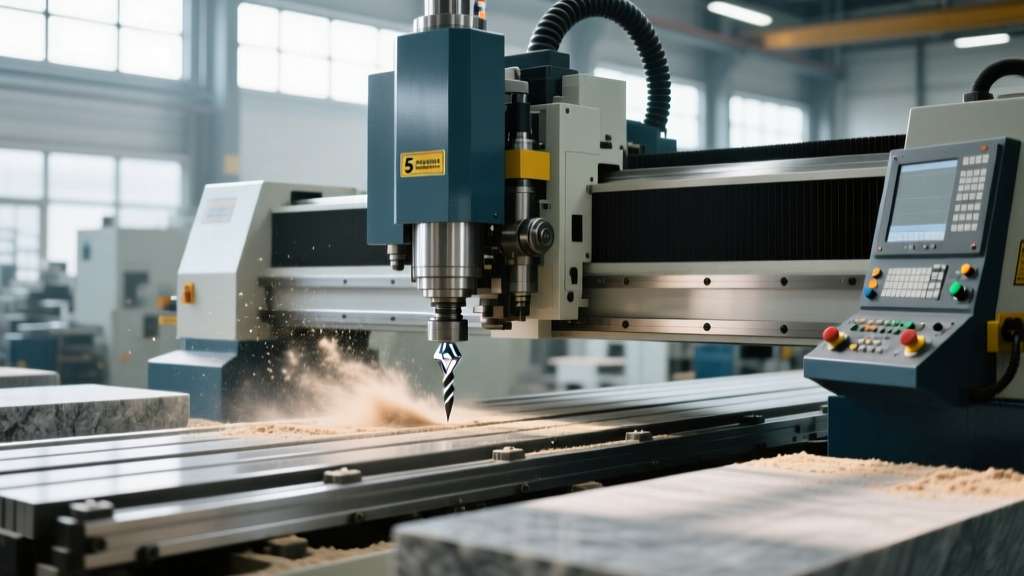
Machining granite requires overcoming a compressive strength that frequently exceeds 200 MPa and a Mohs hardness of 6 to 7. Unlike wood or aluminum, granite cannot be sheared; it must be micro-fractured and ground away. A modern CNC granite cutting machine achieves this through a combination of high-torque spindles, specialized diamond matrix tooling, and rigid kinematic structures designed to dampen the severe vibrations generated during stone removal.
While entry-level 3-axis CNC routers can perform basic straight-line slab cutting and simple edge profiling, true monumental and architectural fabrication relies on 5-axis CNC stone centers. These machines introduce a tilting spindle head (A-axis) and a rotating table or secondary rotary axis (C-axis), enabling complex 3D contouring, under-mount sink bowl polishing, and mitered edge profiling in a single setup.
Engineering Insight: The structural foundation of a high-end stone CNC is typically a monolithic cast-iron or heavily ribbed steel-welded base filled with epoxy granite. This composite dampening is critical; granite cutting generates high-frequency chatter that will degrade surface finish and destroy spindle bearings if the machine frame lacks sufficient mass and damping coefficient.Spindle Dynamics and Tooling Interfaces
The spindle is the heart of any stone fabrication center. Machining granite demands a paradoxical combination of low RPM and massive torque, coupled with the high RPM needed for final polishing passes. Leading spindle manufacturers like HSD Spindles engineer specific stone-cutting units that operate across this wide band.
Critical Spindle Specifications
- Power Output: 18 kW to 35 kW (24 to 47 HP) continuous duty. Lower power spindles will stall during deep 3cm profiling passes.
- RPM Range: 0 to 12,000 RPM. Heavy roughing with diamond core bits occurs between 2,500 and 4,500 RPM, while resin-bond polishing wheels require 8,000+ RPM.
- Tool Taper: HSK-F63 or HSK-B80. The HSK (Hollow Shank Taper) interface provides simultaneous face-and-taper contact, ensuring extreme rigidity and repeatability under the heavy radial loads of stone cutting. Standard BT or CAT tapers are insufficient for 5-axis stone work due to Z-axis pull-out risks.
- Cooling: Liquid-cooled (water/glycol mix) spindle jackets are mandatory. Air-cooled spindles cannot dissipate the thermal load generated by cutting stone and will suffer premature bearing failure.
Diamond Tooling Metallurgy
Granite is highly abrasive. Standard carbide end mills will dull in seconds. CNC stone machines utilize tooling embedded with synthetic industrial diamonds. The "bond" (the metal matrix holding the diamonds) must be carefully matched to the specific granite being cut. Hard, dense granites (like Absolute Black) require a softer metal bond (e.g., cobalt-bronze) that wears away to constantly expose fresh, sharp diamonds. Softer, more porous granites require a harder bond (e.g., tungsten carbide-based) to prevent the tool from wearing prematurely.
Kinematics: Bridge Saw vs. Gantry Router vs. 5-Axis Center
Understanding the mechanical layout of a CNC granite cutting machine is vital for determining its production capabilities and footprint.
| Machine Type | Kinematic Design | Best Application | Typical Price Range (USD) |
|---|---|---|---|
| CNC Bridge Saw | Moving bridge on fixed rails; 4 or 5-axis head. | High-volume countertop squaring, sink cutouts, mitering. | $120,000 – $220,000 |
| Fixed-Bridge Gantry | Fixed bridge, moving table; highly rigid. | Heavy monumental carving, thick slab 3D profiling. | $180,000 – $350,000+ |
| 3-Axis Stone Router | Moving gantry over stationary table; 3-axis. | Basic edge profiling, simple engraving, straight cuts. | $45,000 – $85,000 |
Water Management and Silica Mitigation
Cutting granite dry generates respirable crystalline silica (RCS), a severe health hazard. The OSHA standard 1910.1053 strictly mandates engineering controls, making closed-loop flood cooling an absolute requirement for any CNC granite cutting machine.
Flood Cooling Specifications
A 5-axis stone center requires a minimum flow rate of 15 to 25 Gallons Per Minute (GPM) at the tool tip. This serves three purposes:
- Thermal Shock Prevention: Keeps the diamond matrix cool. Overheating causes the metal bond to glaze, rendering the tool useless and potentially shattering the diamond segments.
- Slurry Evacuation: Flushes the granite swarf (sludge) out of the cut kerf. If slurry packs into the cut, it creates immense friction, leading to tool deflection and broken shanks.
- Dust Suppression: Captures silica particles at the source before they can become airborne.
Guideway Technology: Linear vs. Hydrostatic
The method by which the machine axes move dictates its longevity in a wet, abrasive environment.
- Profile Linear Guides (Recirculating Ball): Common on mid-tier machines. They rely on steel ball bearings rolling on steel rails. In a stone environment, if the way covers (bellows) and wiper seals fail, slurry ingress will pit the rails and cause catastrophic failure. Maintenance intervals are strict (weekly wiper inspection).
- Hydrostatic Guideways: Found on premium machines (e.g., Breton, CMS). A thin film of pressurized oil separates the moving carriage from the rail. There is zero metal-on-metal contact. This not only provides superior vibration dampening for a mirror-finish polish but also completely eliminates the risk of abrasive slurry destroying the guideways, vastly extending the machine's mechanical lifespan.
CAM Software and Slab Nesting
Operating a CNC granite cutting machine requires specialized CAM (Computer-Aided Manufacturing) software capable of handling stone-specific variables. Standard metalworking CAM packages often fail here. Software like AlphaCAM Stone or CMS Stone's proprietary interfaces include modules for:
- Vein Matching: Aligning the natural patterns of adjacent granite slabs for kitchen island waterfall edges.
- Slab Nesting & Remnant Management: Algorithmically placing sink cutouts and countertop profiles onto irregular slab boundaries captured via overhead slab photography, maximizing yield and minimizing waste.
- Toolpath Compensation: Automatically adjusting for the specific radius of diamond profiling wheels, which wear down over time, unlike fixed-diameter carbide end mills.
Common Failure Modes in Granite Machining
Understanding how these machines fail allows shop owners to implement preventative maintenance protocols.
- Z-Axis Ball Screw Binding: The Z-axis carries the heavy spindle and is most exposed to falling slurry. If the telescopic way covers tear, slurry enters the ball nut, hardens like concrete, and seizes the axis. Solution: Implement weekly air-purge checks on way covers.
- Spindle Bearing Contamination: High-pressure coolant can force its way past the spindle's air-purge labyrinth seals if the shop's air compressor drops below the required 90 PSI. Water enters the ceramic bearings, causing rust and catastrophic seizure at 10,000 RPM. Solution: Install dedicated, monitored air-pressure switches interlocked with the spindle enable circuit.
- Vacuum Pod Loss: For machines using vacuum hold-downs instead of mechanical clamps, granite's porous nature can cause vacuum bleed. Solution: Use specialized porous-stone vacuum seals and ensure the slab edges are sealed with silicone before engaging the pump.
For further technical guidelines on stone fabrication tolerances and material handling, refer to the Natural Stone Institute's technical resources. Investing in a properly specified CNC granite cutting machine—prioritizing spindle torque, hydrostatic protection, and robust slurry management—transforms a volatile fabrication process into a highly predictable, high-margin manufacturing operation.