Safety Standards for CNC Machined Copper Parts: OSHA & Alloy Risks
Navigate OSHA compliance, alloy toxicity, and electrical standards for CNC machined copper parts. Master chip management, coolant safety, and traceability.
Toxicological Profiles and OSHA Exposure Limits
Machining copper extends far beyond managing tool wear and thermal conductivity; it requires strict adherence to occupational health regulations based on the specific alloy being cut. While pure copper poses minimal systemic toxicity, the alloying elements added to improve machinability introduce severe compliance liabilities. Facility managers must classify copper stock by its UNS (Unified Numbering System) designation before loading it into the CNC hopper.
C11000 (ETP) and C10100 (OFE Copper)
Electrolytic Tough Pitch (C110) and Oxygen-Free Electronic (C101) coppers are virtually pure. The primary OSHA compliance focus here is nuisance dust. Under NIOSH and OSHA guidelines, the Permissible Exposure Limit (PEL) for copper dust and mists is 1.0 mg/m³ as an 8-hour Time-Weighted Average (TWA). Standard shop ventilation is usually sufficient, but enclosed CNC cabins with basic mist collectors are required to maintain this baseline.
C14500 (Tellurium Copper)
Tellurium is added to copper to create free-machining characteristics similar to leaded steel. However, dry machining or high-temperature friction generates tellurium dioxide (TeO2) fumes. Inhalation causes 'tellurium breath' (a severe garlic-like odor) and mild central nervous system depression. Local Exhaust Ventilation (LEV) at the cutting zone is mandatory to capture these specific particulates before they enter the operator's breathing zone.
C17200 (Beryllium Copper)
Beryllium copper offers exceptional strength and non-sparking properties but represents one of the most heavily regulated materials in CNC machining. Beryllium is a confirmed human carcinogen. The OSHA PEL for beryllium is an extremely strict 0.2 µg/m³ (8-hour TWA), with a Short-Term Exposure Limit (STEL) of 2.0 µg/m³ over 15 minutes.
⚠️ CRITICAL COMPLIANCE WARNING: Beryllium Copper (C172)Under OSHA Standard 1910.1024, machining C17200 requires fully enclosed CNC workstations with negative pressure, HEPA filtration (99.97% efficiency at 0.3 microns), and mandatory respiratory protection programs if engineering controls fail to maintain the 0.2 µg/m³ limit. Sweeping dry beryllium chips with compressed air is a direct OSHA violation carrying severe financial penalties.
Chip Morphology and Machine Guarding Compliance
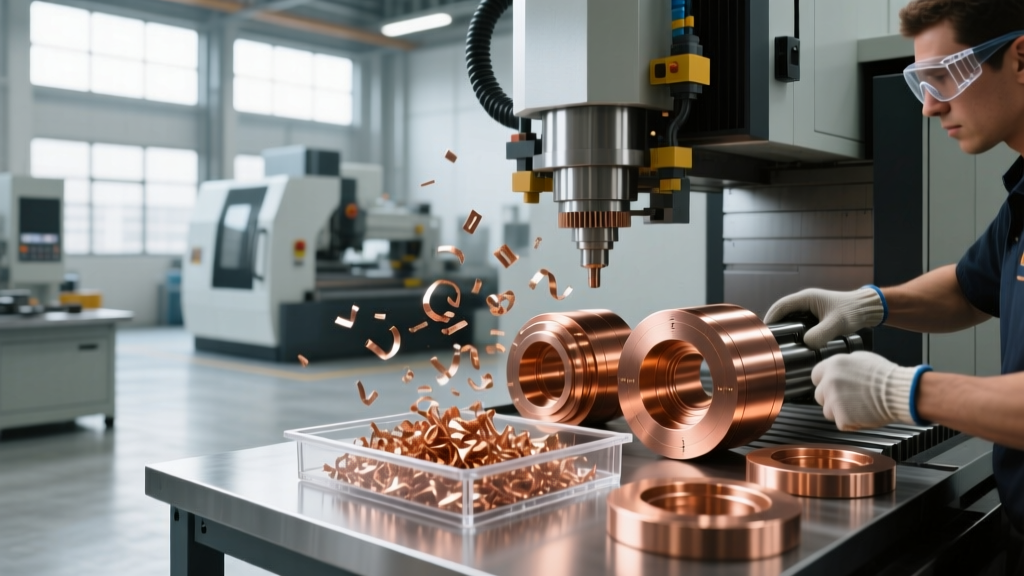
Copper's high ductility and low yield strength result in continuous, stringy chips that can wrap around spindles, tool holders, and conveyor hinges. This creates a severe entanglement hazard and a direct violation of OSHA 1910.212 (General Requirements for All Machines). Uncontrolled chip wrapping can also pull workpieces out of fixturing, causing catastrophic kinetic failures inside the enclosure.
| Alloy Designation | Chip Morphology | Guarding & Mitigation Strategy |
|---|---|---|
| C11000 (ETP) | Long, continuous, highly entangled 'bird nests' | High-pressure through-tool coolant (1500+ PSI); aggressive chip-breaker geometries on turning inserts. |
| C14500 (Tellurium) | Short, brittle, easily fractured segments | Standard flood coolant; standard conveyor guarding; LEV for dust capture. |
| C17200 (Beryllium) | Fine, abrasive dust and micro-shards | Fully sealed enclosure; HEPA vacuum extraction; no manual chip clearing during operation. |
| C36000 (Free-Machining Brass)* | Small, fragmented chips (Lead content) | Standard guarding; RoHS compliance tracking for lead content. |
*Note: While technically a brass (copper-zinc alloy), C36000 is frequently grouped in copper machining departments and carries its own lead-exposure compliance requirements.
Coolant Chemistry, Mist Exposure, and Fire Safety
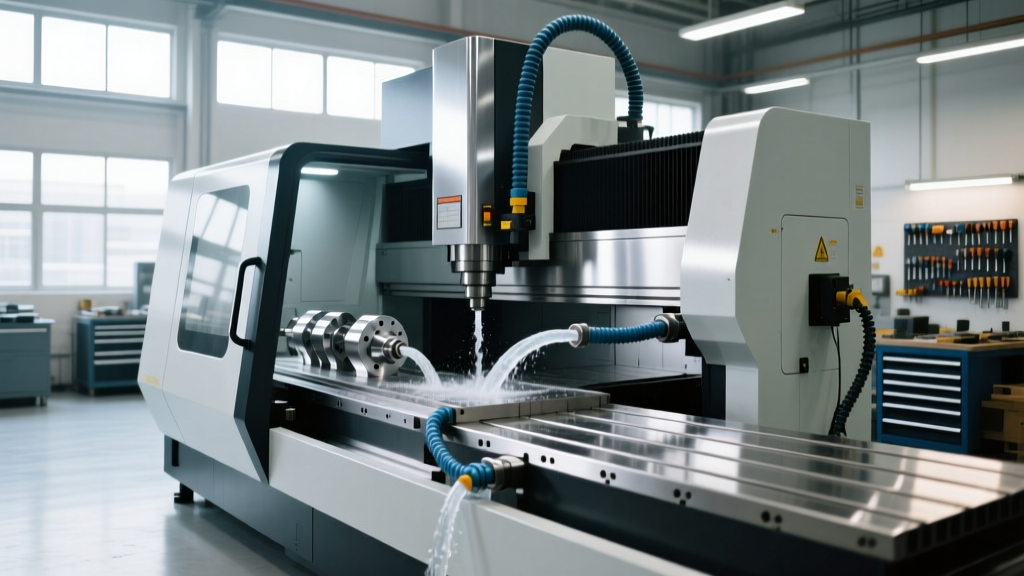
Copper is highly reactive with specific cutting fluid additives. Using the wrong coolant chemistry not only ruins the surface finish but creates compliance issues regarding fluid degradation and operator exposure.
The Sulfur Staining Problem
Many heavy-duty EP (Extreme Pressure) coolants contain active sulfur to protect cutting tools. Active sulfur chemically attacks copper, forming copper sulfide—a black, irreversible stain that ruins electrical contacts and optical components. Furthermore, the chemical reaction breaks down the coolant's emulsion, causing the oil to separate and increasing the concentration of airborne mist.
Actionable Specification: Always specify semi-synthetic or synthetic coolants formulated with benzotriazole (BTA) or tolyltriazole (TTA) corrosion inhibitors. These molecules form a passivation layer on the copper surface without degrading the fluid matrix. Maintain the coolant pH strictly between 8.5 and 9.2 to prevent both bacterial growth and copper oxidation.
Mist Inhalation and Flash Points
High-speed CNC milling of copper generates significant heat due to the material's friction coefficient, vaporizing coolant into respirable mist. OSHA regulates mineral oil mist under the general particulate PEL, but the ACGIH recommends a stricter Threshold Limit Value (TLV) of 0.2 mg/m³. To comply, utilize enclosed machines equipped with centrifugal mist collectors rated for a minimum of 95% efficiency on sub-micron particles. Additionally, ensure your chosen copper-compatible coolant has a closed-cup flash point exceeding 350°F (176°C) to prevent ignition from dry-cutting friction or spindle fires.
Electrical Traceability: ASTM and UL Standards
When CNC machined copper parts are destined for electrical infrastructure—such as busbars, switchgear contacts, or grounding lugs—safety compliance shifts from the machine shop floor to the end-use application. Machining alters the surface geometry and can introduce contaminants that affect electrical resistance and arc-flash safety.
'Dimensional accuracy in CNC machined busbars is not just a mechanical tolerance issue; it is an electrical safety imperative. A poor surface finish or incorrect corner radius increases localized resistance, leading to thermal runaway and catastrophic switchgear failure under load.'
Material Certification and ASTM B187
For bus bars, rod, and shapes, compliance requires adherence to the ASTM B187 Standard Specification. This standard dictates the electrical conductivity requirements (minimum 100% IACS for C11000) and mechanical properties. CNC machine shops must maintain unbroken material traceability (Mill Test Reports) from the raw extrusion to the final machined part. Scrap copper or recycled alloys cannot be used for UL-listed electrical components without rigorous spectrographic verification.
UL 891 and Surface Finish Compliance
Under UL 891 (Switchboards), copper busbars must meet specific plating and surface finish requirements to prevent galvanic corrosion and ensure proper bolted joint torque. CNC machining leaves tool marks that can reduce the effective contact area of a bolted busbar joint. Shops must implement secondary finishing processes—such as vibratory tumbling or specific grit abrasive blasting—to achieve a surface roughness (Ra) of 63 µin (1.6 µm) or better on all mating surfaces, ensuring UL compliance for thermal dissipation.
Facility Ventilation and Air Quality Benchmarks
Achieving compliance for CNC machined copper parts requires engineered environmental controls. Relying on general HVAC dilution is insufficient for high-volume copper machining facilities.
✅ Ventilation Engineering Checklist for Copper CNC Cells:- Capture Velocity: LEV hoods positioned within 12 inches of the cutting zone must maintain a capture velocity of 200–300 feet per minute (fpm) to overcome the thermal updraft generated by the cutting action.
- Duct Transport: Ductwork must maintain a minimum transport velocity of 3,500 fpm to prevent heavy copper dust from settling and accumulating in the horizontal runs, which poses a secondary inhalation risk during maintenance.
- Filtration Staging: Use a multi-stage filtration system: MERV 8 pre-filters for large chips, followed by MERV 14 secondary filters, and HEPA (99.97% at 0.3µm) final stages if machining tellurium or beryllium alloys.
- Makeup Air: Ensure the facility's makeup air system replaces exhausted CFM at a 1:1 ratio to prevent negative building pressure, which can cause back-drafting of combustion appliances or dust infiltration from adjacent bays.
Mastering the safety and compliance landscape for CNC machined copper parts requires a dual focus: protecting the operator from alloy-specific toxicological hazards and protecting the end-user through rigorous adherence to electrical and material traceability standards. By implementing targeted coolant chemistries, high-pressure chip management, and precise LEV systems, machine shops can safely scale production while remaining fully compliant with OSHA, EPA, and UL regulations.