CNC Machining Titanium: Operator Best Practices & Feeds
Master CNC machining titanium with expert operator training. Learn exact speeds, feeds, high-pressure coolant setups, and toolpath strategies for Ti-6Al-4V.
The Metallurgical Reality of Ti-6Al-4V
Titanium Grade 5 (Ti-6Al-4V) accounts for nearly 50% of global titanium usage in aerospace and medical manufacturing. Machining this alloy requires operators to fundamentally unlearn the habits built on steel and aluminum. The primary challenge is thermal conductivity. Ti-6Al-4V has a thermal conductivity of roughly 6.7 W/m·K, which is approximately one-quarter that of 1045 carbon steel and one-sixteenth that of 6061 aluminum. Consequently, heat generated at the shear zone does not dissipate into the workpiece or the chips; it concentrates directly at the cutting edge, leading to rapid plastic deformation of the tool substrate.
Critical Operator Note: Titanium exhibits severe 'springback' (elastic recovery) after the tool passes. If your radial depth of cut is too light, the tool will rub against the work-hardened surface rather than shearing the material, accelerating notch wear and causing catastrophic tool failure.Tooling Substrate and Geometry Specifications
Standard end mills will fail within minutes when machining titanium. Operators must select tooling engineered specifically for high-temperature alloys. According to tooling manufacturers like Harvey Tool, the following specifications are non-negotiable for production environments:
Substrate and Coating
- Substrate: Sub-micron grain carbide (0.5 to 0.8 µm) provides the necessary hot hardness to resist plastic deformation at 1200°F+ cutting zone temperatures.
- Coating: Aluminum Titanium Nitride (AlTiN) or Titanium Aluminum Nitride (TiAlN) are mandatory. These coatings form a protective aluminum oxide layer at high temperatures. Never use TiCN (Titanium Carbonitride), as the carbon can chemically react with the titanium workpiece at elevated temperatures, causing severe built-up edge (BUE).
Geometry and Helix Angles
Variable helix and variable pitch geometries are required to disrupt harmonic frequencies and prevent chatter. Look for end mills with a 35°/37° or 38°/41° variable helix. A higher flute count (5 to 7 flutes) is preferred for finishing and adaptive roughing to maintain feed rates while keeping the chip load per tooth low.
Speeds, Feeds, and Radial Engagement Matrix
The golden rule of CNC machining titanium is maintaining a strict chip thickness. If the chip is too thin, the tool rubs; if it is too thick, the cutting edge fractures. The following parameters apply to Ti-6Al-4V using solid carbide AlTiN-coated end mills with through-tool coolant. For deeper technical baselines, refer to the Machining Doctor titanium guidelines.
| Operation Type | Surface Speed (SFM) | Feed per Tooth (IPT) | Radial Engagement | Axial DOC |
|---|---|---|---|---|
| Adaptive Roughing | 150 - 180 | 0.003" - 0.005" | 5% - 8% of D | 1.5x to 2.0x D |
| Slotting (Full Width) | 80 - 110 | 0.0015" - 0.002" | 100% of D | 0.5x D |
| Contour Finishing | 220 - 280 | 0.001" - 0.002" | 2% - 4% of D | 1.0x D |
| Drilling (Solid Carbide) | 60 - 85 | 0.002" - 0.004" IPR | N/A | Peck 0.5x D |
High-Pressure Coolant (HPC) Integration
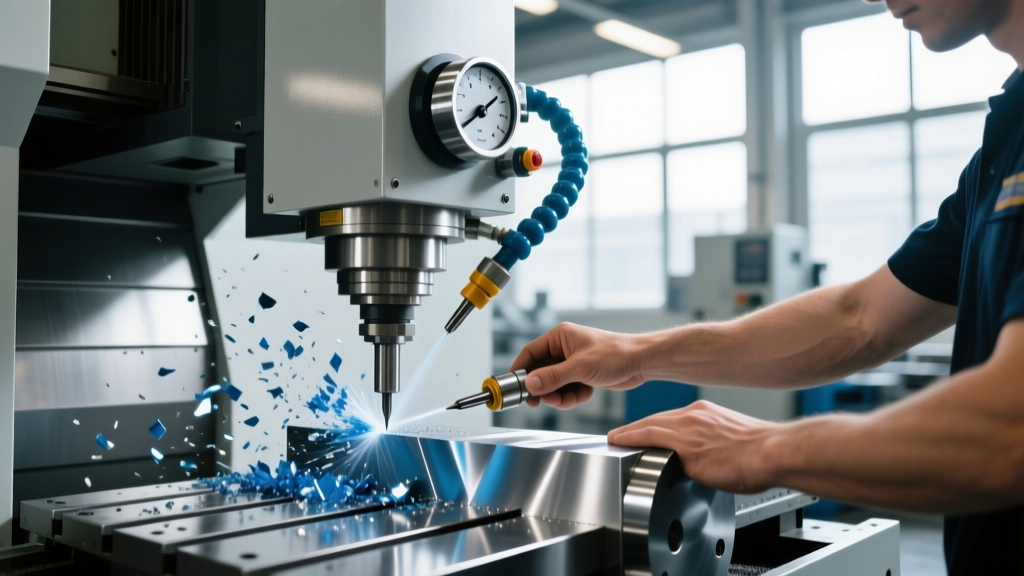
Flood coolant is entirely insufficient for roughing titanium. Modern 2026 machining centers equipped with 1000 to 1500 PSI through-spindle coolant (TSC) systems are the industry standard for Ti-6Al-4V. High pressure serves two critical functions:
- Thermal Shock and Lubrication: It penetrates the vapor barrier (Leidenfrost effect) that forms at the cutting edge, cooling the tool substrate.
- Chip Evacuation: It physically breaks the stringy, work-hardened titanium chips and blows them out of the flute valleys. Recutting a titanium chip will instantly destroy the cutting edge.
'If you are machining titanium without minimum 1000 PSI through-tool coolant, you are not machining; you are merely destroying expensive carbide.' — Senior Aerospace Manufacturing Engineer
CAM Toolpath Strategies for Titanium
Operators and programmers must collaborate to ensure constant tool engagement. Traditional zig-zag or offset pocketing toolpaths cause the tool to engage 100% of its diameter in corners, spiking the cutting forces and generating massive heat.
Mandatory Toolpath Protocols
- Adaptive/Trochoidal Clearing: Use dynamic motion toolpaths that maintain a constant radial engagement (ideally 5-8%). This allows the cutting edge to cool during the non-cutting portion of the rotation.
- Corner Radius Matching: Never program a toolpath that forces the tool into a sharp internal corner. Always leave a corner radius larger than the tool radius, or use a smaller tool specifically for corner clearing.
- Ramping and Helical Interpolation: Avoid plunging directly into the material. Use helical ramping with a pitch angle no steeper than 2° to 3° to gradually introduce the tool to the cut.
Troubleshooting Common Failure Modes
When a tool fails in titanium, the fracture pattern tells the story of the operational error. Use this decision matrix to diagnose and correct issues on the shop floor.
1. Premature Flank Wear and Notch Wear
Cause: Cutting speed (SFM) is too high, or the tool is rubbing due to insufficient feed per tooth (IPT) at low radial engagements.
Fix: Decrease SFM by 15%. Verify chip thickness calculations and increase IPT. Ensure the tool is not dwelling in the cut.
2. Built-Up Edge (BUE) and Galling
Cause: Lack of chemical barrier between tool and workpiece, or insufficient coolant pressure allowing chips to weld to the flute.
Fix: Switch to an AlTiN-coated tool. Increase TSC pressure to 1200+ PSI. Verify that you are not using a TiCN-coated tool.
3. Micro-Chipping on the Cutting Edge
Cause: Severe chatter, vibration, or a lack of rigidity in the workholding setup. Titanium requires massive clamping force.
Fix: Reduce the axial depth of cut (DOC). Switch to a variable pitch end mill to break harmonic resonance. Check spindle runout; it must be under 0.0002".
Operator Safety and Fire Mitigation Protocols
Titanium fines and dry chips are highly combustible. When machining dry or with mist, the fine dust can ignite at temperatures as low as 1200°F, leading to intense, self-sustaining chemical fires. The National Fire Protection Association (NFPA) strictly regulates the handling of combustible metals.
Fire Emergency Protocol:- NEVER use water, foam, or CO2 on a titanium fire. Water will dissociate into hydrogen and oxygen, causing a violent explosion.
- Only use Class D dry powder fire extinguishers (e.g., Met-L-X or sodium chloride-based agents) to smother the fire.
- Ensure the machine enclosure is cleared of dry chip accumulation daily. Use high-volume flood coolant or high-pressure TSC to keep chips fully submerged and cool.
Mastering CNC machining titanium is less about brute force and more about thermal management, precise chip thinning calculations, and rigorous adherence to toolpath consistency. By enforcing these parameters on the shop floor, operators can extend tool life by up to 300% and maintain the tight tolerances required for critical aerospace and medical components.