CNC Stone Carving Machine ROI: Monument & Architecture Case Studies
Analyze real-world ROI and applications of a CNC stone carving machine in monument manufacturing and 5-axis architectural mitering. Includes tooling data.
The Shift to Automated Stone Fabrication
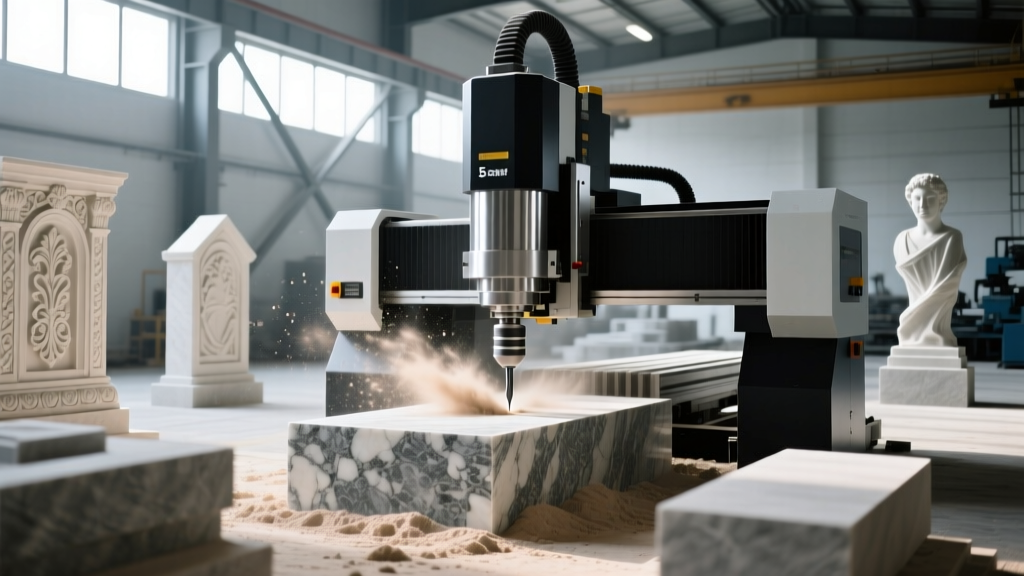
The transition from manual templating and hand-routing to automated machining has fundamentally altered the economics of natural stone fabrication. A modern cnc stone carving machine is no longer just a luxury for high-volume shops; it is a baseline requirement for maintaining tight margins on complex architectural mitering, deep-relief monument carving, and precision sink cutouts. Unlike wood or aluminum, stone presents unique machining challenges: extreme abrasiveness, high hardness (Mohs 6-7 for granite), and the necessity for continuous high-volume coolant flow.
This analysis breaks down real-world applications, tooling wear rates, and financial return on investment (ROI) across two primary sectors: memorial monument manufacturing and high-end architectural countertop fabrication.
Baseline Machine Specifications for Stone
- Spindle Power: 15 HP to 35 HP (11 kW - 26 kW) continuous duty
- RPM Range: 0 - 12,000 RPM (Variable Frequency Drive with high low-end torque)
- Coolant Requirement: 10 - 15 GPM (Gallons Per Minute) minimum at the cutting edge
- Positional Tolerance: ±0.005 inches over a 10-foot bed
- Way Protection: Heavy-duty polyurethane bellows with positive air-purge systems
Case Study 1: High-Volume Monument & Memorial Carving
Monument manufacturing relies heavily on deep V-carving, 3D relief modeling, and rotary-axis statuary work. Shops working with Barre Gray, Georgia Blue, and Absolute Black granite face severe tooling degradation if feed rates and spindle speeds are not perfectly calibrated.
Deep Relief Carving in Absolute Black Granite
A mid-sized memorial supplier in the Northeast US upgraded from manual sandblasting to a 4-axis CNC stone carving machine equipped with a 24 HP HSD spindle and a 36-inch rotary table. The objective was to produce 3D floral relief patterns and deep-cut portrait etchings without the secondary finishing labor required by sandblasting.
| Tooling Type | Spindle RPM | Feed Rate (IPM) | Depth of Cut (Per Pass) | Avg. Tool Life |
|---|---|---|---|---|
| 1/2" Vacuum Brazed Diamond V-Bit (90°) | 4,500 | 35 IPM | 0.125" | 14 - 18 linear feet |
| 3/8" Sintered Diamond Ball Nose | 6,000 | 25 IPM | 0.080" | 22 - 26 linear feet |
| 1/4" Electroplated Diamond Taper | 8,000 | 40 IPM | 0.050" | 8 - 10 linear feet |
By utilizing sintered diamond tooling rather than electroplated bits for the roughing passes, the shop reduced tooling costs by 41% annually. According to fabrication standards outlined by the Natural Stone Institute, maintaining a consistent coolant flow over the cutting edge is critical when working with dense igneous rocks to prevent thermal shock, which micro-fractures the diamond matrix and causes premature bit failure.
Case Study 2: Architectural Countertops & 5-Axis Mitering
The architectural stone sector demands seamless 45-degree mitered edges on kitchen islands, waterfall panels, and complex 3D sink bowls. This requires a 5-axis CNC stone carving machine capable of interpolating the A and C axes simultaneously while managing the immense weight of quartzite and sintered porcelain slabs.
Mitering Macaubas Quartzite and Dekton
A high-end fabricator specializing in luxury residential projects invested in a 5-axis bridge saw/router hybrid (similar to the Park Industries TITAN or Breton Smartcut platforms). The primary challenge was chipping on the fragile resin-filled edges of Macaubas quartzite and the extreme brittleness of 12mm Dekton sintered stone during 45-degree miter cuts.
"The secret to chip-free mitering on 5-axis stone CNCs isn't just the spindle speed; it's the climb-milling direction and the use of continuous-rim sintered diamond mitering wheels. We run the A-axis at exactly 45.2 degrees to leave a 0.010-inch flat landing, preventing the razor-sharp edge from crumbling under the weight of the slab during assembly."
For sink cutouts in 3cm granite, the shop utilizes a 3/8" down-shear diamond core bit with a compressed air-through-spindle option. The air blast clears the heavy slurry from the deep flutes, preventing the bit from binding and snapping—a common failure mode in shops that rely solely on external flood coolant for deep pocketing.
Hidden Costs & Critical Failure Modes in Stone CNCs
Operating a CNC stone carving machine introduces environmental hazards that do not exist in wood or metal machining. Stone dust mixed with water creates an abrasive slurry that aggressively attacks machine components. Understanding these failure modes is essential for calculating true operational costs.
⚠️ Critical Warning: Slurry Ingress & Spindle Death
The most frequent catastrophic failure in stone CNCs is water ingress into the spindle bearings. Stone machining requires high-pressure coolant. If the spindle's labyrinth seals fail, or if the positive air-purge system is disabled, water wicks up into the ceramic bearings. A replacement 24 HP HSD stone spindle costs between $12,000 and $18,000 and requires 48 hours of downtime to install and recalibrate. Never operate a stone CNC without verifying the spindle air-purge pressure is above 2.5 bar before initiating the coolant pump.
Z-Axis Ball Screw Degradation
Stone spindles are heavy, often weighing over 60 lbs due to the reinforced casting required to dampen vibrations. The Z-axis ball screw carries this dead weight continuously. If the automatic lubrication system runs dry, or if abrasive slurry breaches the Z-axis way covers, the ball screw will pit and develop backlash within 18 months. Replacement of a precision-ground Z-axis ball screw assembly typically exceeds $8,500 in parts and labor.
Financial Breakdown: ROI & Machine Pricing Tiers
Capital expenditure for stone CNC equipment varies wildly based on axis count, bed size, and software integration. Below is a realistic pricing and ROI matrix based on current market conditions for fabrication shops running a standard 2,000-hour annual schedule.
| Machine Tier | Estimated Cost | Primary Application | Est. ROI Period |
|---|---|---|---|
| Tier 1: 3-Axis Router | $45,000 - $85,000 | Flat carving, basic sink cutouts, drainboards | 12 - 16 Months |
| Tier 2: 4-Axis Monument CNC | $95,000 - $145,000 | Deep relief, rotary statuary, architectural columns | 18 - 24 Months |
| Tier 3: 5-Axis Contouring Hybrid | $220,000 - $380,000+ | Seamless mitering, 3D architectural panels, complex vanities | 24 - 36 Months |
Industry publications like Stone World frequently note that the ROI on 5-axis machines is accelerated not just by speed, but by the elimination of secondary manual polishing and edge-seaming labor, which currently commands $45 to $85 per hour in skilled fabrication markets.
Tooling & Coolant Infrastructure Requirements
Purchasing the machine is only the first step. The support infrastructure dictates whether the machine runs profitably or bleeds money through consumables and downtime.
Water Filtration and Slurry Management
A 15 GPM coolant system moves over 900 gallons of water per hour. If this water is recirculated without proper filtration, the suspended granite and quartzite particles (which are harder than the machine's linear rails) will destroy coolant pump impellers and clog the spindle's internal cooling channels. Fabricators must install a multi-stage settling tank or a centrifugal hydrocyclone separator capable of filtering particles down to 20 microns before the water returns to the machine's reservoir.
Diamond Grit Selection by Material
- Soft Marble & Limestone: Use a harder metal bond with a lower diamond concentration to prevent the bit from wearing away too quickly in the soft, abrasive calcium carbonate matrix.
- Hard Granite & Quartzite: Use a softer metal bond that continuously exposes fresh, sharp diamond crystals as the matrix wears. A 30/40 mesh diamond grit is standard for aggressive roughing, while a 60/80 mesh is required for finish passes to minimize edge chipping.
- Sintered Porcelain (Dekton/Neolith): Requires specialized continuous-rim electroplated bits designed specifically to mitigate the extreme internal tension of sintered materials. Standard segmented core bits will cause catastrophic blowout on the exit side of the cut.
Integrating a CNC stone carving machine into a fabrication workflow requires a rigorous approach to maintenance, tooling science, and coolant management. Shops that master these variables consistently achieve tolerances that manual fabricators cannot match, securing the most lucrative contracts in both the memorial and luxury architectural markets.