CNC Machine for Cutting Metal: Fiber Laser vs Plasma 2026
Compare fiber laser and HD plasma CNC machines for cutting metal. Analyze 2026 pricing, kerf widths, cut speeds, and tolerances to choose the right system.
The Procurement Dilemma: Precision vs. Raw Penetration
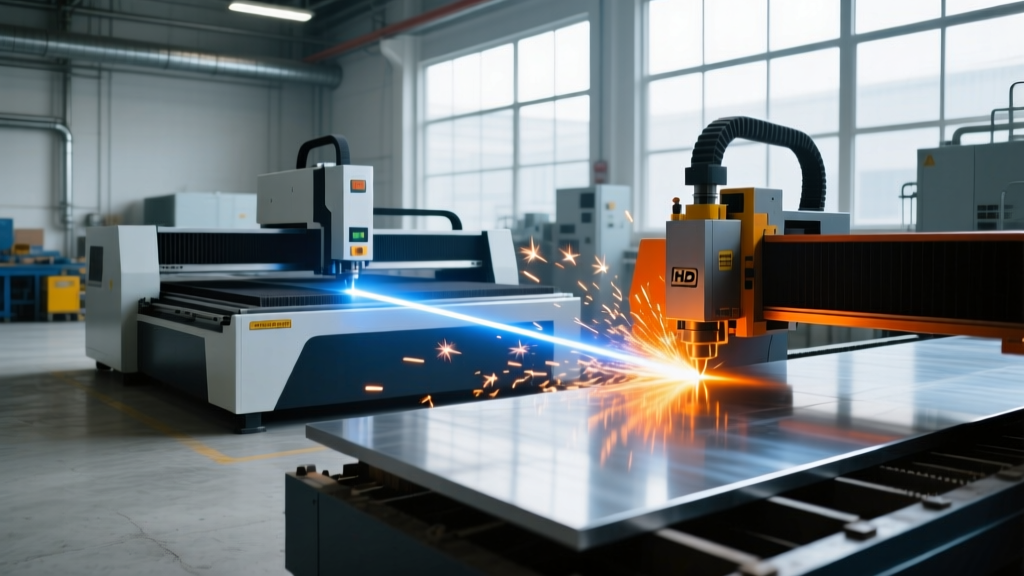
Selecting the optimal CNC machine for cutting metal requires moving beyond generic marketing claims to evaluate specific metallurgical interactions, kerf geometries, and total cost of ownership (TCO). In 2026, the primary battleground for flatbed metal profiling remains between high-power fiber lasers and high-definition (HD) plasma systems. While both technologies have advanced significantly, they serve fundamentally different economic and metallurgical use cases. A 30kW fiber laser excels in high-mix, tight-tolerance sheet metal fabrication, whereas a 300-amp HD plasma system dominates in heavy plate processing where edge squareness and sub-millimeter tolerances are secondary to raw throughput and capital efficiency.
Quick Procurement Decision Matrix
- Choose Fiber Laser if: Your primary material is under 20mm (0.75"), you require tolerances tighter than ±0.1mm, and you need oxide-free edges for immediate powder coating or welding.
- Choose HD Plasma if: You routinely cut mild steel plate between 20mm and 50mm (0.75" to 2"), your tolerance requirement is ±0.5mm, and your capital budget is strictly under $150,000.
Fiber Laser CNC: The Tolerance and Speed Benchmark
The shift from CO2 to solid-state fiber laser technology is now complete in the industrial sector. Modern CNC fiber lasers utilize ytterbium-doped optical fibers, with resonators from manufacturers like IPG Photonics and nLIGHT pushing continuous wave (CW) outputs to 30kW and beyond. When evaluating a CNC machine for cutting metal at the high end of the spectrum, a 24kW system is currently the sweet spot for job shops balancing electrical consumption with cutting speed.
Real-World Cutting Metrics and Assist Gases
Cutting speed in fiber lasers is heavily dictated by the assist gas. For mild steel up to 6mm, oxygen is used to trigger an exothermic reaction, yielding speeds around 12 m/min. However, oxygen leaves an oxidized edge that requires grinding before welding or painting. For oxide-free cuts, high-pressure nitrogen is used. A 24kW fiber laser cutting 10mm mild steel with nitrogen can achieve speeds of 8.5 m/min, while a 12kW system will max out around 3.5 m/min on the same thickness.
Leading platforms like the Mazak OPTIPLEX 3015 NEO or the TRUMPF TruLaser 3030 integrate automated nozzle changers and capacitive height sensing to maintain a strict 0.8mm standoff distance, which is critical for preventing back-reflections that can destroy a $15,000 cutting head.
Capital Expenditure and Facility Requirements
Procuring a mid-to-high-tier fiber laser CNC requires significant capital. In 2026, a fully equipped 12kW system with automated material handling towers ranges from $320,000 to $450,000. Stepping up to a 24kW or 30kW resonator pushes the price into the $550,000 to $750,000 range. Furthermore, facility upgrades are mandatory: 24kW+ machines require reinforced concrete pads to dampen high-speed acceleration vibrations, and bulk liquid nitrogen tanks (typically 3,000 to 6,000-gallon capacity) must be installed outside the facility, requiring municipal permitting and strict safety setbacks.
CNC Plasma Systems: Thick Plate Economics
While fiber lasers dominate sheet metal, CNC plasma remains the undisputed king of heavy plate profiling. High-definition plasma technology, pioneered by systems like the Hypertherm XPR300, constricts the plasma arc through a specialized nozzle, increasing energy density and dramatically improving edge squareness compared to conventional air plasma.
Overcoming the Bevel Angle Challenge
The historical weakness of plasma cutting is the kerf bevel—a natural 3 to 5-degree taper caused by the arc's expansion as it exits the material. In structural steel fabrication governed by AWS D1.1 codes, excessive bevel requires costly secondary milling. Modern HD plasma systems mitigate this through two methods: specialized consumable sets (like Hypertherm's True Hole technology for mild steel) that optimize gas flow dynamics, and 5-axis CNC bevel heads that physically tilt the torch to compensate for the taper in real-time. A 5-axis plasma table from manufacturers like CamMaster or MultiCam can produce weld-ready V-grooves and Y-grooves in a single pass on 30mm plate, eliminating secondary edge-prep operations entirely.
Cost of Ownership and Consumable Life
The initial capital outlay for a high-quality CNC plasma table with a 300-amp HD power source ranges from $65,000 to $140,000, a fraction of the cost of a high-power fiber laser. However, buyers must account for consumable wear. A standard XPR300 oxygen process on mild steel yields approximately 2,000 to 2,500 pierces per electrode/nozzle set. At roughly $45 per set, consumable costs average $0.02 per pierce. While this is highly economical, shops running 24/7 high-pierce nesting programs must factor in the labor cost of torch maintenance and the machine downtime required for consumable changeovers.
Head-to-Head Technical Comparison Matrix
The following table contrasts a 24kW Fiber Laser, a 300A HD Plasma, and an Abrasive Waterjet to highlight the operational boundaries of each CNC machine for cutting metal.
| Parameter | 24kW Fiber Laser | 300A HD Plasma | Abrasive Waterjet (50HP) |
|---|---|---|---|
| Max Efficient Thickness (Mild Steel) | 25mm (1") | 50mm (2") | 150mm+ (6"+) |
| Kerf Width (10mm MS) | 0.2mm - 0.4mm | 2.5mm - 3.2mm | 0.8mm - 1.2mm |
| Positional Tolerance | ± 0.05mm | ± 0.50mm | ± 0.10mm |
| Heat Affected Zone (HAZ) | Narrow (0.1mm - 0.3mm) | Wide (1.5mm - 3.0mm) | None (Cold Cutting) |
| Approximate 2026 CapEx | $450,000 - $650,000 | $75,000 - $140,000 | $250,000 - $350,000 |
Edge Cases: When to Choose Abrasive Waterjet Instead
There is a specific metallurgical scenario where neither laser nor plasma is acceptable: cutting heat-treated tool steels, aerospace-grade titanium alloys, or thick tempered aluminum where the Heat Affected Zone (HAZ) will ruin the material's temper or induce micro-cracking. In these cases, an abrasive waterjet (such as a Flow Mach 500 or Omax Maxiem) is the only viable CNC machine for cutting metal. Waterjets utilize a high-pressure stream of water mixed with garnet abrasive to erode the material mechanically. While the cut speed on 20mm steel is agonizingly slow compared to plasma (often under 0.5 m/min), the complete absence of thermal distortion and HAZ makes it indispensable for aerospace and specialized tool-and-die applications.
"The biggest mistake fabricators make in 2026 is buying a 30kW fiber laser to cut 1-inch mild steel plate simply because the marketing brochure shows it can. The assist gas costs to pierce and cut thick plate with nitrogen are astronomical, and the edge quality degrades. If 80% of your work is over 20mm, buy a high-definition plasma table and save half a million dollars in capital and operational expenses."
Actionable Procurement Checklist
Before signing a purchase order for any metal cutting CNC system, execute the following validation steps to ensure the machine aligns with your shop's actual production reality:
- Demand a Cut-Bench Sample: Do not rely on OEM sample parts. Provide the vendor with your exact CAD file (including worst-case small hole diameters and acute corners) and a batch of your specific material. Evaluate the sample for dross attachment, kerf taper, and HAZ discoloration.
- Audit the Nesting Software: The hardware is only as efficient as the CAM software driving it. Ensure the quoted package includes advanced nesting software (like SigmaNEST or Hypertherm ProNest) capable of true-shape nesting, common-line cutting, and automated lead-in/lead-out optimization to reduce pierce counts.
- Calculate True Assist Gas Costs: If opting for a fiber laser, request a liquid nitrogen vaporization chart from your local gas supplier (e.g., Linde or Air Liquide). Calculate the cost per hour of cutting at 25 bar pressure, and add this to your hourly machine rate.
- Verify Fume Extraction Capacity: Plasma cutting 10mm galvanized or stainless steel generates hexavalent chromium and dense zinc oxide fumes. Ensure the downdraft table is paired with a cartridge dust collector rated for the specific CFM required by the table's zoning dampers, meeting OSHA PEL standards.
- Inspect the Linear Drive System: For high-precision laser cutting, insist on linear motors or high-precision helical rack-and-pinion drives with absolute encoders. Recirculating ball screws on large-format tables (over 1.5 meters wide) are prone to thermal growth and backlash, which will destroy positional accuracy over a 3-year operational lifespan.