2026 CNC Glass Machining Innovations: 5-Axis & Ultrasonic
Explore 2026 CNC glass machining innovations. Discover how 5-axis contouring, ultrasonic milling, and diamond tooling eliminate chipping and boost yield.
The Shift from 2.5D Edging to True 5-Axis Glass Contouring
Historically, CNC glass machining was restricted to 2.5D operations: straight-line edging, basic beveling, and vertical drilling. The brittle nature of soda-lime and borosilicate substrates meant that complex 3D contouring inevitably resulted in catastrophic edge chipping and sub-surface micro-cracking. However, the landscape of CNC glass machining in 2026 has fundamentally shifted. Driven by the aerospace, medical device, and advanced optics sectors, manufacturers are now leveraging 5-axis simultaneous milling combined with ultrasonic oscillation to machine aluminosilicate and quartz glass into complex aerodynamic and optical geometries with sub-micron surface finishes.
The Economics of Yield: 5-Axis vs. Traditional Edging
Transitioning to advanced 5-axis CNC glass machining requires significant capital expenditure, but the return on investment is realized through yield optimization. Traditional manual or semi-automated glass edging lines typically operate with a scrap rate of 12% to 15% due to handling fractures and edge blowout. Modern 5-axis ultrasonic CNC cells reduce this scrap rate to under 1.8%. For high-value aluminosilicate glass (priced at $45 to $120 per square meter), saving 13% in material yield pays for the machine tooling upgrade within 14 months of continuous production.
Ultrasonic-Assisted Milling: Physics and Parameters
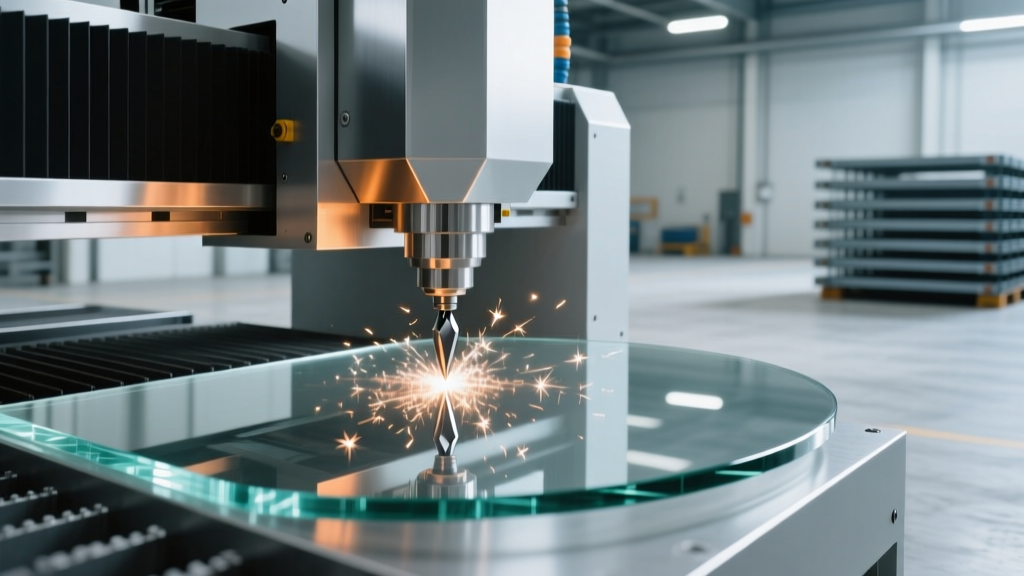
The core innovation enabling complex CNC glass machining today is ultrasonic-assisted milling. By superimposing a high-frequency, low-amplitude oscillation onto the rotational movement of the cutting tool, the cutting mechanism shifts from continuous shearing to intermittent micro-chipping. This drastically reduces the cutting forces exerted on the brittle glass matrix.
Spindle and Amplitude Specifications
According to recent technical benchmarks published by DMG MORI's Ultrasonic division, modern glass-machining spindle systems operate at frequencies between 20 kHz and 40 kHz. The critical parameter for glass is the amplitude, which must be strictly maintained between 4 µm and 10 µm. If the amplitude exceeds 12 µm, the tool induces macro-fractures; if it drops below 3 µm, the process reverts to conventional milling, causing rapid diamond tool wear and thermal shock.
- Spindle Interface: HSK-E40 or HSK-A50 (required for high-speed concentricity).
- RPM Range: 18,000 to 32,000 RPM.
- Bearing Type: Sealed ceramic hybrid bearings to prevent abrasive glass dust ingress.
- Oscillation Generator: Piezoelectric transducers integrated directly into the tool holder.
Advanced Diamond Tooling Matrix for 2026
Standard carbide end mills are entirely obsolete for CNC glass machining. Even standard PCD (Polycrystalline Diamond) tools struggle with the abrasive wear caused by the silica matrix. The current industry standard relies on CVD (Chemical Vapor Deposition) thick-film diamond coatings and electroplated diamond profile wheels. Selecting the correct grit size and bond type is non-negotiable for achieving optical-grade edges without secondary polishing steps.
| Operation | Tool Type & Coating | Grit Size / Layer | Feed Rate (mm/min) | Depth of Cut (ap) |
|---|---|---|---|---|
| Roughing (3D Contour) | CVD Diamond End Mill | 12 µm - 15 µm layer | 800 - 1,200 | 0.5 mm - 1.0 mm |
| Semi-Finishing | Electroplated Diamond Pin | D76 (Mesh 200/230) | 1,500 - 2,000 | 0.1 mm - 0.2 mm |
| Finishing / Polishing | Resin-Bond Diamond Wheel | D15 (Mesh 1000+) | 2,500 - 3,500 | 0.02 mm - 0.05 mm |
| Drilling (Micro-holes) | Sintered Diamond Core Drill | D46 (Mesh 325/400) | Peck cycle: 0.2mm | Full thickness |
Coolant Chemistry and Micro-Filtration Protocols
In CNC glass machining, the coolant does more than dissipate heat; it manages the chemical stability of the glass surface and flushes away highly abrasive silica swarf. Using standard water-soluble cutting fluids designed for aluminum or steel will cause severe alkali leaching, resulting in a cloudy, etched surface finish on the glass.
Critical Warning: Coolant pH Management
Maintain your synthetic glass coolant pH strictly between 8.5 and 9.2. If the pH drops below 8.0, the fluid becomes acidic enough to etch borosilicate surfaces. If it rises above 9.5, it will attack the cobalt or nickel binders in your diamond tooling, causing premature grit shedding. Use a digital pH meter calibrated weekly, not litmus paper.
Furthermore, filtration is paramount. Glass dust acts as a lapping compound. If recirculated, it will embed into the resin-bond polishing wheels and scratch the workpiece. Modern CNC glass cells, such as those highlighted in USGlass Magazine's recent fabrication technology reports, utilize multi-stage centrifugal separators paired with 5-micron absolute paper band filters to ensure the coolant remains optically clear.
High-Pressure Through-Tool Delivery
For deep-hole drilling and deep-pocket milling in thick quartz blocks, flood coolant is insufficient. You must utilize through-spindle coolant (TSC) delivered at a minimum of 70 bar (1,000 PSI). This pressure is required to eject the glass slurry from the cutting zone before it can fuse to the diamond coating under localized friction heat.
Troubleshooting Sub-Surface Damage and Edge Chipping
Even with 5-axis capabilities and ultrasonic assistance, process deviations will manifest as sub-surface damage (SSD) or exit-edge chipping. SSD is particularly insidious because it is invisible to the naked eye but will cause the glass component to shatter under thermal or mechanical load in the field. Below is a diagnostic matrix for the most common CNC glass machining defects.
| Symptom | Root Cause | Corrective Action |
|---|---|---|
| Exit-edge blowout (chipping on the bottom side of a drilled hole) | Tool breaking through the final glass layer with full downward feed force. | Implement a 'breakthrough' peck cycle: reduce Z-axis feed rate by 80% for the final 0.5mm of material, or use a sacrificial backer board. |
| Cloudy, frosted surface finish after finishing pass | Coolant contamination (glass dust acting as lapping abrasive) or worn resin-bond wheel. | Check filtration system for bypass leaks. Dress the resin-bond diamond wheel with a silicon carbide stick to expose fresh grit. |
| Micro-cracking visible under polarized light (High SSD) | Amplitude on ultrasonic spindle dropped below 3 µm, or depth of cut (ap) exceeded tool deflection limits. | Recalibrate piezoelectric generator. Reduce ap by 30% and increase spindle RPM to maintain chip thinning. |
| Rapid tool wear (CVD coating flaking off) | Thermal shock from intermittent coolant flow or pH > 9.5 attacking the carbide substrate beneath the coating. | Ensure continuous TSC flow before spindle engagement. Test and buffer coolant pH immediately. |
Future Outlook: Laser-Assisted CNC Integration
As we look toward the next iteration of fabrication technology, specialized glass machinery manufacturers like LiSEC and advanced research labs are pioneering laser-assisted CNC glass machining. By directing a CO2 or ultrafast femtosecond laser precisely ahead of the diamond cutting edge, the glass is locally heated above its strain point. This localized thermal softening allows the mechanical tool to shear the glass rather than fracture it, effectively eliminating sub-surface damage entirely. While currently limited to high-end aerospace optics due to the $800,000+ price tag of integrated laser-CNC cells, this hybrid approach represents the definitive future of brittle material machining.
For fabricators upgrading their floor in 2026, the immediate priority should be securing 5-axis ultrasonic capabilities, implementing strict 5-micron coolant filtration, and transitioning to CVD diamond tooling. Mastering these three pillars will separate high-yield, precision glass machinists from those still struggling with the limitations of 20th-century edging lines.