2026 Cost Guide: CNC Laser Cutting Machine Sheet Metal
Detailed 2026 cost analysis for CNC laser cutting machine sheet metal operations, covering CapEx, OpEx, assist gases, and ROI frameworks for fabricators.
Capital Expenditure (CapEx): Machine Pricing Tiers
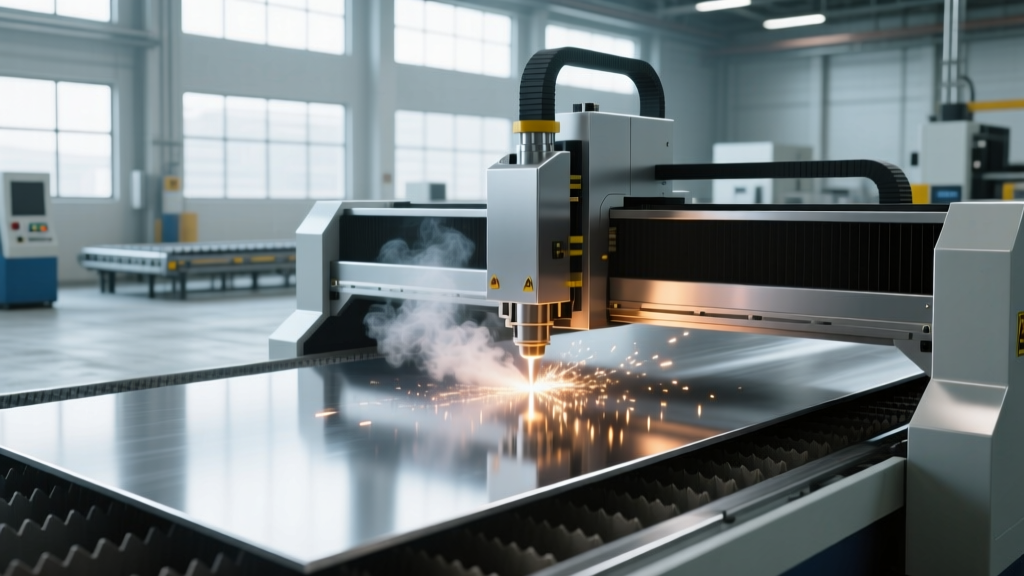
Procuring a CNC laser cutting machine for sheet metal fabrication requires a precise understanding of current capital markets. As of 2026, fiber laser technology has completely eclipsed CO2 systems for sheet metal processing, driven by the dominance of solid-state resonators from manufacturers like IPG Photonics and nLIGHT. Budgeting for these systems must account for the power tier required for your specific material thickness and throughput demands.
| Power Tier | Resonator Type | Estimated CapEx (Machine Only) | Optimal Material Application |
|---|---|---|---|
| 3kW - 4kW | Fiber | $120,000 - $180,000 | Thin gauge (up to 10ga / 3mm) steel, aluminum, brass. |
| 6kW - 8kW | Fiber | $250,000 - $380,000 | Mid-range (up to 1/2 in / 12mm) mild and stainless steel. |
| 12kW - 15kW | Fiber | $450,000 - $650,000 | Thick plate (up to 1 in / 25mm), high-speed thin gauge. |
| 20kW+ | Fiber | $800,000 - $1,200,000+ | Heavy plate (1.5 in+), extreme throughput environments. |
Beyond the base machine cost, fabricators must allocate an additional 15% to 20% of the CapEx budget for facility preparation. This includes installing dedicated 480V/3-phase electrical drops, reinforced concrete foundations to maintain micron-level gantry tolerances, and specialized HVAC climate control for the electronics cabinet.
The Hidden OpEx: Where Budgets Actually Bleed
The purchase price of a CNC laser cutting machine is only the entry fee. Operating expenses (OpEx) dictate long-term profitability, and assist gas consumption remains the most volatile variable in sheet metal laser cutting economics.
Warning: The High-Pressure Air Compressor TrapMany shops attempt to offset the high cost of bulk liquid nitrogen by investing $40,000 to $60,000 in a high-pressure rotary screw compressor (e.g., Kaeser or Atlas Copco) to cut stainless and aluminum with compressed air. While this drops gas OpEx to nearly zero, compressed air cutting produces an oxidized edge that requires secondary grinding or sanding before powder coating or welding. Always factor the labor cost of edge-deburring into your compressed air ROI calculations.
Assist Gas Economics: Nitrogen vs. Oxygen
When processing stainless steel and aluminum, high-purity nitrogen is mandatory to achieve an oxide-free edge. A 12kW fiber laser cutting 1/2-inch aluminum can consume upwards of 2,500 standard cubic feet per hour (SCFH). At a bulk liquid nitrogen rate of $0.06 per SCFH, the gas cost alone is $150 per hour of beam-on time. Conversely, cutting mild steel with oxygen requires significantly lower gas volume (typically 50-150 SCFH) and lower pressure, making oxygen assist highly economical despite the slower pierce times on thick plate.
Consumables and Optics Depreciation
Modern cutting heads, such as the Precitec ProCutter or Raytools BM114, utilize auto-focus and capacitive height sensing. While these reduce setup time, their replacement costs are steep. A complete cutting head replacement can exceed $15,000. Daily consumables include ceramic rings ($3-$8), copper nozzles ($2-$12 depending on single or double layer), and protective lower windows ($20-$45). A well-managed 6kW machine should budget approximately $1.50 to $2.50 per hour for standard optical consumables.
Calculating True Cost-Per-Part: A 2026 Framework
To establish accurate quoting models, fabricators must move beyond simple machine-hour rates. The true cost-per-part framework requires synthesizing beam-on time, pierce time, material utilization, and nesting efficiency. According to industry analysis from The Fabricator, shops that ignore pierce-time penalties on thick materials frequently underquote complex parts by 15% to 20%.
Scenario: 6kW Machine Cutting 1/4-Inch Mild Steel
- Material Cost: 1/4-inch HRPO steel at $45.00 per hundredweight (CWT).
- Machine Rate: $95.00/hour (inclusive of labor, overhead, and machine depreciation).
- Gas & Consumables: $12.00/hour (Oxygen assist).
- Nesting Efficiency: 82% material utilization (18% skeleton waste).
If a nested sheet takes 14 minutes of beam-on time and 3 minutes of pierce/repositioning time, the total machine cost is $25.88. However, because 18% of the sheet is scrapped, the effective material cost per usable part increases by a factor of 1.22. Advanced nesting software like SigmaNEST or ProNest utilizes true-shape nesting and offcut management to push utilization above 88%, directly impacting the bottom line.
Automation and Material Handling Add-Ons
Manual loading and unloading of 4x8 or 5x10 sheet metal creates a bottleneck that starves high-power resonators. Automating material handling is no longer optional for shops running 12kW+ machines. Budgeting for automation requires evaluating the following systems:
- Shuttle Tables (Pallet Changers): Standard on most mid-range machines. Cost is usually baked into the base price, allowing load/unload while the machine cuts. Adds zero footprint but requires manual forklift loading.
- Tower Storage Systems: Automated raw material and cut-part sorting towers (e.g., Bystronic ByTower, Trumpf STOPA). CapEx adder: $150,000 - $300,000. Essential for lights-out manufacturing.
- Automated Load/Unload Arms: Vacuum cup or fork-based systems that move single sheets from a pallet to the cutting bed. CapEx adder: $80,000 - $120,000.
When evaluating automation, calculate the labor savings against the maintenance footprint. Automated sorting systems require dedicated compressed air lines, sensor calibration, and specialized programming time to ensure parts do not tip or collide during extraction.
Software, Nesting, and Digital Twin Integration
The physical fiber laser cutting technology is only as efficient as the G-code driving it. Budgeting for a CNC laser cutting machine must include the software stack. Basic OEM software is often included, but enterprise-level nesting and ERP integration require third-party licenses.
Expect to pay $12,000 to $25,000 for a perpetual license of advanced nesting software, plus an annual maintenance fee of 15% to 20%. These platforms offer features like kerf-width compensation, lead-in/lead-out optimization, and micro-joint tabbing, which prevent cut parts from tilting and crashing into the cutting head—a single collision that can result in $5,000 to $20,000 in immediate repair costs.
Strategic Budget Allocation Summary
Capital allocation for sheet metal laser cutting requires a holistic view of the fabrication ecosystem. A $400,000 budget for a 6kW machine is insufficient if it does not reserve $75,000 for a high-pressure air compressor, $20,000 for nesting software, and $40,000 for initial facility electrical upgrades. By mapping CapEx against true OpEx variables like assist gas volatility and consumable degradation, fabricators can build resilient financial models that maintain margins regardless of material market fluctuations.