Noise & Vibration Damping Alternatives for Affordable CNC Machines
Compare passive, active, and mechanical vibration damping alternatives to reduce noise and chatter on affordable CNC machines.
The Acoustic Reality of Budget CNC Routing
When investing in an affordable CNC machine, buyers typically accept trade-offs in rigidity and mass. Desktop and benchtop routers (such as the Shapeoko 4, X-Carve, or entry-level Taig models) utilize aluminum extrusions, MDF wasteboards, and lightweight steel gantries. While this keeps the price point under $5,000, it creates a severe acoustic and vibrational liability. Without the 2,000+ lb cast-iron mass of a vertical machining center (VMC) to absorb kinetic energy, budget CNCs routinely generate 85 to 95 decibels (dBA) at the operator's ear during heavy 2D profiling or 3D roughing.
Beyond the discomfort, this noise level violates occupational safety thresholds. According to OSHA's occupational noise exposure standards, an 8-hour time-weighted average (TWA) of 85 dBA mandates a formal hearing conservation program. Furthermore, the vibrations that cause this noise also manifest as tool chatter, reducing bit life and degrading surface finishes. Below, we compare the most effective damping alternatives—ranging from passive isolation to mechanical source-control—specifically engineered for the lightweight frames of affordable CNC machines.
⚠️ Safety Warning: Acoustic foam and Mass Loaded Vinyl (MLV) are frequently confused. Foam absorbs high-frequency reverberation inside an enclosure but does virtually nothing to block low-frequency structural vibration. For actual noise isolation on a budget CNC, mass and decoupling are mandatory.Passive Damping Alternatives: A Comparative Matrix
Passive damping focuses on decoupling the machine from the floor or adding mass to the frame to shift its resonant frequency below the operational range of the stepper motors. Here is how the top alternatives compare for lightweight CNC frames.
| Alternative Material | Primary Function | Estimated Cost | Effectiveness (Low-Freq) | Installation Effort |
|---|---|---|---|---|
| Sorbothane Hemispheres (50A) | Vibration Decoupling | $40 - $60 (set of 4) | High | Low |
| Mass Loaded Vinyl (2 lb/sqft) | Acoustic Blocking | $1.50 - $2.50 / sq ft | Medium-High | Medium |
| Epoxy Granite Fill | Mass Addition / Damping | $80 - $120 per extrusion | Very High | High (Curing time) |
| High-Density Neoprene (70A) | Shock Absorption | $20 - $30 (sheet) | Low-Medium | Low |
Deep Dive: Sorbothane vs. Neoprene for Base Isolation
Many hobbyists place standard rubber or neoprene mats under their affordable CNC machines. This is a fundamental engineering error. Neoprene (typically 70A durometer) is too stiff to isolate the low-frequency vibrations (20-50 Hz) generated by CNC spindle harmonics and stepper motors. It merely acts as a non-skid pad.
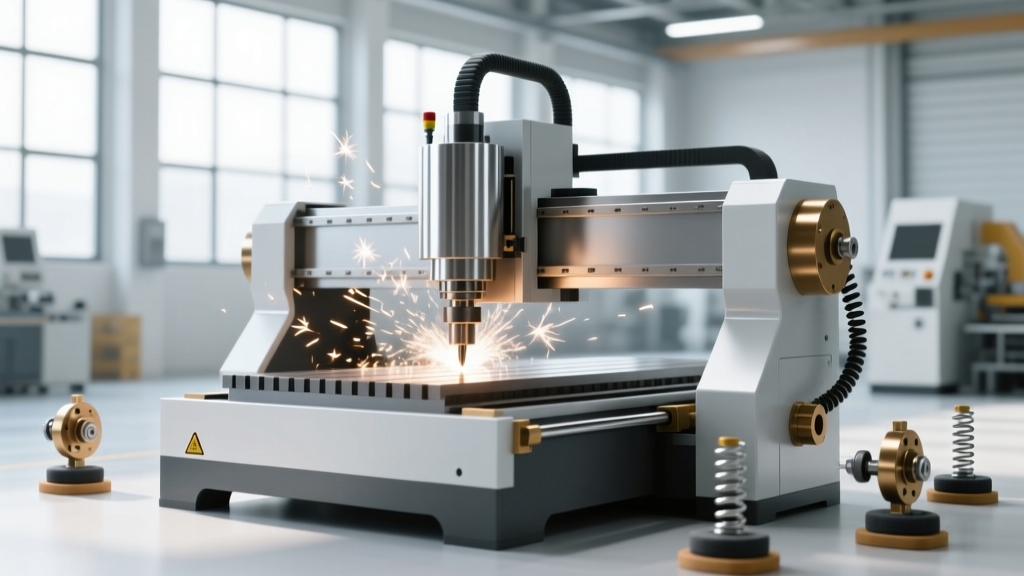
Sorbothane, a proprietary viscoelastic polyurethane, is the superior alternative. According to Sorbothane's engineering data, the material boasts a damping coefficient (tan delta) exceeding 0.20, meaning it dissipates over 20% of vibrational energy as heat per cycle. For a standard 150-lb desktop CNC router, using four 2-inch diameter, 50-durometer Sorbothane hemispheres (rated for 30-45 lbs each) will drop the transmitted floor vibration by up to 80%. The critical metric here is static deflection; you must calculate the exact weight of your machine to select the correct durometer, ensuring the pads compress by 10% to 15% under load.
The Epoxy Granite Alternative for Aluminum Extrusions
If your affordable CNC machine relies on 1530 or 2040 aluminum extrusions for the base, the frame lacks internal damping. Aluminum rings like a bell when struck. The most aggressive alternative is filling the extrusion channels with an epoxy granite composite.
- The Recipe: Mix 1 part 100% solids, low-viscosity epoxy (e.g., System Three SilverTip) with 4 parts graded silica sand (by weight).
- The Process: Cap the ends of the extrusions, drill injection holes, and slowly pour the mixture, using a vibration table or orbital sander pressed against the metal to eliminate air pockets.
- The Result: This increases the mass of the base by up to 300% and introduces massive internal friction. The composite's damping capacity is roughly 10 times greater than cast iron, effectively killing high-frequency chatter before it reaches the spindle.
Acoustic Enclosures: MLV vs. Acoustic Foam
When passive base damping isn't enough to protect the operator's hearing, an enclosure becomes necessary. The CDC's NIOSH guidelines on occupational noise emphasize engineering controls (like enclosures) over administrative controls. However, building an enclosure for a CNC router requires navigating the physics of sound transmission.
💡 Pro-Tip: The Decoupled MLV SandwichDo not glue Mass Loaded Vinyl (MLV) directly to the rigid walls of your CNC enclosure. Sound will bypass the MLV via structural flanking. Instead, build a double-wall enclosure with a 1-inch air gap, and hang the MLV on flexible bungee cords or specialized acoustic hangers inside the gap. This 'room-within-a-room' approach yields a Sound Transmission Class (STC) rating of 35+, dropping a 95 dB router down to a safe 60 dB outside the box.
Acoustic Foam (Open-Cell Polyurethane): Costs roughly $1.00/sq ft. Excellent for stopping the 'pinging' echoes of endmills cutting aluminum inside the enclosure, but provides zero sound isolation. Use it only as an interior lining after mass has been addressed.
Mass Loaded Vinyl (2 lb/sqft): Costs roughly $2.00/sq ft. Limp and dense, MLV acts as an acoustic barrier. A 2 lb/sqft sheet provides an STC of ~27. It is mandatory for blocking the low-frequency hum of router motors and dust collection vacuums.
Mechanical Alternatives: Solving Vibration at the Source
Damping the frame and enclosing the machine are reactive measures. The most effective alternatives address the vibration at the source: the drive system. Budget CNC machines predominantly use open-loop NEMA 23 stepper motors, which suffer from severe mid-band resonance.
Stepper Motor Harmonic Dampers
Open-loop stepper motors experience a drastic drop in torque and a spike in vibration between 150 and 300 RPM. This is a mechanical resonance caused by the rotor overshooting the magnetic stator field. If your CAM software forces the machine to accelerate through this zone slowly, the entire gantry will shake violently.
The Alternative: Install a mechanical harmonic damper (such as the US Digital STP-FLD series) on the rear shaft of the stepper motor. These devices use internal friction rings to absorb the kinetic overshoot, flattening the torque curve and eliminating the 150-300 RPM vibration spike. They cost roughly $35 per axis and require no software tuning.
The Closed-Loop Stepper Upgrade
If harmonic dampers are a band-aid, closed-loop stepper motors are the cure. Upgrading an affordable CNC machine to closed-loop steppers (like the Leadshine iHSV57 series, currently priced around $75-$95 per axis in 2026) fundamentally changes the machine's acoustic profile.
- Resonance Elimination: The integrated encoder allows the driver to apply field-oriented control (FOC), smoothing the current delivery and eradicating mid-band resonance.
- Idle Noise Reduction: Open-loop steppers draw full current even when stationary, causing a loud, high-pitched whine and significant heat. Closed-loop systems drop current to near-zero when idle, making the machine silent between toolpaths.
- Stall Prevention: If the cutter hits a hard knot in oak or aluminum, an open-loop motor will silently lose steps, ruining the part. A closed-loop motor will either push through the load or trigger an E-stop alarm, saving your material.
Decision Framework: Which Alternative Should You Choose?
Selecting the right combination of damping alternatives depends on your specific shop environment, budget, and the materials you machine. Use this framework to prioritize your upgrades:
- Scenario A: Apartment / Shared Workspace (Strict Noise Limits)
Priority: Full Enclosure with decoupled MLV + Sorbothane base isolation. You must block airborne noise and prevent structure-borne vibration from traveling through the floor joists to neighbors below. - Scenario B: Garage Shop (Chatter & Poor Surface Finishes)
Priority: Epoxy Granite extrusion fill + Closed-loop stepper upgrade. Your primary enemy is tool chatter ruining edge profiles, not airborne noise. Adding frame mass and eliminating stepper resonance will yield VMC-like surface finishes on a budget frame. - Scenario C: Low Budget (<$100) Immediate Relief
Priority: 50-Durometer Sorbothane hemispheres + Mechanical harmonic dampers on the X/Y axes. This combination costs under $90, takes 20 minutes to install, and will reduce floor-transmitted vibration and mid-range motor buzzing by over 60%.
Ultimately, an affordable CNC machine does not have to remain a loud, chattering liability. By understanding the physics of structural resonance and selecting the correct damping alternatives—rather than relying on generic rubber mats or ineffective foam—you can transform a budget router into a precision, shop-friendly manufacturing tool.