CNC Machine Examples: Industrial vs Consumer Technical Specs
Compare industrial and consumer CNC machine examples. We analyze spindle torque, ballscrew classes, controller look-ahead, and rigidity specs.
The Mechanical Divide: Evaluating CNC Machine Examples Across Market Tiers
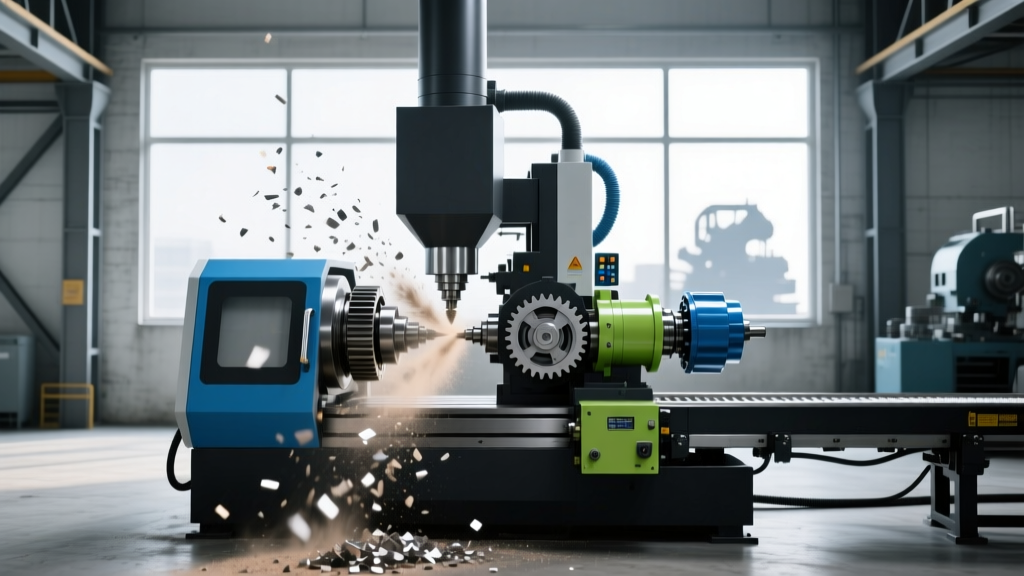
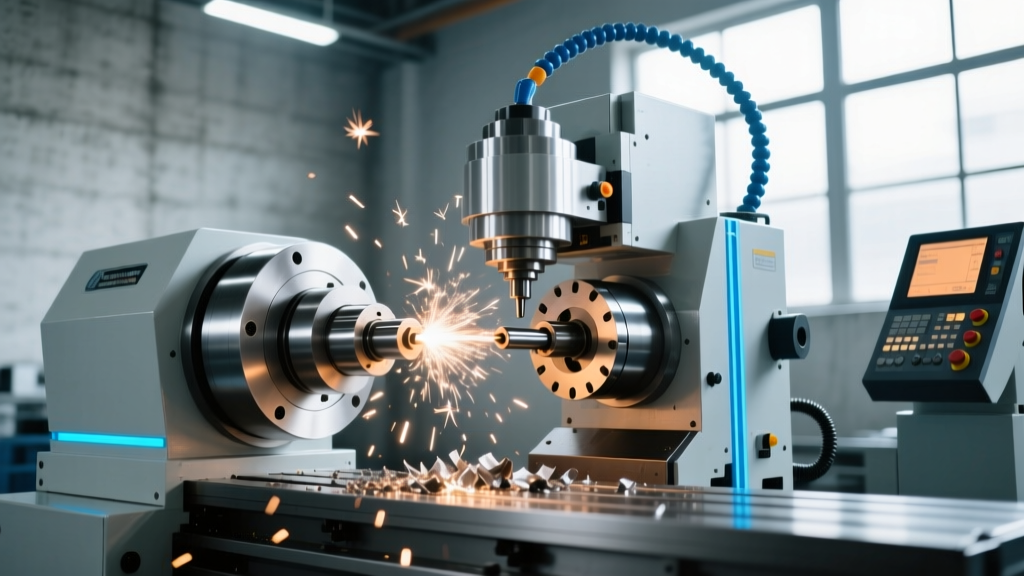
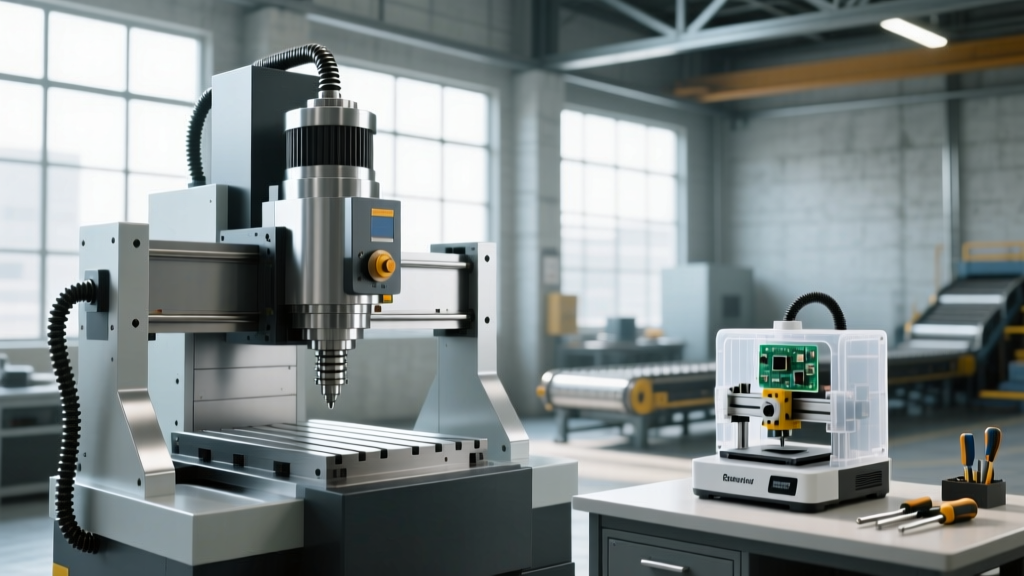
When sourcing cnc machine examples for a production floor versus a prototyping garage, the divergence in mechanical engineering becomes immediately apparent. The distinction between industrial vertical machining centers (VMCs) and consumer-grade desktop routers is not merely a matter of scale; it is defined by fundamental differences in kinematics, metallurgical damping, control architecture, and thermal stability. As of 2026, the market has seen prosumer machines encroach on light industrial territory, yet the physics of heavy metal removal remains strictly governed by mass and precision ground components.
Core Engineering Divergence
Industrial VMCs prioritize continuous duty cycles, sub-micron repeatability, and high-torque cutting forces. Consumer CNCs prioritize footprint, accessibility, and rapid setup, sacrificing torsional rigidity and low-RPM torque to achieve a lower entry price.
Chassis Rigidity and Metallurgical Damping
The foundation of any CNC machine is its chassis. Industrial machines, such as the Haas VF-2, utilize heavily ribbed Meehanite cast iron. Cast iron possesses a high damping coefficient, meaning it absorbs the high-frequency vibrations generated during aggressive milling operations. This prevents chatter, which otherwise destroys surface finish and accelerates carbide tool wear.
Conversely, consumer machines like the Shapeoko or X-Carve rely on 6061-T6 extruded aluminum profiles bolted together with steel brackets. While aluminum is stiff by weight, it lacks the internal damping characteristics of cast iron. When a consumer CNC encounters the interrupted cut of a steel workpiece, the extruded frame resonates. This harmonic vibration forces the operator to drastically reduce feed rates and depth of cut to maintain tool life.
Thermal Growth and Stability
Industrial machines account for thermal expansion. A 40-inch steel ballscrew can grow over 0.005 inches when heated by friction and ambient shop temperatures. Industrial VMCs utilize pretensioned ballscrews—anchored with heavy-duty bearing blocks and stretched during assembly to counteract thermal expansion. Consumer machines leave screws untensioned, meaning a two-hour milling job will yield different Z-depths at the start than at the end due to ambient thermal drift.
Motion Systems: Ground vs. Rolled Ballscrews
The mechanism translating rotary motor motion into linear axis movement dictates the machine's positioning accuracy and backlash.
| Specification | Industrial VMC (e.g., Haas VF-2) | Prosumer Mill (e.g., Tormach 1100MX) | Consumer Router (e.g., Shapeoko 5) |
|---|---|---|---|
| Drive Mechanism | C3 Ground Ballscrews | C5/C7 Rolled Ballscrews | Acme Lead Screws / Belts |
| Linear Guidance | Preloaded THK/Hiwin Linear Rails | Linear Guides (Light Preload) | V-Wheels on Extruded Aluminum |
| Backlash | < 0.0002 in (Double-nut preloaded) | ~ 0.0005 in | 0.002 in - 0.005 in |
| Repeatability | ± 0.0001 in | ± 0.0005 in | ± 0.002 in |
| Rapid Traverse | 1,000+ IPM | 300 IPM | ~ 150 IPM (Limited by stepper torque) |
Ground ballscrews (C3 class) are manufactured by grinding the thread profile, yielding extreme accuracy and smooth operation under heavy axial loads. Rolled ballscrews (C7 class), found in machines like the Tormach 1100MX, are formed by pressing, which is cheaper but introduces microscopic surface irregularities that increase friction and limit load capacity. Consumer machines often use TR8 acme lead screws or Kevlar-reinforced belts, which inherently suffer from higher friction, stiction, and elastic stretch under load.
Spindle Architecture and Torque Curves
Cutting force is a function of spindle torque at the working RPM. According to Sandvik Coromant's milling technical guidelines, machining hard metals like 4140 steel or titanium requires high torque at low RPMs (1,000 - 3,000 RPM) to maintain proper chip thickness without stalling the cutter.
- Industrial Vector Drives: A 30-horsepower vector spindle on an industrial VMC delivers peak torque (often exceeding 100 ft-lbs) starting as low as 500 RPM, maintaining a flat torque curve up to base speed. This allows the use of large diameter face mills and rigid tapping.
- Consumer High-Frequency Spindles: Consumer routers typically use brushed or brushless DC trim routers (e.g., Makita or Carbide 3D VFD spindles). These generate 1.25 to 2.5 HP but rely on high RPM (18,000 - 30,000) to achieve their rated power. At 3,000 RPM, their torque drops to near zero, making them physically incapable of driving a 2-inch face mill through steel without stalling or breaking the drive belt.
Controller Look-Ahead and Kinematic Processing
The physical hardware is only half the equation; the CNC controller's ability to process G-code dictates surface finish on complex 3D contours.
Block Processing and Jerk Control
Industrial controllers (Fanuc, Haas NGC, Siemens Sinumerik) process upwards of 1,000 to 2,000 blocks of G-code per second. More importantly, they utilize advanced S-curve acceleration profiles and 'jerk' limiting. Jerk is the rate of change of acceleration. By mathematically smoothing the transitions between micro-segments in a 3D toolpath, the industrial controller prevents sudden directional shocks that cause dwell marks on the workpiece.
Consumer controllers, typically running GRBL or basic Mach3/4 profiles, process between 30 and 100 blocks per second. They lack sophisticated jerk control, relying on simple trapezoidal acceleration. When machining complex 3D molds consisting of thousands of 0.001-inch line segments, consumer controllers frequently starve the motion planner, resulting in micro-pauses, stepper motor resonance, and visible faceting on the finished part.
Real-World Failure Modes: Pushing Consumer Machines to Industrial Limits
Attempting to run industrial-grade toolpaths on consumer hardware results in specific, predictable failure modes:
Common Edge Cases and Hardware Failures
- V-Wheel Flat Spotting: Under the continuous lateral load of milling aluminum, Delrin V-wheels compress and develop flat spots, introducing cyclical Z-axis wobble.
- Stepper Stalling (Lost Steps):strong> Unlike industrial closed-loop AC servos, consumer open-loop steppers cannot detect when they miss a step due to cutting forces exceeding holding torque. This results in scrapped parts with shifted coordinate systems.
- Spindle Bearing Seizure: Consumer router spindles are designed for light wood dust, not the heavy, abrasive swarf generated by milling cast iron or steel. Chip intrusion rapidly destroys the unsealed cartridge bearings.
Decision Framework: Sizing the Machine to the Application
Selecting between industrial and consumer CNC machine examples requires mapping your production requirements to the machine's physical limits.
Choose Consumer/Prosumer CNCs when:
- Materials are strictly non-ferrous (woods, plastics, soft aluminums like 6061).
- Tolerances are held to ±0.005 inches or looser.
- Spindle utilization is under 4 hours per day.
- Capital expenditure must remain under $15,000.
Mandate Industrial VMCs when:
- Machining hardened steels, stainless alloys, or titanium.
- Running automated pallet changers or unattended lights-out manufacturing.
- Holding tight geometric dimensioning and tolerancing (GD&T) true position callouts within ±0.0005 inches.
- Utilizing high-pressure through-spindle coolant (TSC) at 300+ PSI to evacuate chips from deep cavities.
Ultimately, while consumer machines offer unparalleled accessibility for makers and light prototyping, the physics of metal removal demand the mass, preloaded kinematics, and computational power found only in true industrial machinery.