Troubleshooting Coolant Leaks in American Made CNC Machines
Expert guide to diagnosing and repairing coolant leaks and enclosure seal failures in American made CNC machines like Haas and Hurco. Get actionable fixes.
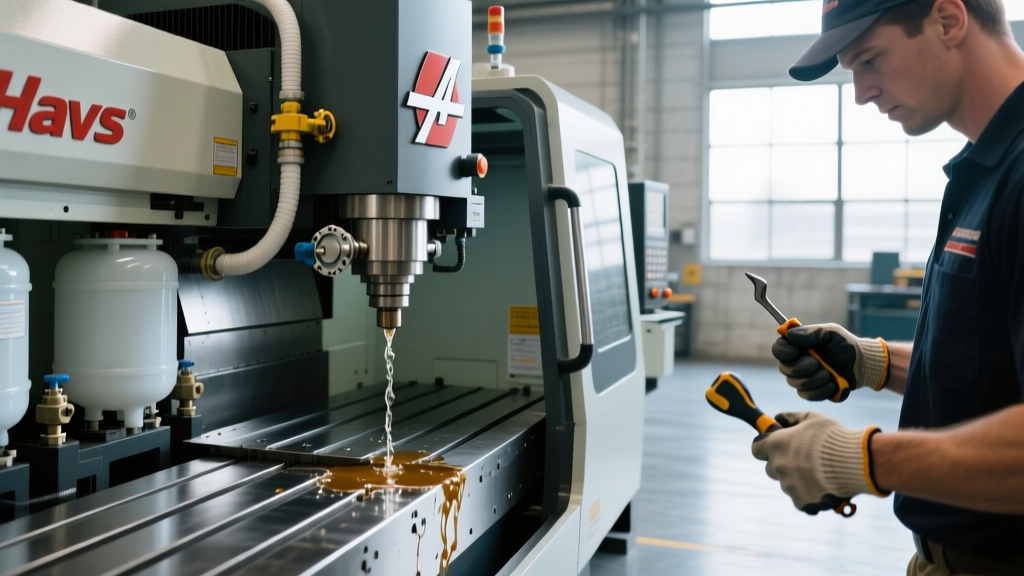
Coolant containment and enclosure integrity are critical for maintaining uptime on domestic vertical and horizontal machining centers. When American made CNC machines like the Haas VF-2SS or Hurco VMX50i develop leaks, the resulting fluid ingress into linear guideways, ball screws, or electrical cabinets can cause $10,000+ in catastrophic damage. Furthermore, escaping coolant mist poses severe respiratory risks, strictly regulated under OSHA guidelines on metalworking fluids. This guide provides exact diagnostic pathways, material specifications, and repair protocols for enclosure and coolant system failures on US-manufactured equipment.
Symptom-to-Failure Diagnostic Matrix
Before ordering replacement parts, isolate the exact failure point using this diagnostic matrix. Misdiagnosing a way cover leak as a door seal failure is a common error that wastes 48+ hours of downtime.
- Symptom: Coolant pooling on the shop floor near the X-axis motor.
Root Cause: Telescopic steel way cover wiper seal degradation or chip packing under the cover.
Immediate Fix: Retract axis fully, clean the way cover mating surface, and inspect the polyurethane wiper lips for tearing. - Symptom: Fine aerosol mist escaping the main operator door during high-pressure through-spindle coolant (TSC) cycles.
Root Cause: Door bulb seal compression set failure or negative pressure failure in the enclosure exhaust fan.
Immediate Fix: Perform the "paper test" (close door on a strip of paper; if it pulls out easily, the seal lacks compression). Replace with Shore A 40 EPDM bulb seal. - Symptom: Low coolant pressure alarm (e.g., Haas Alarm 114) despite full sump.
Root Cause: Pump inlet strainer clogged with tramp oil sludge, causing cavitation, or impeller wear.
Immediate Fix: Drop the sump pan, clean the 40-mesh stainless inlet screen, and check pump impeller clearance (must be <0.015").
Way Cover and Bellows Containment Repair
American made CNC machines typically utilize either 1018 cold-rolled steel telescopic way covers or polyurethane-coated fabric bellows for axis protection. Both are highly susceptible to chip-induced abrasion.
Telescopic Steel Cover Wiper Replacement
The wiper seals on steel way covers prevent coolant from migrating between the nested steel boxes. When these fail, coolant reaches the precision ground ball screws. Pro-Tip: Never use standard nitrile rubber for way cover wipers on machines running synthetic coolants. Synthetics lack the lubricity of semi-synthetic fluids and will cause nitrile to dry out and crack within 3 months. Always specify Viton (FKM) or high-grade polyurethane wipers for synthetic environments. Replacement Protocol:
- Lock out/tag out the machine and block the axis mechanically.
- Remove the way cover assembly (typically 4-6 M8 socket head cap screws on the mounting flange).
- Peel back the degraded wiper. Clean the aluminum retaining channel with isopropyl alcohol.
- Apply a 2mm bead of Loctite 495 (or equivalent cyanoacrylate) to the new wiper base and press firmly into the channel. Allow 10 minutes to cure before reinstallation.
Fabric Bellows Patching vs. Replacement
For machines utilizing fabric bellows (common on older Fadal or Hurco models), small punctures from sharp stringy chips (like 304 stainless or Inconel) can be temporarily patched. Use a two-part marine-grade epoxy (e.g., Marine-Tex) mixed with a fiberglass mesh patch. However, if the internal PVC stiffeners are fractured, the bellows will collapse under rapid traverse (G00) movements, requiring full replacement. As of early 2026, OEM lead times for proprietary bellows assemblies average 3-4 weeks, making aftermarket suppliers like Dynatect essential for rapid turnaround.
Enclosure Door Seal Material Selection
The operator door and side access panels rely on continuous compression seals to maintain negative pressure and contain mist. According to the CDC NIOSH criteria for metalworking fluid exposure, maintaining enclosure integrity is the primary engineering control for operator safety. Selecting the wrong seal durometer or material will result in rapid failure.
| Material | Best Application | Shore A Durometer | Coolant Compatibility | Est. Cost (per ft) |
|---|---|---|---|---|
| EPDM Rubber | Main operator doors, large gaps | 40 - 50 | Excellent for water-based synthetics & semi-synthetics | $4.50 - $6.00 |
| Nitrile (Buna-N) | Chip conveyor access doors | 60 - 70 | Good for straight oils and heavy duty semi-synthetics | $3.00 - $4.50 |
| Viton (FKM) | High-temp zones near spindle head | 70 - 80 | Required for aggressive solvents and high-temp oils | $12.00 - $18.00 |
| Silicone Sponge | Electrical cabinet doors | 30 - 40 | Poor coolant resistance; use only for dust/air sealing | $8.00 - $11.00 |
Coolant Pump Cavitation and Delivery Troubleshooting
Enclosure leaks are often secondary symptoms of coolant delivery issues. If the pump is cavitating, it creates micro-bubbles that expand when hitting the high-pressure TSC union inside the spindle, blowing coolant past the labyrinth seals and into the enclosure air space.
Diagnosing Cavitation
Listen to the coolant pump motor. A steady hum indicates normal operation. A sound resembling gravel passing through the pump housing indicates cavitation. Step-by-step resolution:
- Check Concentration: Use a digital refractometer. For standard semi-synthetic fluids (like TRIM MicroSol 585XT), target a Brix reading of 6.0% to 8.0%. If the reading is below 4.0%, the fluid lacks the necessary surface tension inhibitors, promoting foaming and cavitation.
- Inspect the Skimmer: Tramp oil alters the fluid's surface tension. Ensure the belt or disc skimmer is running continuously during non-cutting cycles. If tramp oil exceeds 2% of the sump volume, perform a complete sump dump and clean.
- Verify Inlet Plumbing: The suction line from the sump to the pump must be at least 1.5" ID for standard 1HP flood coolant pumps. Any restriction or air leak on the suction side will draw air into the impeller. Apply shaving cream to suction fittings; if the cream is sucked into a joint, you have an air leak.
OEM vs. Aftermarket Parts Sourcing (2026 Pricing)
When repairing American made CNC machines, maintenance managers must weigh the precision of OEM parts against the cost and speed of aftermarket alternatives. While Haas Automation's official service portal guarantees exact fitment, third-party suppliers often provide upgraded materials at lower costs.
| Component | OEM Sourcing (Avg. Cost) | Aftermarket Sourcing (Avg. Cost) | Recommendation |
|---|---|---|---|
| X-Axis Telescopic Way Cover Assy | $950 - $1,400 | $450 - $650 (Dynatect / Hema) | Use Aftermarket for older machines (5+ years); OEM for new machines under warranty. |
| Main Door Bulb Seal (50ft roll) | $220 ($4.40/ft) | $140 ($2.80/ft - McMaster-Carr) | Always Aftermarket. EPDM specs are identical; OEM markup is unnecessary. |
| Flood Coolant Pump (1HP, 3-Phase) | $680 - $850 | $320 - $450 (Brinkmann / Grundfos) | OEM if plug-and-play wiring is required; Aftermarket if shop has an electrician. |
| Spindle Labyrinth Air Seal Kit | $180 - $250 | Not Recommended | Strictly OEM. Spindle tolerances require exact factory spec seals to prevent bearing ruin. |
By systematically diagnosing the leak source, selecting the correct elastomer for the specific coolant chemistry, and maintaining strict fluid concentration parameters, shops can eliminate enclosure leaks and extend the life of their domestic machining centers by years. Regular monthly inspections of way cover wipers and door seal compression should be integrated into standard preventive maintenance schedules to prevent catastrophic fluid ingress.