CNC Stitching Machine Controller Types: Operator Training Guide
Master CNC stitching machine controller types and interfaces. Learn operator best practices for Fanuc, Siemens, and custom textile CNC HMI systems.
Programmable pattern sewers and large-format CNC stitching machines represent a specialized intersection of textile manufacturing and precision automation. Unlike standard 3-axis metal-cutting mills, a CNC stitching machine must synchronize high-speed rotary hooks (often exceeding 3,000 stitches per minute) with multi-axis gantry movements, all while managing dynamic material flex. For operators transitioning from manual industrial sewing or traditional metal CNC environments, mastering the Human-Machine Interface (HMI) and controller logic is the primary bottleneck to achieving high-yield production.
The Anatomy of CNC Stitching Machine Interfaces
The controller on a CNC stitching machine does more than map X and Y coordinates; it actively manages mechanical variables unique to textile assembly. Modern interfaces must process real-time feedback from electronic thread tensioners, pneumatic presser foot lifter servos, and optical thread-break sensors. When an operator inputs a pattern, the controller calculates the required presser foot height based on material thickness sensors and adjusts the stitch length dynamically to prevent fabric puckering at high speeds.
Technical Insight: In high-speed programmable pattern sewers, the X/Y stepper motors must decelerate precisely 2 milliseconds before the needle penetrates the fabric to prevent needle deflection. Controllers achieve this via look-ahead algorithms similar to those found in 5-axis aerospace milling, but tuned for fabric shear mechanics.Dominant Controller Architectures in Industrial Stitching
Industrial CNC stitching systems generally fall into two controller categories: proprietary embedded textile systems and open-architecture PC-based PLCs. Understanding which architecture you are operating dictates your workflow for pattern import, maintenance, and troubleshooting.
| Controller Architecture | Typical Brands / Models | Best Application | Standard Pattern Formats |
|---|---|---|---|
| Embedded Proprietary HMI | Juki AMS-210EN, Brother BAS-326G | Apparel, webbing, automotive airbags, footwear | Proprietary (.juki, .bas), DST |
| PC-Based Industrial PLC | Siemens Sinumerik, Beckhoff TwinCAT | Sailmaking, large-format geotextiles, marine upholstery | DXF, PLT, AI (via CAM nesting) |
| Open-Architecture CNC | Fanuc 31i adapted for heavy canvas | Military tents, heavy-duty filtration bags | G-Code (Custom M-codes for thread trim) |
Embedded Systems: The Juki and Brother Standard
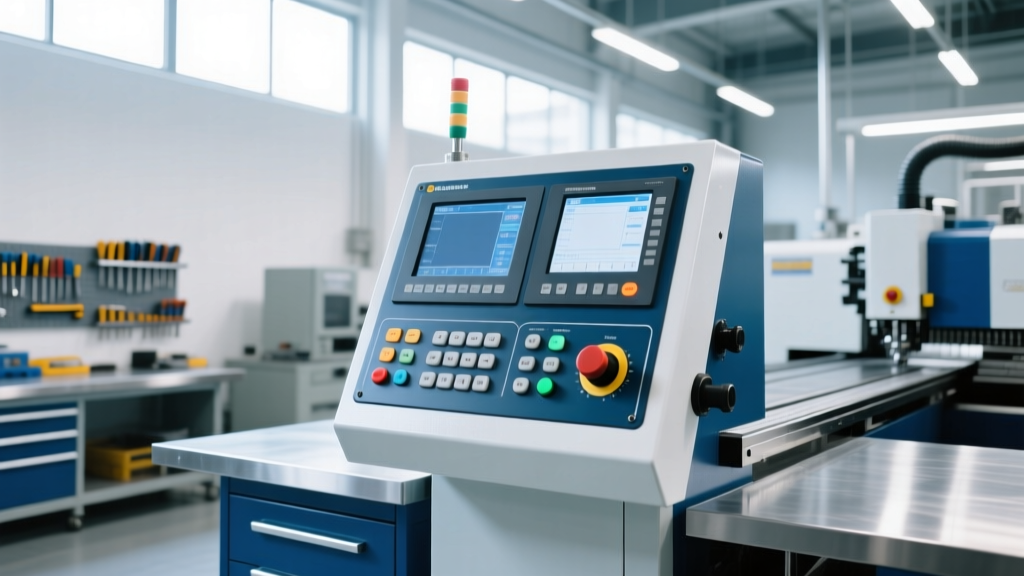
For small-to-medium format stitching (typically up to 300mm x 200mm sewing areas), embedded controllers dominate. The Juki AMS-210EN series, priced between $18,000 and $24,000 depending on the clamping fixture, utilizes a dedicated LCD pendant. Operators interact via a combination of membrane buttons and a touchscreen. The interface is heavily optimized for rapid bobbin-thread counting and stitch-density mapping. However, these systems lack native CAD integration; patterns must be digitized on an external PC using software like Juki's PM-1 and transferred via USB or LAN.
PC-Based Systems: Large-Format Gantry Stitching
When stitching 40-foot sail panels or automotive interior wraps, manufacturers deploy gantry-mounted CNC stitching heads driven by PC-based PLCs like the Siemens Sinumerik 840D sl. These interfaces resemble standard metal-cutting CNCs but include custom HMI overlays for textile-specific M-codes. For example, an M-code might trigger a pneumatic fabric roller to prevent material shifting during a 10-inch X-axis traverse. Upgrading a legacy mechanical stitcher to a modern PC-based CNC interface typically costs between $12,000 and $28,000, factoring in servo drives and the HMI panel.
Operator Training Framework: From Boot-Up to Execution
Effective operator training must move beyond basic button-pushing and focus on the physics of the stitch formation as managed by the controller. Follow this standardized workflow for pattern verification and execution.
- Pneumatic Clamp Calibration: Before loading the pattern, access the HMI's I/O Monitor screen. Verify that the pneumatic clamping pressure is set correctly for the material. Running a 2mm nylon webbing with the clamp pressure set for 12oz canvas will result in X/Y axis slippage, causing the controller to throw a positional deviation error.
- Electronic Tension Mapping: Modern CNC stitching machines feature servo-driven thread tensioners. On the Brother BAS series, navigate to Main Menu > Thread Tension > Pattern Edit. Operators must input the baseline tension (e.g., 45 grams for top thread, 120 grams for bobbin). The controller will automatically scale this tension down during tight corner radii to prevent thread snapping.
- Laser Trace Verification: Never execute a dry run with the needle engaged. Use the controller's Laser Trace or Boundary Walk function. The machine will use a low-power red diode laser to project the exact sewing path onto the clamped fabric. Verify that the stitch path does not intersect with the metal clamping jaws, which will instantly shatter the needle and damage the rotary hook.
Troubleshooting Controller Errors and Desynchronization
CNC stitching machines operate in high-vibration, lint-heavy environments. Controllers are programmed with specific fault codes to protect the mechanical linkages. Operators must understand how to diagnose these without immediately calling a technician.
- Error E-042 (X-Axis Stepper Desync): The controller detects that the physical gantry position does not match the encoder feedback. Resolution: Power down the main servo drive. Check the X-axis timing belt for tension and lint buildup. Clean the home-proximity sensor with isopropyl alcohol, as fabric dust frequently blocks the optical beam, causing the machine to lose its absolute zero reference upon reboot.
- Error E-118 (Presser Foot Height Fault): The Z-axis servo responsible for lifting the presser foot cannot reach the commanded height. Resolution: This usually indicates a mechanical jam in the lifting linkage or a blown fuse on the Z-axis servo amplifier board. Check the HMI diagnostic screen for the exact servo amperage draw; a spike above 2.5A indicates a physical bind.
- Pattern Scaling Drift: If a 100mm pattern consistently sews at 102mm on the X-axis but 100mm on the Y-axis, the controller's steps-per-millimeter calibration is misaligned with the drive pulley ratio. Access the Machine Parameters (often requiring a supervisor password) and adjust the X-axis pulse multiplier by the exact deviation percentage.
Safety Interlocks and Controller Overrides
Textile CNCs present unique entanglement hazards due to the continuous feed of flexible materials. Adherence to OSHA machine guarding guidelines is mandatory. Modern controllers integrate directly with safety light curtains and dual-channel E-stop circuits.
According to CDC NIOSH machine guarding protocols, operators must never reach into the stitching envelope while the spindle (rotary hook) is enabled, even at low jogging speeds. Advanced controllers utilize Safe Torque Off (STO) technology. If the light curtain is breached, the STO circuit cuts power to the main drive servos within 15 milliseconds, while the controller simultaneously triggers the pneumatic thread trimmer and lifts the presser foot to release the fabric tension.
'The transition from manual sewing to CNC stitching requires a fundamental shift in mindset. A manual operator feels the fabric tension through their hands; a CNC operator must learn to feel it through the HMI data screens, trusting the servo feedback loops to manage the physical forces.' — Lead Automation Engineer, Industrial Textile Manufacturing
Compliance with ISO Machinery Standards
Facilities deploying large-format CNC stitching gantries must ensure their control cabinets comply with ISO 11161 safety of machinery standards. This dictates that the controller's safety logic must be hardwired independently of the primary PLC processing the stitching pattern. Operators should be trained to perform weekly tests of the E-stop logic by triggering the safety circuit mid-cycle to verify that the controller safely aborts the pattern, trims the thread, and returns the gantry to the loading position without requiring a full system reboot.
Optimizing HMI Ergonomics for Shift Work
Controller interfaces should be customized for the specific operator and shift. Most modern HMIs allow for the creation of distinct user profiles. Supervisors should configure a 'Setup' profile with full access to machine parameters, tension mapping, and pattern editing, and a 'Run' profile that locks out critical parameters, displaying only the start/stop buttons, bobbin thread counter, and current stitch progress bar. This prevents accidental alteration of the X/Y scale or pulse multipliers during high-volume production runs, ensuring consistent stitch quality across multiple shifts.