ER vs. OZ: Which Tool Holder in CNC Machine Hobby Rigs Wins?
Compare ER, OZ, and R8 collet systems for entry-level CNC routers and mini-mills. Find the best tool holder in CNC machine hobby setups for 2026.
When hobbyists and makers transition from 3D printing to subtractive manufacturing, the spindle interface is frequently the most overlooked component. You can invest in a rigid frame like the Shapeoko 5 or a precision mini-mill like the Tormach PCNC 440, but if the tooling interface is flawed, your tolerances will suffer. Selecting the correct tool holder in CNC machine setups dictates your runout, clamping force, and ultimate surface finish. In 2026, the entry-level market is dominated by three primary collet systems: ER, OZ, and R8/proprietary quick-change. This analysis breaks down the mechanical realities of each to help you stop breaking 1/8-inch end mills and start holding tighter tolerances.
⚠️ The Hidden Cost of Runout: A standard cheap ER11 collet can exhibit up to 0.002" (50 microns) of runout. When spinning a 0.040" diameter carbide end mill at 20,000 RPM for PCB isolation routing, that runout effectively increases the tool diameter by 10%, causing immediate flute chipping and poor surface finishes. Always measure runout at the tool tip, not the collet face.The Contenders: Collet System Comparison Matrix
Before analyzing the mechanics, here is how the primary hobbyist tool holding systems compare across critical metrics for benchtop and floor-standing maker machines.
| System | Typical Sizes | Avg. Runout (Precision Grade) | Clamping / Pull-out Force | Best Hobby Application |
|---|---|---|---|---|
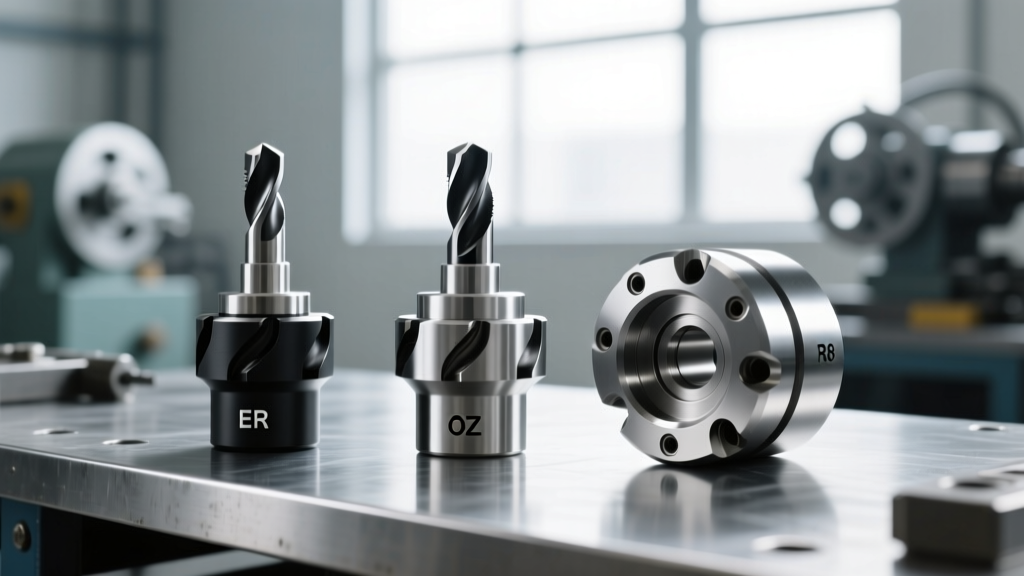
| ER | ER11, ER16, ER20 | 0.0002" (5µm) | Low to Medium (150 - 350 lbs) | Routing, PCB milling, light aluminum |
| OZ | OZ11, OZ16, OZ25 | 0.0001" (2.5µm) | High (400 - 800 lbs) | High-speed routing, heavy roughing |
| R8 / TTS | R8, Tormach TTS | 0.0003" (8µm) | Very High (Drawbar dependent) | Mini-mills, manual/CNC hybrid work |
Deep Dive: ER Collets (The Hobbyist Default)
The ER system, originally patented by Rego-Fix in 1973, remains the undisputed standard for 90% of entry-level CNC routers. Machines like the Sainsmart Genmitsu PROVerXL 4030 V2 utilize an ER11 spindle, while heavier hobby routers like the Onefinity Foreman step up to ER20. The ER collet features a 16-degree taper and a front extraction groove, allowing it to collapse evenly around the tool shank.
The 1mm Collapsing Rule
A critical mistake makers make is assuming an ER collet can hold any tool within a wide range. While an ER20 collet is stamped "10-12mm", it has a total collapsing range of only 1mm (or 0.5mm for high-precision variants). If you attempt to clamp a 10.1mm shank in a 10mm nominal collet, the front bearing ring of the collet will bottom out before the taper fully seats, resulting in catastrophic runout and tool pull-out. According to tooling experts at MSC Industrial Direct, you should always purchase collets matched exactly to your tool shank diameter (e.g., a dedicated 1/4" collet for 1/4" end mills) rather than relying on the collapse range.
Pros and Cons of ER Systems
- Pros: Massive availability, low cost ($15-$35 per collet), wide clamping range per collet, excellent concentricity when paired with a ball-bearing nut.
- Cons: Lower pull-out force compared to OZ; standard spanner wrenches can over-torque and distort the collet if the user lacks a torque wrench.
The OZ Alternative: Why Advanced Makers Are Switching
The OZ collet system is rapidly gaining traction in the maker community, particularly among those upgrading to high-speed, 1.5kW to 2.2kW water-cooled VFD spindles. While ER collets rely on a slotted design that collapses uniformly, OZ collets feature a different slot geometry and a steeper taper angle, which translates to significantly higher rigidity and clamping force.
"When routing dense hardwoods or taking aggressive roughing passes in 6061-T6 aluminum, the axial cutting forces can easily exceed the pull-out threshold of an ER16. Switching to an OZ16 system effectively doubles the clamping force without requiring a larger spindle nose." — Benchtop CNC Machining Forums, 2025 Tooling Thread.
OZ vs. ER: The High-Speed Balance Factor
At spindle speeds exceeding 24,000 RPM, micro-vibrations become a primary concern. OZ collets are inherently shorter and possess a lower center of gravity compared to their ER counterparts. This reduced projection minimizes harmonic chatter. If your hobby setup involves a Makita compact router or a high-frequency HSD spindle, an OZ11 or OZ16 tool holder in your CNC machine will yield noticeably better edge finishes on acrylic and aluminum composites.
R8 and Proprietary Quick-Change: The Mini-Mill Standard
If your entry-level machine is a benchtop mill rather than a gantry router—such as the Tormach PCNC 440 or a converted Grizzly G0704—you are likely dealing with an R8 taper or a proprietary quick-change system like the Tormach Tooling System (TTS).
R8 tool holders rely on a drawbar pulling the tool up into the spindle taper. This provides immense rigidity for side-loading operations like slotting and facing. However, R8 lacks quick-change capabilities. The TTS system solves this by utilizing a retention knob and a spring-loaded spindle nose, allowing hobbyists to swap from a 3/8" end mill to a spot drill in under three seconds without losing the Z-axis work coordinate. While a starter TTS kit costs upwards of $250 in 2026 (compared to $60 for a full ER16 set), the time saved during complex, multi-tool hobby projects justifies the investment.
The Secret Weapon: Ball-Bearing Collet Nuts
Regardless of whether you choose ER or OZ, the nut you use to tighten the collet is just as important as the collet itself. Standard ER nuts force the collet to twist as they are tightened, which can introduce 0.0003" of artificial runout. 💡 Pro-Tip for 2026 Upgrades: Upgrade to a ball-bearing clutch nut. These nuts feature an integrated thrust bearing that allows the nut to turn independently of the collet. This eliminates twisting, ensures the collet seats perfectly straight into the taper, and extends collet life by reducing galling. Expect to pay $25-$40 for a precision ball-bearing nut from brands like Maritool or Techniks.
Practical Decision Framework: What Should You Buy?
Stop guessing and use this framework to select the exact tooling interface for your specific maker workflow.
- Scenario A: PCB Milling, Wax Carving, and Soft Plastics.
Machine Type: 3018 CNC, Genmitsu 3020, Inventables X-Carve.
Recommendation: ER11 or ER16. The cutting forces are minimal. Prioritize a high-precision (AA-grade) ER11 collet set specifically sized for 0.8mm, 1.5mm, and 3.175mm (1/8") shanks. Pair with micro-grain carbide end mills from Harvey Tool for the best results. - Scenario B: Hardwood Routing, Sign Making, and Light Aluminum.
Machine Type: Shapeoko 5, Onefinity X-35, CNC Router Parts 4x8.
Recommendation: ER20 or OZ16. If you are taking 0.2" depth-of-pass cuts in 6061 aluminum with a 1/4" end mill, the axial pull-out force is high. Use an OZ16 if your spindle accepts it, or an ER20 with a ball-bearing nut torqued precisely to 75 ft-lbs. - Scenario C: Precision Mini-Milling and Prototyping.
Machine Type: Tormach PCNC 440, Precision Matthews PM-25MV.
Recommendation: TTS or R8. Do not use ER collets in a milling machine spindle if a TTS or R8 option exists. The side-loads of milling will cause ER collets to fret and wear out the spindle bore over time. Invest in a 10-piece TTS starter set and a dedicated torque wrench for the retention knobs.
Sourcing and Authenticity in the Current Market
The market is flooded with unbranded, $15 ER collet sets sold on massive e-commerce platforms. These are typically manufactured from low-grade spring steel with poor heat treatment, leading to rapid loss of elasticity and permanent deformation. For a hobbyist machining critical parts, the cost of a ruined workpiece far exceeds the price of premium tooling. Source your tool holders from established industrial suppliers or dedicated CNC niche brands. Look for collets manufactured to DIN 6499 standards, which guarantee the baseline geometry and collapse tolerances. In 2026, a high-quality, individually certified ER20 collet will cost between $28 and $45. Treat your tool holder in CNC machine setups not as a consumable, but as a precision instrument that dictates the absolute ceiling of your machine's accuracy.