Industrial vs Consumer CNC Sanding Machine Tech Specs
Compare industrial and consumer CNC sanding machine specifications. Explore vacuum tables, feed rates, and abrasive tech to choose the right equipment.
The Kinematics of Surface Finishing: Rigid vs. Compliant Axes
The fundamental divergence between an industrial CNC sanding machine and a consumer-grade CNC adapted for sanding lies in Z-axis compliance and lateral force management. Industrial contour sanders, such as the Costa Levigatrici KVT series or Viet Opera models, utilize pneumatic compliance heads. These heads feature a pressurized air bladder behind the sanding pad that dynamically deflects to maintain constant contact pressure across complex 3D topographies. If a machined wood panel warps by 1.5mm due to moisture changes, the industrial compliance head absorbs the deviation without altering the abrasive cut depth.
Consumer-grade CNCs—typically 3-axis desktop routers like the Shapeoko 5 or Onefinity retrofitted with a sanding spindle—lack this pneumatic articulation. They rely on a rigid Z-axis. To sand a contoured surface, the user must execute a G-code macro probe cycle (G38.2) to map the surface topography, generating a secondary toolpath. This process is computationally heavy, slow, and highly susceptible to error; a 0.2mm discrepancy in the probe map results in either an unsanded ridge or a severe gouge in the workpiece.
Engineering Insight: Sanding generates immense lateral friction. An industrial CNC sanding machine utilizes 5kW+ AC vector drives and hardened 35mm linear guideways to resist over 250 lbs of lateral sanding pressure. Consumer CNCs rely on NEMA 23 stepper motors or 400W closed-loop servos that will routinely lose steps and ruin the finish if lateral friction exceeds 15-20 lbs.
Technical Specification Matrix
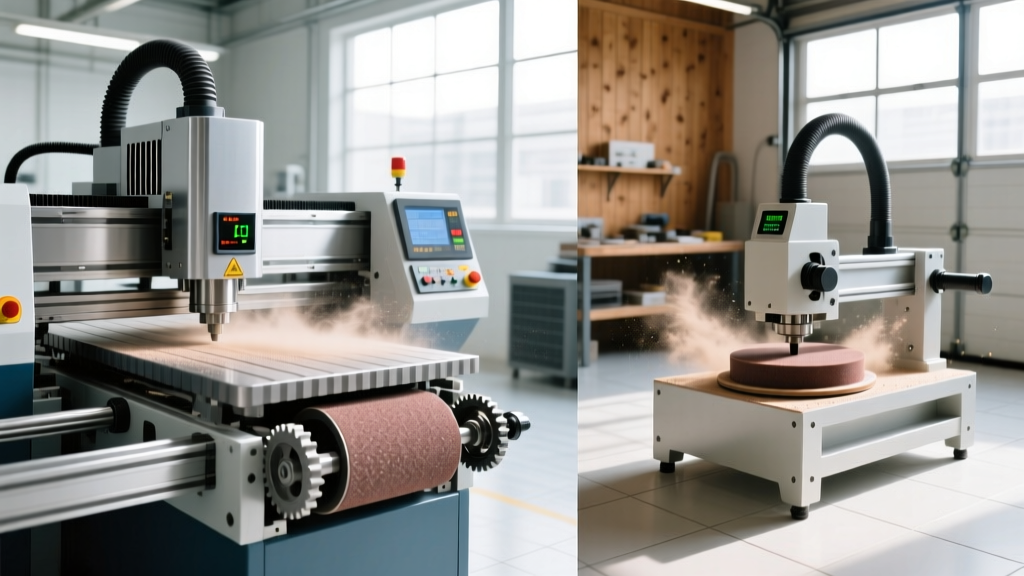
The following matrix contrasts the physical and operational specifications of dedicated industrial CNC contour/wide-belt sanders against consumer/prosumer CNC routers adapted for abrasive finishing.
| Parameter | Industrial CNC Sanding Machine (e.g., SCM/Costa) | Consumer/Desktop CNC (Retrofitted Router) |
|---|---|---|
| Axes of Motion | 5 to 6 axes (including robotic arm articulation) | 3 axes (X, Y, Z) |
| Z-Axis Compliance | Pneumatic bladder (0.5 - 4.0 bar adjustable) | Rigid (requires macro-probing for contours) |
| Feed Rate (Sanding) | 30 - 150 ft/min (PLC synchronized) | 10 - 40 IPM (limited by stepper torque) |
| Abrasive Interface | 1350mm wide belts, oscillating brush heads | 5" - 6" hook-and-loop ROS discs |
| Dust Extraction Need | 4,000+ CFM at 12" Static Pressure | 600 - 1,200 CFM at 2" Static Pressure |
| Vacuum Hold-Down | 2500 m³/h regenerative blowers, zoned | Mechanical clamps or low-CFM vacuum pods |
| Capital Cost Range | $140,000 - $450,000+ | $2,500 - $12,000 |
Abrasive Media and Tooling Interfaces
Industrial CNC sanding machines are engineered for continuous abrasive media consumption and automated grit progression. High-end models feature automated tool changers (ATC) capable of swapping between stiff cross-grain brush heads, soft conforming foam pads, and aggressive wide-belt contact wheels. The PLC automatically adjusts the spindle RPM and oscillation frequency based on the RFID tag embedded in the tool holder, ensuring the exact parameters for 80-grit roughing versus 320-grit final polishing are applied without operator input.
Consumer setups are limited to standard hook-and-loop random orbital sanding discs or small flap wheels mounted in a standard ER11 or ER20 collet. Because consumer CNCs lack automated tensioning, the abrasive paper must be manually changed. Furthermore, the rotational speed of a consumer router spindle (often peaking at 24,000 RPM) is entirely unsuited for sanding; operators must manually restrict the VFD (Variable Frequency Drive) to 2,000 - 4,000 RPM to prevent burning the wood or melting the hook-and-loop backing.
⚠️ Warning: The Dust Extraction Bottleneck
Fine wood dust generated by CNC sanding is highly combustible and poses severe respiratory hazards. According to OSHA Combustible Dust Guidelines, accumulated dust exceeding 1/32 of an inch can trigger deflagration. Industrial sanders integrate sector-based vacuum blowers directly into the sanding head, capturing 95% of particulate at the source. Consumer CNCs rely on peripheral shop vacuums, which fail to capture the ultra-fine 5-micron particles that bypass standard filters. Always reference NIOSH Wood Dust Safety standards when designing dust collection for enclosed CNC environments.
Vacuum Hold-Down and Workholding Physics
Effective CNC sanding requires the workpiece to remain perfectly stationary under heavy lateral abrasive loads. Industrial CNC sanding machines utilize high-pressure regenerative vacuum blowers paired with porous MDF or synthetic spoilboards. The table is divided into programmable zones; the PLC activates only the valves under the specific workpiece footprint, maintaining maximum vacuum density (often exceeding 0.8 bar of holding force).
Consumer CNCs typically rely on T-track mechanical clamps or low-volume vacuum tables. Mechanical clamps interfere with the sanding toolpath, forcing the operator to manually pause the machine, reposition the clamps, and re-zero the Z-axis—a process that destroys production efficiency and introduces alignment errors. Low-volume consumer vacuum pumps (typically 3-5 CFM) lack the static pressure to hold a part against the lateral drag of a 120-grit sanding disc, leading to part shift and ruined components.
Common Failure Modes and Edge Cases
Consumer CNC Edge Cases
- Stepper Motor Stall: Applying excessive downward Z-force to compensate for a warped board causes lateral friction to exceed the stepper motor's holding torque, resulting in lost steps and a ruined surface finish.
- Collet Runout: Standard consumer ER collets exhibit 0.001" to 0.003" of runout. In milling, this is negligible; in sanding, it causes the abrasive disc to wobble, creating visible oscillation marks (pig-tails) on the finished surface.
Industrial CNC Edge Cases
- Pneumatic Bladder Rupture: Running the compliance head without proper filtration allows fine dust to infiltrate the air lines, scoring the internal cylinder walls and causing pressure leaks that result in uneven sanding pressure.
- Sensor Fouling: Optical edge-sensors used to detect part width for automated head positioning can become blinded by dust accumulation, causing the machine to aggressively sand the conveyor belt or miss the workpiece entirely.
Purchasing Decision Framework
Selecting between industrial and consumer CNC sanding architectures requires an objective analysis of production volume, part geometry, and capital availability. Consult the SCM Group Sanding Technologies catalog for precise industrial footprint and power requirements before facility planning.
- Choose Consumer/Prosumer CNC if: You are a custom luthier, boutique sign-maker, or hobbyist producing fewer than 50 contoured parts per week. You must be willing to write custom G-code macros for surface probing and accept manual abrasive changing.
- Choose Industrial CNC Sanding if: You manufacture cabinet doors, architectural millwork, or composite aerospace components at scale. If your parts feature deep 3D contours (e.g., raised panel doors with intricate ogee profiles) and you require consistent, automated grit progression from 120 to 400 without manual intervention, the ROI on a 6-axis contour sander justifies the capital expenditure within 18 to 24 months through eliminated manual labor.