Smallest CNC Machine Tolerances: Cost vs. Accuracy Budget Guide
Discover the true cost of micro-precision. We break down smallest CNC machine accuracy specs, tolerance tiers, and hidden metrology budgets.
The Paradox of Micro-Precision: Footprint vs. Financial Investment
When manufacturing engineers search for the smallest CNC machine, the primary motivation is often spatial efficiency or the need to machine micro-features. However, a critical disconnect exists between the physical footprint of a desktop or benchtop micro-mill and the financial footprint required to achieve industrial-grade tolerances. A machine that occupies four square feet of bench space might cost $5,000, but holding a positional accuracy of ±5µm (0.0002 inches) on that same machine requires an ecosystem of tooling, metrology, and environmental controls that can easily push the total capital expenditure past $60,000.
This guide provides a rigorous cost analysis of accuracy and tolerance specifications in micro-machining, breaking down the hidden multipliers that dictate your true budget when investing in ultra-compact CNC equipment.
Executive Budget Summary:- Prosumer/Hobbyist Tier (±0.005"): $4,000 – $8,000 total setup cost.
- Entry Industrial Tier (±0.0005"): $25,000 – $45,000 total setup cost.
- Ultra-Precision Micro Tier (±0.00005"): $90,000 – $150,000+ total setup cost.
Defining the Tolerance-to-Cost Multiplier
In CNC machining, cost does not scale linearly with accuracy; it scales exponentially. Tightening a tolerance from ±0.005 inches to ±0.0005 inches might double the machine cost. Tightening it further to ±0.00005 inches (50 microns or roughly 2 microns of positional variance) will multiply the cost by a factor of ten. This is because achieving micron-level accuracy on the smallest CNC machines requires defeating thermal expansion, vibrational harmonics, and spindle runout—challenges that are inherently more difficult to solve in compact, lightweight machine frames.
Accuracy vs. Repeatability in Compact Frames
Budget planners must distinguish between accuracy (how close a cut is to the absolute programmed dimension) and repeatability (how consistently the machine returns to the same coordinate). Many compact 5-axis mills, such as the popular Pocket NC V2-50 series, offer excellent repeatability for their size class (often around ±0.0005" to ±0.001"), but absolute volumetric accuracy may drift without frequent kinematic calibration and thermal stabilization. If your application requires tight absolute tolerances across a multi-hour unmanned run, you must budget for closed-loop linear scales and active spindle chillers, which are rarely standard on sub-$10,000 machines.
Capital Expenditure (CapEx) Breakdown by Tolerance Tier
The following matrix illustrates the realistic budget required to achieve specific tolerance bands, factoring in the machine, necessary peripheral hardware, and initial tooling.
| Tolerance Tier | Target Spec (Positional) | Machine Class Examples | Base Machine Cost | Required Peripheral Budget | Total Estimated CapEx |
|---|---|---|---|---|---|
| Standard Desktop | ±0.005" (127µm) | Bantam Tools PCNC, Inventables X-Carve Pro | $3,500 - $5,000 | $500 (Basic collets, standard end mills) | $4,000 - $5,500 |
| Prosumer Micro | ±0.0005" (12.7µm) | Pocket NC V2-50, Datron neo (entry config) | $8,000 - $45,000 | $4,500 (Spindle chiller, ER8 micro-collets, granite plate) | $12,500 - $49,500 |
| Ultra-Precision | ±0.00005" (1.27µm) | Kern Micro HD, Datron Cube (high-end config) | $120,000 - $250,000+ | $35,000+ (Climate control, active damping, vision systems) | $155,000 - $285,000+ |
The Hidden OpEx of Sub-Millimeter Machining
When budgeting for the smallest CNC machines capable of micro-machining, facility managers often overlook the operational expenses (OpEx) required to maintain the stated tolerance specifications on the machine's brochure.
1. Spindle Runout and Micro-Tooling Attrition
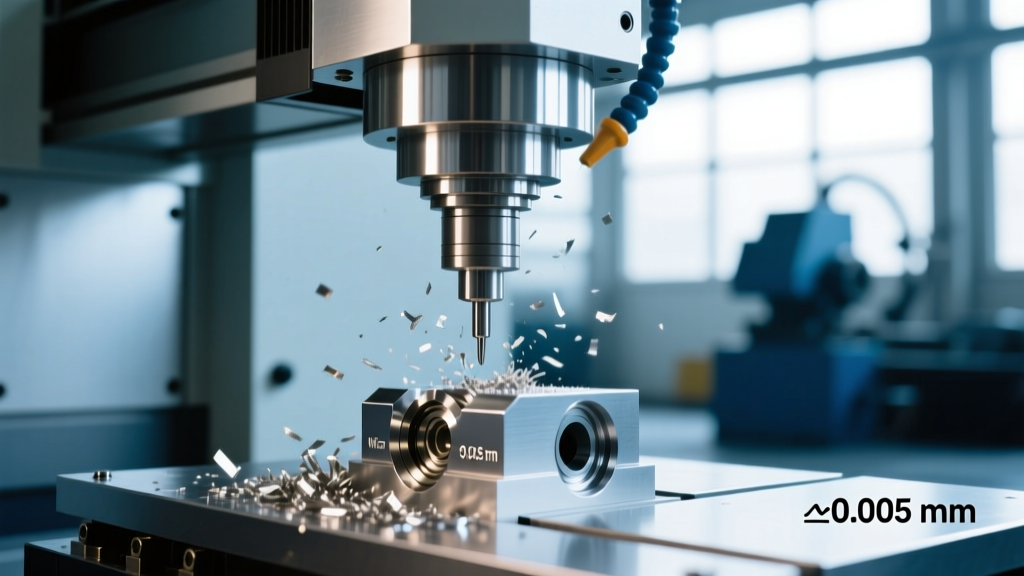
According to cutting tool engineering data from Sandvik Coromant, micro-end mills (diameters under 1.0mm) are highly susceptible to catastrophic failure if spindle runout exceeds 2µm to 3µm. At 30,000 RPM, a mere 5µm of runout creates an uneven chip load that will instantly snap a 0.020" carbide cutter.
Budget Warning: High-quality micro-tooling is expensive. A single Harvey Tool 0.015" corner radius end mill can cost upwards of $65. If your compact CNC machine utilizes a budget spindle with 10µm of runout, you will spend thousands of dollars annually replacing shattered tooling, entirely erasing the capital savings of buying a cheaper machine.To achieve the <0.0005" tolerance tier, you must budget for high-precision ER8 or ER11 collet chucks (costing $150–$300 each) and potentially a high-frequency air turbine spindle upgrade ($4,000–$8,000) if the base machine does not support low-runout, high-RPM requirements.
2. Thermal Expansion in Compact Environments
The physical advantage of the smallest CNC machines—their compact size—becomes a thermal liability. Small machine frames heat up rapidly from spindle friction and ambient room changes. Aluminum 6061 has a coefficient of thermal expansion of roughly 23.6 µm/m·°C. If your workshop temperature fluctuates by just 4°C (7.2°F) during a shift, a 50mm aluminum part will expand or contract by nearly 5µm. If your target tolerance is ±5µm, ambient temperature shifts alone will cause out-of-tolerance scrap.
The Fix: Budgeting for ultra-precision requires environmental controls. You must allocate funds for a dedicated spindle oil chiller ($1,500 - $3,000) and, in extreme cases, an insulated machine enclosure with localized HVAC ($5,000+). Furthermore, the NIST Physical Measurement Laboratory emphasizes that dimensional metrology and precision manufacturing must be referenced to standard temperatures (typically 20°C / 68°F) to ensure tolerance validity.
Metrology: The Budget Killer in Micro-Machining
The most common point of failure in micro-CNC budget planning is metrology. You cannot hold a ±5µm machining tolerance if your measurement equipment only resolves to 10µm. The rule of thumb in precision engineering is the 10:1 rule—your measurement tool must be ten times more accurate than the tolerance you are trying to hold.
"Investing $40,000 in a micro-machining center while relying on $200 digital calipers is a fundamental misallocation of capital. If you are machining to 5 microns, you need a vision measuring machine or a high-end CMM, which will often cost more than the CNC machine itself."
— Precision Manufacturing Engineering Consensus
Metrology Equipment Cost Matrix
- Digital Micrometers (Mitutoyo 293 Series): ~$350 each. (Resolves to 1µm, but relies on operator feel; poor for complex 3D micro-features).
- Toolmaker's Microscope: ~$3,000 - $8,000. (Excellent for 2D edge profiling and thread inspection).
- Automated Vision Systems (e.g., Keyence IM Series): $30,000 - $60,000. (Mandatory for high-volume, multi-axis micro-part inspection holding ±5µm true position tolerances).
- Granite Surface Plate & Stand (Grade AA): $1,500 - $4,000. (Required as a stable baseline for any manual metrology).
Decision Framework: Allocating Your Micro-Precision Budget
When planning the acquisition of the smallest CNC machine for high-tolerance work, follow this capital allocation framework to ensure your budget aligns with your physical requirements.
- Define the Absolute Tolerance Limit (40% of planning time): Review your CAD models. Are the ±0.0005" tolerances applied to critical mating surfaces, or are they blanket title-block tolerances that can be relaxed? Eliminating unnecessary tight tolerances on non-critical features can save tens of thousands of dollars in machine and metrology upgrades.
- Allocate 60% to Machine & Spindle, 40% to Peripherals: For a $20,000 total budget, do not buy a $18,000 machine and leave $2,000 for tooling and measurement. Buy a $12,000 machine and allocate $8,000 for a spindle chiller, high-precision collets, a Grade AA granite plate, and a quality toolmaker's microscope.
- Budget for Kinematic Calibration: Compact 5-axis machines require frequent calibration. Budget $2,000 for a wireless 3D tool setter and probing system (like a Renishaw OMP60 or equivalent micro-probe) to allow the machine to map its own volumetric errors and update the controller offsets automatically.
- Factor in Scrap and Tooling R&D: Micro-machining requires extensive feed-and-speed tuning. Allocate a minimum of $1,500 in your first-year OpEx budget specifically for scrap material and broken micro-end mills while you dial in the harmonic sweet spots of your specific compact machine frame.
Final Verdict on Micro-CNC Budgeting
The market for the smallest CNC machines offers incredible capabilities, bringing 5-axis micro-machining to the desktop. However, accuracy is not merely a function of the machine's linear guides or ball screws; it is the result of a holistic system comprising thermal stability, spindle runout, tooling quality, and metrological verification. By shifting your budget analysis from the base machine price to the total cost of the tolerance ecosystem, you can avoid catastrophic OpEx overruns and achieve reliable, repeatable micro-precision.