CNC Machine Transport: Industrial vs Consumer Specs
Compare CNC machine transport logistics, rigging costs, and structural specs between industrial cast-iron mills and consumer aluminum routers.
The Physics of Mass: Why Transport Defines CNC Architecture
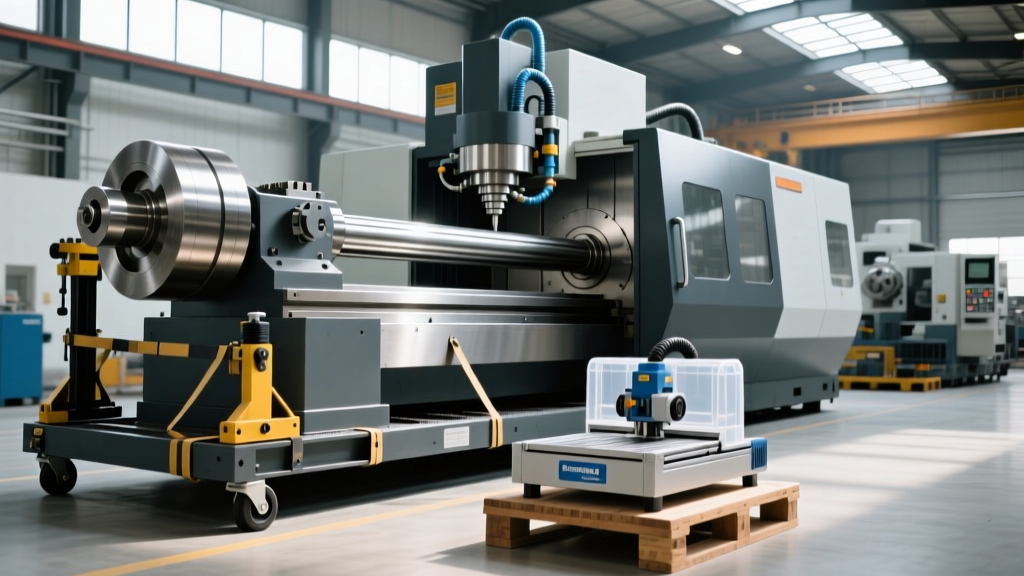
The fundamental divide between industrial and consumer-grade CNC machines is not merely a matter of spindle speed or axis travel; it is rooted in the physics of mass, structural damping, and the logistical realities of CNC machine transport. Moving a 7,500-pound Meehanite cast-iron vertical machining center (VMC) requires heavy rigging, specialized air-ride freight, and reinforced concrete foundations. Conversely, a 90-pound consumer-grade aluminum extrusion router can be shipped via standard parcel carriers and assembled on a wooden workbench. These transport constraints directly dictate the mechanical engineering, material selection, and dynamic stiffness of the machines.
⚠️ Rigging Threshold Warning: Any CNC machine exceeding 2,000 lbs requires professional rigging. Attempting to move a 6,500 lb Haas VF-2SS with standard warehouse forklifts without proper machine skates and a verified center-of-gravity calculation risks catastrophic tip-overs and voids the manufacturer warranty. Refer to OSHA rigging safety guidelines for load-bearing protocols.Structural Materials: Cast Iron vs. Aluminum Extrusions
Industrial CNCs prioritize vibration damping over portability. The base and column of machines like the Mazak VCN-530C or Haas VF series are cast from Class 40 gray cast iron or Meehanite. According to metallurgical standards, the graphite flakes within gray cast iron provide an internal damping capacity up to 10 times greater than steel or aluminum. This mass absorbs high-frequency chatter during heavy material removal rates (MRR).
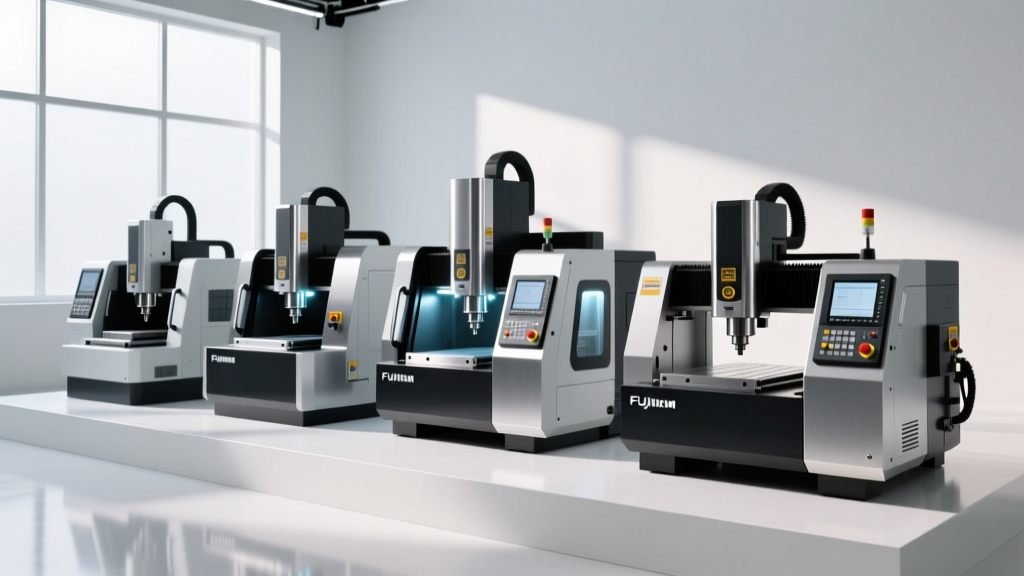
Consumer machines, such as the Carbide 3D Shapeoko 5 or Inventables X-Carve, utilize 6061-T6 aluminum extrusions and cold-rolled steel linear rails. While aluminum offers an excellent strength-to-weight ratio for parcel shipping, its low mass and poor damping coefficient mean the machine structure itself can resonate during aggressive cuts, limiting the user to softer materials like woods, plastics, and non-ferrous alloys.
Material & Transport Specification Matrix
| Specification | Industrial VMC (e.g., Haas VF-2SS) | Consumer Router (e.g., Shapeoko 5) |
|---|---|---|
| Base Material | Meehanite Cast Iron | 6061-T6 Aluminum Extrusion |
| Shipping Weight | ~6,500 lbs (2,948 kg) | ~90 lbs (40.8 kg) |
| Transport Method | Flatbed air-ride, crane/forklift rigging | Standard LTL or Parcel (FedEx/UPS) |
| Damping Coefficient | High (Graphite flake microstructure) | Low (Requires tuned mass dampers for chatter) |
| Foundation Requirement | 6-inch reinforced concrete, precision leveled | Standard workbench, torsion-box base |
Drive Systems and Transit Vulnerabilities
The mechanism used to drive the axes highlights another transport-driven engineering divergence. Industrial machines utilize C3-grade precision ground ball screws with pre-loaded angular contact bearings. These components are highly sensitive to axial shock. During CNC machine transport, riggers must secure the axes (often using factory-installed shipping brackets) to prevent the table mass from slamming against the bearing blocks during sudden braking or cornering on highways.
Consumer machines typically employ V-belts, timing belts, or Acme lead screws. While these lack the positional accuracy and rapid traverse speeds of ball screws (industrial machines hit 1,000+ IPM, while consumer routers cap around 300 IPM), belt-driven systems are inherently forgiving to transit shocks. A Shapeoko can be shipped fully assembled with minimal risk of internal mechanical damage from standard delivery handling.
Spindle Mass, Z-Axis Load, and Thermal Growth
The Z-axis assembly further illustrates the transport and spec divide. An industrial VMC utilizes a 40-taper or 50-taper spindle cartridge weighing upwards of 300 lbs, supported by massive Z-axis linear guideways and a counterbalance system (nitrogen cylinder or counterweight). Transporting this requires locking the Z-axis to prevent the counterbalance from violently shifting during transit. Consumer machines utilize lightweight 65mm or 80mm VFD spindles (like the HSD or Makita routers) weighing under 10 lbs, driven by a single NEMA 23 stepper motor and lead screw. While industrial spindle masses provide immense Z-axis rigidity for facing and 3D contouring in titanium or Inconel, they generate significant thermal growth. Post-transport, the spindle must undergo a mandatory 30-minute warm-up cycle at 8,000 RPM to stabilize bearing preload and thermal expansion before cutting critical tolerances.
💡 Post-Transport Calibration Tip: After transporting an industrial CNC, never immediately power on the servos. The machine must sit in the climate-controlled shop for 48 to 72 hours to allow the cast iron and spindle housing to reach thermal equilibrium with the ambient room temperature before executing laser calibration or ballbar testing.Installation and Calibration: Post-Transport Imperatives
The physical installation following transport is where the true cost of industrial ownership materializes. Placing a consumer CNC involves bolting the gantry to the base and squaring the frame using a digital machinist square. Industrial installation is a multi-day civil and mechanical engineering task.
- Foundation Verification: Verify the concrete slab meets the 3,000 PSI minimum compressive strength and is isolated from external vibrations (e.g., nearby stamping presses or forklift traffic).
- Rough Leveling: Use heavy-duty machine skates and precision steel shims to bring the cast-iron base within 0.010" of level across the X and Y axes.
- Epoxy Grouting: For ultra-precision jig borers or 5-axis trunnion tables, the base is suspended on adjustable jacks and poured with specialized epoxy grout (e.g., Moglice) to create a monolithic, vibration-isolated bond with the floor.
- Precision Leveling: Utilize a 0.0005"/inch resolution master precision level (such as a Starrett 199) to map the table geometry, adjusting the leveling bolts until the bed is perfectly planar.
- Geometric Verification: Run Renishaw ballbar tests to verify circularity and volumetric accuracy, compensating for any geometric twist introduced during the settling phase.
The Hidden CapEx: Sourcing and Rigging Costs
When budgeting for a CNC, the sticker price ignores the logistical reality of CNC machine transport. A new Haas VF-2SS may have a base MSRP of roughly $65,000. However, the total landed cost must include:
- Freight & Rigging: $2,500 to $6,000 for specialized machinery movers, crane rentals, and air-ride flatbed transport.
- Electrical Infrastructure: $3,000+ to install a dedicated 3-phase, 480V drop with appropriate disconnect switches and phase converters if 3-phase is unavailable.
- Foundation Prep: $1,500+ for core drilling, trenching for coolant lines, and epoxy anchoring.
In contrast, a fully loaded consumer setup (e.g., Shapeoko 5 XXL with a Makita spindle and BitSetter) retails for approximately $3,200, with shipping costs hovering around $150 via standard freight, requiring zero facility modifications. For detailed assembly and structural guidelines on consumer-grade extrusions, refer to the Carbide 3D official documentation.
Summary: Matching the Machine to the Facility
The decision between industrial and consumer-grade CNC equipment is ultimately constrained by your facility's ability to support the transport, installation, and operational mass of the machine. Industrial cast-iron VMCs offer unmatched rigidity, thermal stability, and continuous 24/7 duty cycles, but demand significant capital for rigging and facility preparation. Consumer-grade aluminum routers offer immediate deployment and zero logistical friction, trading absolute rigidity for accessibility and rapid ROI in low-volume, non-ferrous production environments.