Case Study: Programming a CNC Machine for Small Workshop Output
Discover how a small job shop optimized output by programming a CNC machine for rapid prototyping, including setup costs, toolpaths, and ROI data.
The Small Workshop Bottleneck: Transitioning to Compact CNCs
For job shops operating under 2,000 square feet, floor space is a premium asset that directly dictates revenue per square foot. In early 2026, Apex Precision, a 1,500-square-foot prototyping facility in Dayton, Ohio, faced a critical bottleneck. Their manual Bridgeport mills and aging 1990s CNC routers could not maintain the tolerances required for modern UAV (unmanned aerial vehicle) chassis components. The solution was not buying a massive 5-axis VMC, but rather integrating a compact vertical machining center and fundamentally rethinking their approach to programming a CNC machine for restricted work envelopes.
Machine Profile: Haas CM-1 Compact Mill
- Footprint: 98" x 84" (fits through standard 36" commercial doors)
- Travel Limits: 12" (X) x 10" (Y) x 12" (Z)
- Spindle: 10,000 RPM inline direct-drive
- Tool Capacity: 10-pocket umbrella changer
- Base Price (2026): ~$42,500 (configured with wireless probing and rigid tapping)
Source: Haas Automation CM-1 Specifications
The Core Challenge: Programming a CNC Machine in a Restricted Envelope
The primary hurdle for Apex Precision was not the hardware itself, but the CAM strategy. When programming a CNC machine with only 12 inches of Z-axis travel and a 10-inch Y-axis limit, standard toolpath generation often leads to catastrophic collisions or excessive air-cutting. The shop's lead programmer, Sarah Jenkins, had to adapt her workflow in Autodesk Fusion 360 to account for the physical realities of a compact enclosure.
Toolpath Optimization for 6061-T6 Aluminum
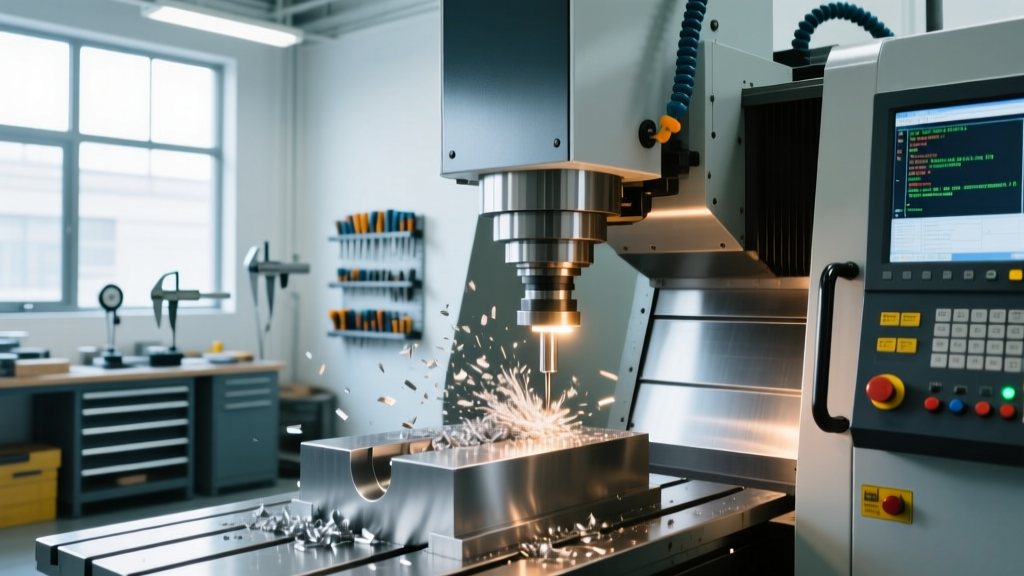
The target part was a UAV motor mount bracket, machined from a 2.5" x 4" x 1" block of 6061-T6 aluminum. On a full-size VMC, a programmer might use a 1/2" roughing endmill and aggressive Z-level passes. On the CM-1, Jenkins utilized a 3D Adaptive Clearing strategy with a 1/4" 3-flute carbide endmill (Harvey Tool #87304).
- Spindle Speed: 11,500 RPM
- Feed Rate: 135 IPM (Inches Per Minute)
- Stepdown: 0.125" (50% of tool diameter)
- Stepover: 0.025" (10% of tool diameter for optimal chip thinning)
By keeping the radial engagement low and the axial depth high relative to the tool diameter, the machine maintained a constant chip load, preventing the spindle from bogging down during heavy roughing passes in the confined workspace.
Post-Processor Customization: Avoiding Overtravel Alarms
One of the most overlooked aspects of programming a CNC machine for small workshops is the post-processor. Generic Haas NGC post-processors assume a standard 30" x 20" work envelope. When Jenkins ran her first simulation, the default post generated G00 rapid moves that sent the tool retracting to the machine's absolute Z-home position between operations. On a machine with a 12" Z-axis limit and a 4" vise sitting on the table, this caused immediate Z-plus overtravel alarms.
The Fix: Jenkins edited the post-processor logic to restrict the Z-retract height to G53 Z-1.0 (1 inch below the machine home) and utilized G92 workspace coordinate shifts to keep all rapid traverses within 3 inches of the part surface. This single modification reduced non-cutting air time by 18% per cycle and eliminated all overtravel faults.
Case Study Data: Production Metrics
Below is the comparative data from Apex Precision's first 500-part run of the UAV motor mount, contrasting their previous manual milling process with the optimized compact CNC workflow.
| Metric | Manual Bridgeport (Previous) | Haas CM-1 CNC (Current) | Improvement |
|---|---|---|---|
| Setup Time (per batch of 50) | 4.5 hours | 1.2 hours | 73% reduction |
| Cycle Time (per part) | 38 minutes | 14.5 minutes | 61% reduction |
| Scrap Rate | 8.2% | 1.1% | 86% reduction |
| Tool Life (Roughing Endmill) | N/A (Indexable inserts) | 140 parts | Predictable wear |
Real-World Gotchas: What the Brochures Don't Tell You
Integrating a small-format CNC into a tight workshop introduces physical and operational challenges that rarely appear in manufacturer literature. Apex Precision encountered three major issues during their first month of operation.
1. Workholding vs. Y-Axis Travel
The shop initially purchased a standard 6-inch Kurt DX6 vise. However, the DX6 base is roughly 7.5 inches wide. When mounted on the CM-1 table, this left less than 1.5 inches of usable Y-axis travel for multi-part fixturing or edge-finding. Solution: They swapped to a 4-inch Kurt DX4 vise, sacrificing some clamping force but regaining 4 inches of critical Y-axis travel, allowing them to machine two motor mounts simultaneously.
2. Chip Evacuation in Compact Enclosures
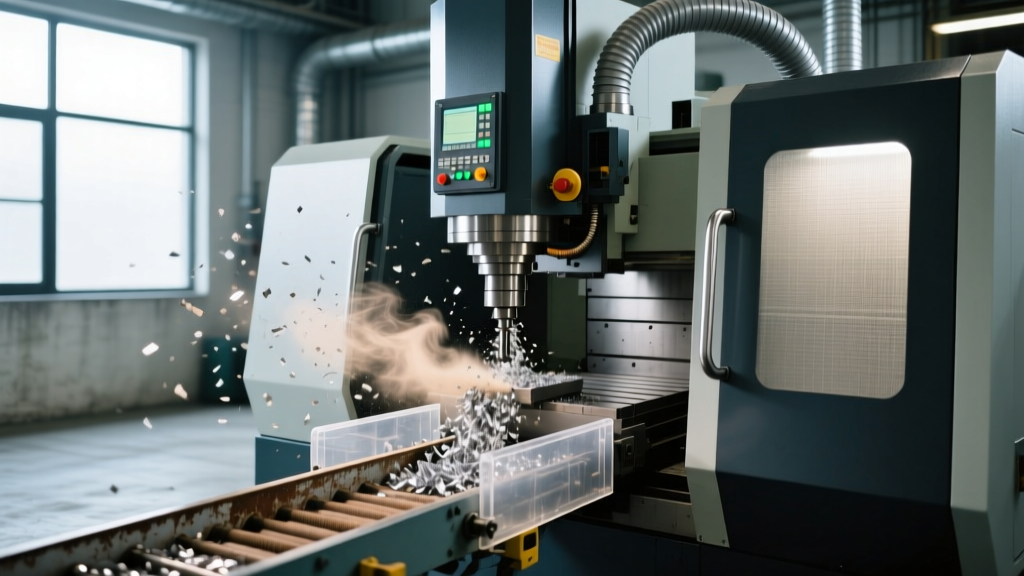
Small machine enclosures lack the aggressive washdown systems of full-size VMCs. During the adaptive clearing passes, aluminum chips piled up on the way covers and eventually jammed the X-axis ball screw wipers. Solution: Jenkins programmed strategic M08 (coolant on) and M09 (coolant off) commands directly into the G-code to pulse the coolant at high pressure during retracts, and installed an aftermarket air-blast nozzle to clear the table between operations.
3. Coolant Concentration and Fogging
In a 1,500 sq ft shop, a 50-gallon coolant sump can quickly overwhelm the HVAC system with mist if not managed properly. Following OSHA guidelines on metalworking fluid exposure, the shop installed a custom mist collector and strictly maintained their semi-synthetic coolant at an 8% concentration using a refractometer, preventing both respiratory issues and aluminum oxidation on the finished parts.
Financial Breakdown and ROI Timeline
The decision to invest in compact CNC technology was driven by strict financial modeling. Here is the exact capital expenditure and break-even analysis for Apex Precision's Haas CM-1 integration in 2026.
Capital Expenditure (CapEx)
- Machine (with probe & chip conveyor): $46,500
- Tooling & Workholding (Kurt DX4, Maritool, Harvey Tool): $4,200
- Fusion 360 Commercial License (Annual): $1,995
- Electrical & Rigging: $2,800
- Total Initial Investment: $55,495
With an average shop rate of $135 per hour and a net profit margin of 32% on UAV prototyping contracts, the machine needed to generate roughly $173,400 in gross revenue to cover the initial CapEx. At an average billing rate of $135/hr, the machine reached its break-even point at 412 spindle hours. Because the CM-1 allowed the shop to run unattended during lunch breaks and after hours via the wireless probing and tool-breakage detection, they hit the 412-hour mark in just 11 weeks.
"The biggest misconception small shop owners have is that they need a 40-taper, 50-inch table machine to do serious work. When you focus on programming a CNC machine specifically for its physical limits, a compact mill will out-produce a massive VMC on small parts simply because the rapids are faster and the setup is half the time."
— Sarah Jenkins, Lead Programmer, Apex Precision
Actionable Framework for Small Shop CNC Integration
If you are planning to introduce a compact CNC into a small workshop environment, follow this sequenced implementation framework to avoid the pitfalls Apex Precision encountered.
- Audit Your Part Envelope: Before purchasing, map the bounding box of your top 20 highest-margin parts. If 80% of them fit within a 10" x 10" x 6" cube, a compact mill is mathematically justified.
- Invest in Wireless Probing: In a small shop, manual edge-finding with a dial indicator eats up 15-20 minutes per setup. A Renishaw or Haas wireless probe reduces setup to under 3 minutes, paying for its $4,000 option cost within the first 300 setups.
- Modify Your CAM Post-Processor: Never run a generic post on a restricted-travel machine. Edit your Z-retract and G53 home positions to prevent overtravel alarms and reduce air-cutting time.
- Right-Size Your Workholding: Buy vises that match your machine's Y-axis travel, not the largest part you plan to cut. Utilize soft jaws and tombstone fixturing to maximize the limited table real estate.
By treating the physical limitations of a small-format machine not as a hindrance, but as a parameter to be optimized in the CAM environment, small workshops can achieve tier-one aerospace tolerances without the footprint or overhead of traditional heavy manufacturing equipment.