How to Use a Portable CNC Machine: Field Safety & Compliance
Learn how to use a portable CNC machine safely in field environments. Covers OSHA compliance, IP ratings, magnetic mounting, and stray voltage mitigation.
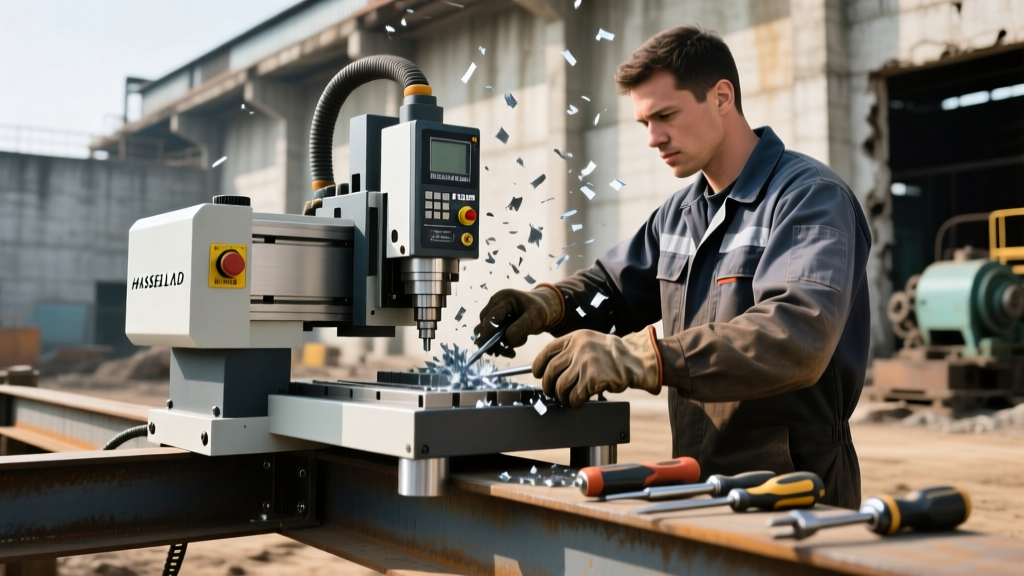
Deploying a portable CNC machine—whether a CNC plasma cutter like the ESAB Crossbow or a portable CNC milling unit from Mirage Machines—transfers the precision of the shop floor into uncontrolled, high-hazard environments like pipeline trenches, shipyards, and mining sites. Understanding how to use a CNC machine in these settings requires more than just G-code proficiency; it demands a rigorous approach to field safety, environmental hardening, and regulatory compliance.
⚠️ CRITICAL FIELD WARNING: Stray voltage from nearby arc welding operations is the leading cause of portable CNC controller failure and operator shock in field environments. Never operate a portable CNC on a workpiece that is actively being welded or grounded to a different welding return path.Core Safety Standards for Field-Deployed CNC Equipment
When taking CNC equipment out of the shop, the regulatory framework shifts. You are no longer just dealing with standard machine guarding; you are navigating construction and heavy industry compliance. The three primary standards governing portable CNC field work include:
- OSHA 1910.147 (Control of Hazardous Energy): Lockout/Tagout (LOTO) procedures must be adapted for portable generators and temporary power distribution boxes used to feed the CNC.
- OSHA 1910.252 (Welding, Cutting, and Brazing): For portable CNC plasma systems, operators must comply with strict fume extraction, flash burn prevention, and combustible material clearance protocols, as outlined by OSHA's cutting and welding standards.
- ANSI B11.8 (Safety Requirements for Drilling, Boring, and Milling Machines): Applies directly to portable CNC line-boring and milling rigs clamped to heavy machinery in the field.
Shop CNC vs. Portable Field CNC: A Safety Protocol Matrix
The safety assumptions you make in a climate-controlled facility will get you injured or cited on a rig site. Below is a direct comparison of required safety adaptations.
| Safety Parameter | Standard Shop CNC | Portable Field CNC |
|---|---|---|
| Machine Grounding | Hardwired to facility earth ground. | Must use dedicated grounding rod or verified structural steel ground; generators often lack true earth ground. |
| Enclosure Rating | NEMA 12 (Indoor dust/drip). | Minimum NEMA 4X / IP65 for pendants and controllers to survive rain and conductive dust. |
| Workholding | Hydraulic/Mechanical vises and T-slots. | Electromagnetic bases, mechanical chain clamps, or vacuum pods requiring continuous verification. |
| LOTO Execution | Main breaker on machine panel. | Lockout must be applied at the temporary distribution panel AND the generator source. |
Mitigating Mounting and Stability Hazards
When learning how to use a CNC machine like the Mirage PMS portable milling system in the field, the most catastrophic failure mode is workholding detachment. A portable CNC mill can exert upward of 800 lbs of lateral cutting force. If the machine is mounted via magnetic bases, you must understand the difference between pull force and shear force.
The Magnetic Base Degradation Factor
A portable CNC base rated for a 2,000 lb magnetic pull force does not mean it can withstand 2,000 lbs of lateral (shear) movement. Shear resistance is typically only 20% to 30% of the rated pull force, relying entirely on friction. Furthermore, field conditions degrade magnetic hold drastically:
- Paint and Rust: A 1/16-inch layer of mill scale or heavy epoxy coating can reduce magnetic adhesion by up to 60%.
- Surface Curvature: Mounting a flat magnetic base to a curved pipe reduces the contact patch, dropping the effective holding force exponentially.
Electrical Compliance: Generators, Ground Loops, and THD
Portable CNC controllers are highly sensitive to power quality. In a shop, they run on clean grid power. In the field, they are often plugged into diesel tow-behind generators. According to NIOSH machining safety guidelines, improper electrical setup in temporary environments is a primary vector for severe electrical hazards.
Total Harmonic Distortion (THD)
Standard construction generators produce 'dirty' power with high THD, which can overheat CNC spindle drives and corrupt memory on the controller. You must specify an inverter-generator or a generator equipped with an Automatic Voltage Regulator (AVR) that guarantees a THD of less than 5%. If your field generator exceeds 5% THD, you must run the CNC through an online double-conversion UPS (Uninterruptible Power Supply) rated for the machine's peak amperage draw (typically 2kVA to 5kVA for portable units).
Isolating Ground Loops
If a portable CNC plasma cutter shares a workpiece with a manual welder, the welding return current will seek the path of least resistance. If the CNC's ground cable is connected, hundreds of amps of welding current can travel backward through the CNC's delicate grounding wire, instantly vaporizing internal traces and creating a lethal shock hazard at the pendant. Rule: The CNC workpiece ground must be physically disconnected or isolated via heavy-duty diodes when nearby welding is occurring.
Pre-Deployment Field Safety Checklist
Before initiating the cycle start on any portable CNC rig, the lead operator must verify the following field-specific parameters:
- Atmospheric Monitoring: If operating in confined spaces (tanks, trenches), verify LEL (Lower Explosive Limit) is below 10% before initiating plasma cutting or milling that generates sparks.
- Pendant IP Verification: Inspect the rubber gaskets on the CNC pendant. If the IP65 seal is cracked or compromised by UV degradation, the unit cannot be used in damp conditions.
- Soft Limit Calibration: Unlike shop machines with physical hard stops, portable CNCs rely on software limits. Manually jog the machine to the absolute physical boundaries of the custom workpiece and set soft limits with a 0.5-inch safety buffer to prevent the tool from crashing into clamps or chains.
- Emergency Stop (E-Stop) Tethering: In high-noise field environments, verbal communication fails. The operator must wear a physical E-Stop lanyard or hold a dead-man's switch pendant to ensure immediate machine halt if they slip or fall on uneven terrain.
"The biggest mistake field machinists make is treating a portable CNC like a hand tool. It requires the same rigorous setup, probing, and LOTO verification as a $500,000 horizontal machining center, just with a much higher degree of environmental variables."
— Senior Field Engineering Manager, Heavy Equipment Repair Sector
Frequently Asked Questions (FAQ)
Do portable CNC operators need different certifications than shop operators?
Yes. While the G-code and CAM knowledge is identical, field operators must hold site-specific certifications. This often includes OSHA 10-Hour or 30-Hour Construction cards, confined space entry permits, and specialized rigger/signalperson certifications if the portable CNC requires overhead crane lifting to mount onto large vessels or mining equipment.
How do I safely perform LOTO on a portable CNC that plugs into a shared site generator?
Under OSHA's LOTO standard, you cannot simply unplug the machine and walk away, as someone could plug it back in. You must place a physical lockout device on the specific breaker in the temporary distribution panel feeding your CNC, and ideally, use a lockout plug adapter directly at the machine's power inlet.
What is the cost difference between field-rated and shop-rated portable CNCs?
Upgrading a standard portable CNC plasma or mill to 'field-ready' status (adding IP67 pendants, NEMA 4X enclosures, heavy-duty magnetic bases, and aviation-grade Mil-Spec cabling) typically adds $3,500 to $8,000 to the base price of the machine. Given that a single water-damaged controller replacement can cost upwards of $4,000 and halt a critical pipeline repair, the field-hardening premium is mandatory for professional compliance.