Portable CNC Machine Factory Setup: Field Work Safety Standards
Learn how to establish a compliant, portable CNC machine factory in the field. Covers OSHA standards, LOTO, magnetic mounting, and swarf containment.
The Mobile CNC Machine Factory: Shifting from Plant to Field
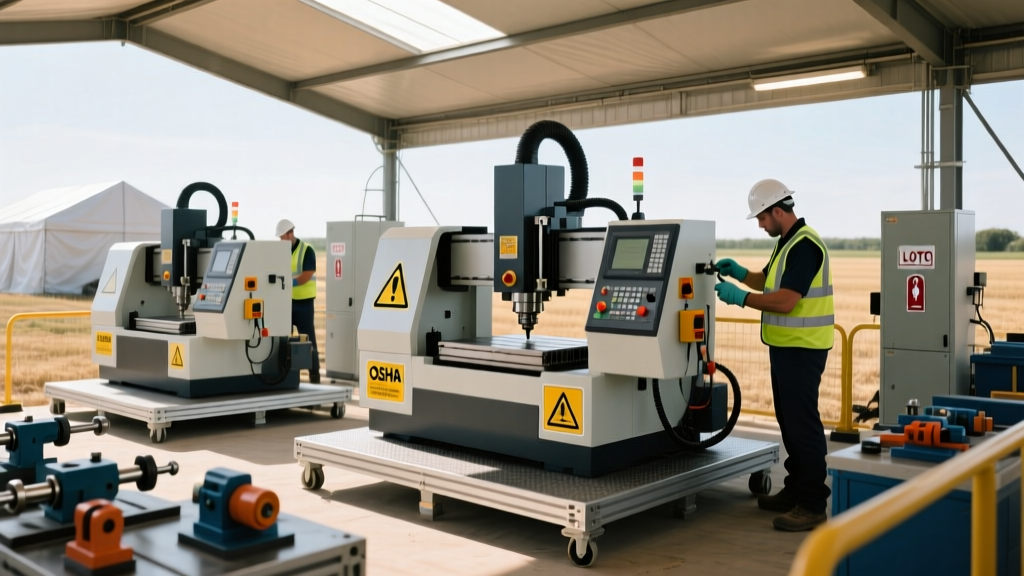
When heavy industry requires on-site repair—whether facing a wind turbine main bearing, milling a ship hull fracture, or boring a pipeline valve flange—operators essentially build a temporary cnc machine factory around the damaged asset. Unlike a traditional manufacturing plant with fixed concrete foundations, overhead cranes, and controlled climates, field-deployed portable CNC machines (such as the York Portable Machine Tools Series 20 CNC Boring Mills or Bug-O Systems CNC welding carriages) operate in chaotic, uncontrolled environments.
Establishing a compliant mobile machining zone requires a fundamental shift in safety protocols. The governing principles of OSHA 1910.212 (General Requirements for All Machines) and the ANSI B11 series for machine safeguarding still apply, but their execution must be radically adapted for temporary, mobile setups. This guide details the exact engineering controls, compliance frameworks, and operational procedures required to run a portable CNC machine factory safely in 2026.
⚠️ CRITICAL WARNING: Magnetic Base SlippagePortable CNCs frequently rely on electromagnetic bases for rapid deployment. A 0.030-inch air gap (caused by paint, rust, or surface pitting) can reduce magnetic holding force by up to 40%. If a 3,000 lb-rated magnet encounters a painted surface with a 0.050-inch coating, the effective holding force drops below the dynamic cutting forces of a 2-inch facemill, resulting in catastrophic tool ejection. Always machine a bare-metal mounting pad or use mechanical bolt-down fixtures for heavy interrupted cuts.
Core Compliance Frameworks for Field-Deployed CNCs
Regulatory compliance in a mobile cnc machine factory hinges on mitigating the unique hazards introduced by the host environment. Below is a compliance matrix contrasting traditional factory controls with required field controls.
| Hazard Category | Traditional CNC Factory Control | Portable Field CNC Control | Governing Standard |
|---|---|---|---|
| Machine Stability & Workholding | Cast iron base, anchored to concrete with epoxy grout. | Mechanical bolt-down to host asset or verified electromagnetic bases with battery backup. | ANSI B11.8 |
| Operator Interface & Pendants | Hardwired, tethered pendants with physical E-stops. | Wireless RF pendants with encrypted channels and hardware E-stop lanyards. | ISO 13849-1 |
| Swarf & Coolant Containment | Integrated sheet metal enclosures and flood coolant trays. | Magnetic chip conveyors, localized vacuum extraction, and biodegradable MQL fluids. | EPA / OSHA 1910.141 |
| Energy Isolation (LOTO) | Main electrical panel disconnect lockout. | Dual lockout: CNC generator AND the host asset's kinetic/potential energy sources. | OSHA 1910.147 |
The Physics of Field Mounting: Securing the Machine
The most critical safety variable in a portable cnc machine factory is the interface between the machine base and the workpiece. In a fixed facility, the machine is the foundation. In the field, the workpiece becomes the foundation.
Electromagnetic vs. Mechanical Workholding
Modern portable CNC boring mills and facing machines offer dual-mounting options. Electromagnetic bases (typically rated between 2,000 and 5,000 lbs of breakaway force) allow for rapid setup. However, compliance requires verifying the magnetic circuit. Operators must use a calibrated pull-tester to verify holding force after surface preparation. If the host asset is constructed of austenitic stainless steel (e.g., 304 or 316 grades), magnetic bases are entirely ineffective, mandating the use of mechanical clamping, chain mounts, or bolted sub-plates.
For mechanical mounting, utilize Grade 8 or Class 10.9 high-tensile fasteners torqued to the manufacturer's exact specification (e.g., 250 ft-lbs for a 3/4-inch bolt). Always employ hardened steel backing plates on the opposite side of thin-walled host assets to prevent localized crushing and stress fractures during heavy roughing passes.
Advanced LOTO: Isolating the Host Asset
Standard Lockout/Tagout (LOTO) procedures focus on isolating the machine's power source. In field machining, this is a fatal oversight. According to OSHA Lockout/Tagout guidelines, all hazardous energy must be controlled. When a portable CNC is mounted to a live industrial system, the host asset possesses its own kinetic, potential, hydraulic, or pneumatic energy.
💡 Field LOTO Protocol: The Dual-Isolation Rule- Isolate the CNC Power: Lock out the portable generator or main disconnect supplying the CNC control cabinet and spindle drive.
- Isolate the Host Asset: If machining a valve body, lock out the upstream and downstream pipeline pressure. If facing a crane slew ring, mechanically pin the boom and lock out the hydraulic swing motors.
- Verify Zero Energy State: Attempt to start the CNC spindle. Then, attempt to actuate the host asset. Both must fail to move.
- Monitor Stored Energy: Large castings or pressurized systems may shift or release stored thermal/mechanical stress during the cutting process, altering the alignment of the portable CNC. Schedule periodic stress-relief pauses during deep cuts.
Wireless Pendant Safety and Signal Interference
By 2026, nearly all tier-1 portable CNC systems utilize wireless Bluetooth or proprietary RF pendants to allow operators to maneuver around massive field assets without tripping over tethered cables. While this improves ergonomics, it introduces a severe safety hazard: signal cross-talk.
In congested industrial sites (e.g., shipyards or refineries), multiple wireless CNCs, heavy-duty radios, and induction heaters operate in close proximity. If a wireless pendant loses its encrypted handshake with the CNC receiver, or if a frequency collision occurs, the machine could execute a phantom G-code command.
Compliance Requirement: Ensure your portable CNC control system (such as Siemens SINUMERIK or Fagor field-portable units) features a hardware-based watchdog timer. If the wireless signal drops for more than 50 milliseconds, the drive must automatically trigger a Category 0 stop (immediate torque removal). Furthermore, operators must wear a physical E-stop lanyard connected directly to the machine's hardwired safety relay, bypassing the wireless network entirely.
Environmental Compliance: Swarf and Fluid Containment
A traditional cnc machine factory captures 100% of its swarf and cutting fluid. A field-deployed CNC operating outdoors or over sensitive infrastructure risks environmental contamination, triggering EPA violations alongside OSHA slip-and-fall hazards.
Transitioning to MQL and Biodegradable Fluids
Flood coolant is rarely viable in field work due to the impossibility of sealing the cutting zone. Instead, compliant field operations utilize Minimum Quantity Lubrication (MQL) systems. MQL delivers a micro-aerosol of lubricant directly to the cutting edge, using less than 50ml of fluid per hour.
When MQL is not sufficient for heavy-duty boring, operators must use vegetable-based ester coolants (e.g., high-oleic sunflower or canola-based formulations). Unlike petroleum-based soluble oils, these fluids are classified as readily biodegradable under OECD 301B standards. If minor drippage occurs onto soil or marine environments during shipyard repairs, the environmental remediation liability is drastically reduced.
"The intersection of OSHA worker safety and EPA environmental compliance is most volatile in field machining. Using petroleum-based straight oils on an outdoor pipeline repair isn't just a fire hazard from the hot chips—it's a reportable spill event if the swarf-oil matrix washes into a drainage ditch during a sudden rainstorm."
— Field Machining Safety Auditor, Industrial Compliance Group
Pre-Deployment Safety Audit Checklist
Before energizing the spindle on any portable CNC setup, the site supervisor must complete and sign off on the following compliance audit:
- Surface Prep Verification: Mounting area ground to bare metal (Ra 125 or better) with zero paint, rust, or scale. Magnetic pull-test documented.
- Dual LOTO Confirmed: CNC generator locked out; host asset kinetic/potential energy isolated and verified.
- Clearance Sweep: 360-degree physical walkthrough confirming the spindle, tool changer, and chip conveyor have full clearance from host asset obstructions throughout the entire programmed Z and X/Y travel.
- Containment Rigging: Magnetic chip catchers, tarps, or vacuum hoods deployed directly beneath the cutting zone to intercept swarf.
- E-Stop Lanyard Test: Operator physically pulls the hardwired lanyard E-stop; spindle and axis drives halt instantly (Category 0 stop verified).
Operating a portable cnc machine factory in the field demands a higher tier of vigilance than fixed-plant manufacturing. By treating the host asset as an active participant in the safety chain, enforcing strict magnetic and mechanical workholding protocols, and adapting LOTO for dual-energy environments, field machining teams can execute complex repairs with zero-incident compliance.