2026 Mill-Turn Centers: Calculating the Cost of CNC Machine Ownership
Discover the true cost of CNC machine mill-turn centers in 2026. Compare multitasking pricing, ROI, and hidden expenses for smart equipment buying.
The Multitasking Premium: Base Pricing Tiers for Mill-Turn Centers
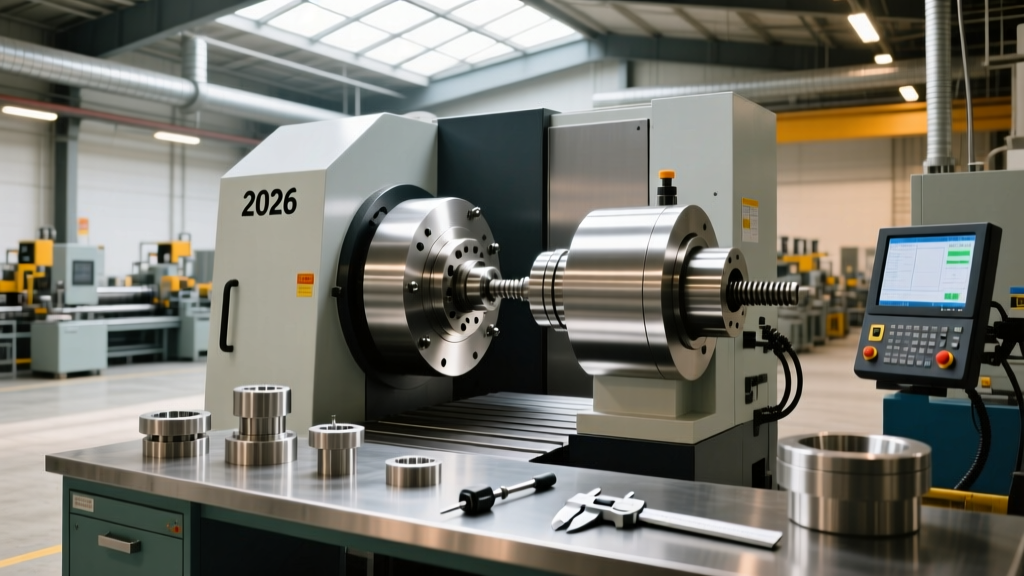
When evaluating the total cost of CNC machine ownership for multitasking centers, buyers must look far beyond the base sticker price. Multi-function CNC machines that combine milling and turning (commonly known as mill-turn centers) command a significant premium over standalone 3-axis mills or 2-axis lathes. However, they consolidate multiple setups into a single chucking, drastically reducing cycle times and cumulative tolerances. In 2026, the capital expenditure for these systems is heavily stratified by automation readiness, axis complexity, and control architecture.
Entry-Level Multitasking: Haas DS-30Y
For job shops transitioning from separate mills and lathes, entry-level Y-axis turning centers offer a bridge to multitasking. The Haas DS-30Y provides a 30hp spindle, Y-axis travel of ±2.00 inches, and a 12-station servo-driven turret. The base price hovers around $195,000. However, to make it production-ready for milling operations, you must add the high-pressure coolant option, chip conveyor, and wireless intuitive probing system (WIPS), pushing the realistic out-the-door cost to approximately $235,000.
Mid-Tier Workhorses: Mazak INTEGREX i-200S
The mid-tier segment is dominated by full simultaneous 5-axis mill-turn machines. The Mazak INTEGREX i-200S features a B-axis milling spindle and a lower turret, allowing simultaneous machining on the main and sub-spindles. Base pricing starts near $450,000, but equipping it with Capto C6 tooling interfaces, the MAZATROL SmoothAi CNC control, and automated tool breakage detection pushes the final capital cost to between $580,000 and $650,000. According to Mazak's official multitasking specifications, these machines are designed to complete complex aerospace and medical components in a single setup.
High-End Precision: DMG MORI NTX 2000
For high-mix, ultra-precision manufacturing (such as titanium aerospace structural parts), the DMG MORI NTX 2000 series represents the pinnacle of mill-turn technology. Featuring a compact B-axis with a built-in motor and integrated CELOS control systems, the baseline cost begins at $720,000. Fully optioned with 1,000 PSI coolant, automation interfaces for Robo2Go, and thermal displacement compensation, buyers should budget upwards of $950,000.
⚠️ The Hidden Tooling and Software Tax
The initial cost of CNC machine multitasking centers is only 70% of your actual startup capital. You must budget for:
- CAM Software: Standard 3-axis CAM will not generate collision-free G-code for a B-axis mill-turn. Mastercam Mill-Turn or ESPRIT licenses cost $12,000 to $18,000, plus $3,000 to $5,000 per custom machine post-processor.
- Quick-Change Tooling: Relying on standard VDI turrets limits milling rigidity. Upgrading to Sandvik Coromant Capto C6 or KM63 quick-change systems costs roughly $1,200 to $1,800 per base toolholder.
- High-Pressure Coolant: Milling exotic alloys requires 1,000 PSI (70 bar) through-spindle coolant. If not factory-installed, aftermarket retrofits cost $15,000 to $22,000 and require specialized filtration units.
Cost of CNC Machine ROI: Mill-Turn vs. Separate Lathe and Mill
To justify the capital outlay, manufacturers must calculate the Return on Investment (ROI) based on setup elimination and floor space optimization. The NIST Manufacturing Extension Partnership (MEP) frequently highlights that reducing part handling and setups is the most effective way to eliminate cumulative tolerance stack-up and scrap. Below is a comparative analysis for a mid-sized aerospace valve body machined from 17-4 PH stainless steel.
| Metric | Traditional (CNC Lathe + 3-Axis Mill) | 5-Axis Mill-Turn Center |
|---|---|---|
| Total Setup Time | 4.5 hours (Op 10, Op 20, Op 30) | 1.2 hours (Single chucking) |
| Cycle Time per Part | 48 minutes (combined) | 36 minutes (simultaneous ops) |
| Scrap Rate (Tolerance Stack) | 8% (concentricity issues) | < 1.5% |
| Floor Space Required | 140 sq. ft. (two machines) | 85 sq. ft. |
| Estimated Breakeven | N/A | 14 - 18 months |
Selecting the Right Configuration to Control Costs
Over-specifying a mill-turn center is a common pitfall that artificially inflates the cost of CNC machine ownership. Buyers must align the machine's kinematic configuration with their actual part geometry.
- C-Axis vs. B-Axis: If your milled features are strictly radial or axial (e.g., cross-holes, keyways, face contours), a C-axis spindle with a driven turret is sufficient and saves $40,000 to $60,000. A full B-axis (tilting spindle) is only necessary for complex 5-axis contoured surfaces, such as impeller blades or angled aerospace ports.
- Lower Turret Integration: Adding a lower turret allows you to turn the main spindle while simultaneously milling the sub-spindle. This reduces cycle time by up to 30% but adds $65,000 to the machine cost and requires advanced CAM programming to avoid turret-to-spindle collisions.
- Bar Feeder Readiness: If you are running high-volume production parts under 2.5 inches in diameter, specifying the machine with an integrated bar feeder interface and sub-spindle part catcher is critical. Retrofitting these later often costs 40% more than factory installation.
"The biggest mistake shops make when buying a mill-turn center is treating it like a lathe that happens to have a milling spindle. The true ROI is unlocked only when the shop re-engineers their fixturing and CAM workflows to leverage simultaneous multi-axis cutting, effectively turning non-cutting time into revenue-generating spindle time."
Maintenance and Operational Overheads
Multitasking machines feature highly complex mechanical assemblies that demand rigorous maintenance schedules. The B-axis milling spindle utilizes direct-drive torque motors and high-precision angular contact bearings. If crashed, a B-axis spindle rebuild can cost between $18,000 and $35,000, with lead times stretching from 6 to 10 weeks.
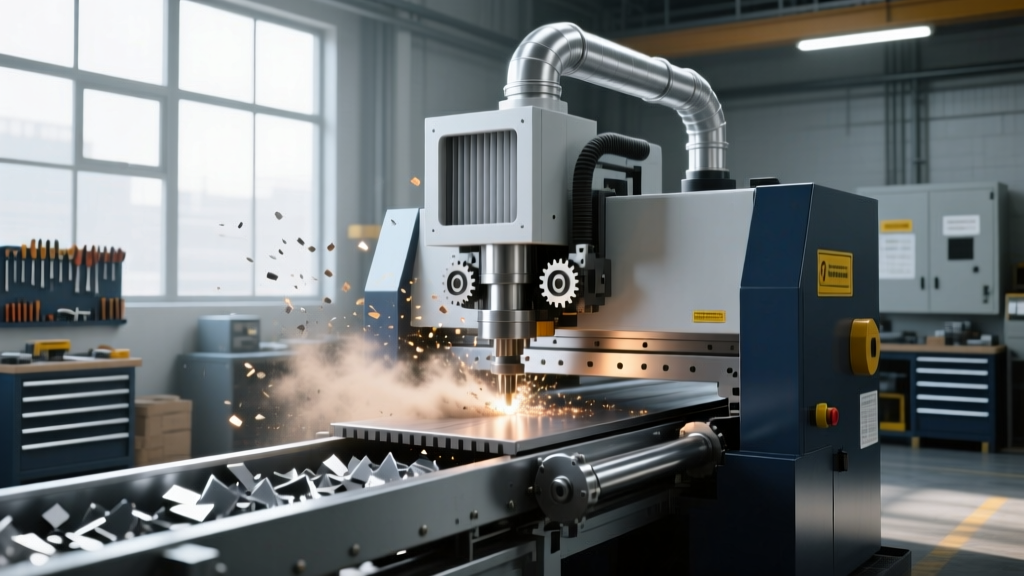
Furthermore, mill-turn centers generate vastly different chip morphologies simultaneously. Long, stringy turning chips from ductile materials can easily tangle around the milling spindle and way covers. Budgeting $8,000 to $12,000 for a high-torque, hinge-belt chip conveyor with automatic reverse-purge functionality is non-negotiable to prevent way-cover degradation and coolant sump contamination.
Frequently Asked Questions
Q: Does buying a used mill-turn center significantly reduce the cost of CNC machine ownership?
A: Purchasing a used 5-axis mill-turn center can reduce capital costs by 30% to 45%. However, buyers must allocate $15,000 for laser calibration and ballbar testing. The geometric accuracy of the B-axis and C-axis intersection degrades over time, and recertifying the kinematic center points is mandatory before cutting tight-tolerance parts.
Q: How does operator training factor into the total cost?
A: Programming and operating a simultaneous mill-turn center requires a higher skill tier than standard 3-axis milling. Budget $4,000 to $6,000 per programmer for advanced CAM training (e.g., Mastercam Mill-Turn certification) and $3,000 for OEM on-site operator training to ensure crash avoidance and optimal toolpath generation.