Miniature CNC Machine Safety Standards for Portable Field Work
Master OSHA and ANSI B11 safety compliance when deploying a miniature CNC machine for portable field work and on-site precision machining.
Bridging the Gap: Miniature CNCs in Field Environments
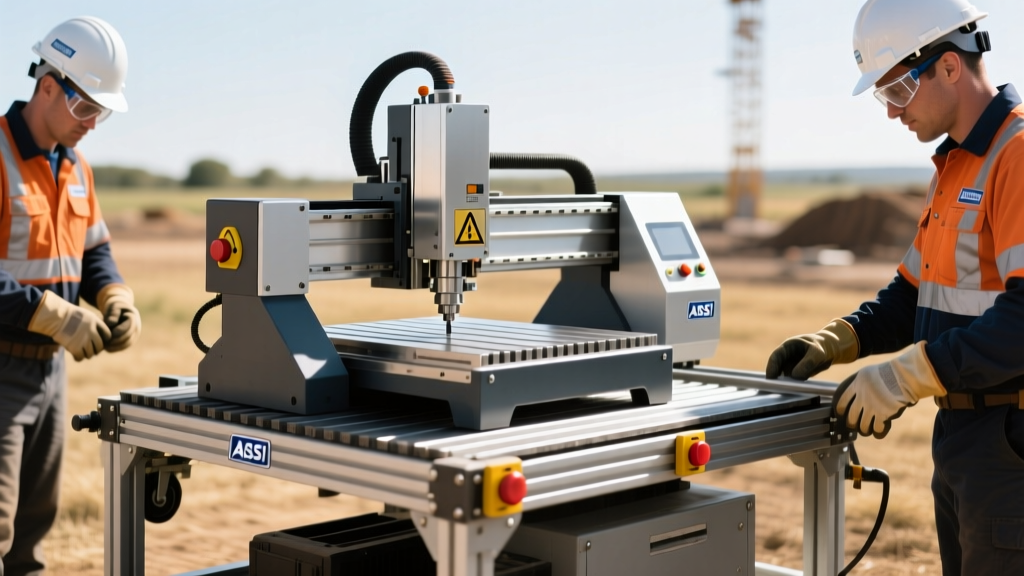
Deploying a miniature CNC machine—such as a Taig 2019DSLS micro-mill, a Proxxon CNC, or a custom compact routing unit—outside the controlled environment of a machine shop introduces a complex matrix of safety and compliance challenges. Field work, whether executed on an offshore oil rig, inside a remote mining facility, or aboard a marine vessel, strips away the inherent safety nets of a traditional shop floor. You are no longer dealing with level concrete, regulated 3-phase power, and climate-controlled air. Instead, operators must contend with uneven terrain, moisture, explosive atmospheres, and temporary power grids.
While heavy-duty portable machine tools like those from Climax Machining Tools are explicitly engineered for field abuse, benchtop-class miniature CNCs require rigorous adaptation to meet occupational safety standards. This guide details the exact OSHA, ANSI, and NFPA compliance frameworks required to safely operate miniature CNC equipment in portable field applications, ensuring both operator safety and regulatory adherence.
⚠️ Field Hazard Warning: Miniature CNC machines typically rely on open-frame stepper motors and exposed lead screws. In a field environment, airborne particulates (silica dust, salt spray, metal shavings) can rapidly degrade these components, leading to catastrophic loss of positional accuracy or sudden mechanical binding. Never deploy an open-frame miniature CNC in the field without a custom NEMA 4X or IP65-rated protective enclosure.Core Regulatory Frameworks: ANSI B11.0 and OSHA 1910.212
The foundation of machinery safety in the United States rests on the NIOSH guidance on machine safeguarding and the ANSI B11.0 standard for the safety of machinery. When a miniature CNC is removed from its intended benchtop environment and mounted to a temporary field fixture (such as a magnetic base bolted to a pipeline flange), the machine's risk profile changes entirely.
Guarding and Point-of-Operation Compliance
Under OSHA 29 CFR 1910.212(a)(1), one or more methods of machine guarding must be provided to protect the operator and other employees in the machine area from hazards such as those created by point of operation, ingoing nip points, rotating parts, and flying chips. For a miniature CNC mounted on-site, standard acrylic splash guards are insufficient.
- Interlocked Perimeter Guarding: If the miniature CNC is mounted on a large static workpiece (e.g., machining a valve body in situ), the entire cutting envelope must be surrounded by temporary modular guarding (such as steel-mesh panels) equipped with safety interlock switches. Opening the guard must trigger an immediate Category 0 stop (removal of power to the spindle and drives).
- Chip Deflection: Miniature spindles operating at high RPMs (often 10,000 to 30,000 RPM) can fracture small-diameter carbide end mills. Polycarbonate shields must be a minimum of 5mm thick to withstand the kinetic energy of shattered tooling at these speeds.
Lockout/Tagout (LOTO) in Temporary Setups
Compliance with OSHA 1910.147 LOTO standards is notoriously difficult in field work where power sources are temporary diesel generators or shared site distribution panels. A miniature CNC must be integrated into the site's LOTO matrix. This requires installing a localized, lockable disconnect switch on the machine's power umbilical, rather than relying solely on the generator's main breaker, which may be located hundreds of feet away and controlled by third-party personnel.
Environmental Tolerances and Enclosure Standards
Field environments subject miniature CNC electronics to temperature extremes, condensation, and corrosive elements. The machine's control board, stepper drivers, and limit switches must be protected according to strict ingress protection (IP) or National Electrical Manufacturers Association (NEMA) ratings.
| Rating Standard | Protection Level | Field Application Scenario |
|---|---|---|
| IP54 / NEMA 3 | Dust and splashing water | Indoor field repairs, sheltered marine engine rooms. |
| IP65 / NEMA 4 | Dust-tight and low-pressure water jets | Outdoor pipeline machining, washdown areas, coastal sites. |
| IP67 / NEMA 4X | Temporary submersion, corrosion-resistant | Offshore rigs, chemical processing plants, high-salinity environments. |
| IP66 / NEMA 6P | High-pressure jets and prolonged submersion | Subsea equipment repair (requires specialized pressure housing). |
When operating a miniature CNC in temperatures below 40°F (4°C), the grease in the miniature linear bearings and lead screws thickens, increasing the load on the stepper motors. This can cause missed steps and tool crashes. Operators must switch to synthetic, low-temperature way oils (such as ISO VG 22 synthetic) and reduce rapid traverse rates by at least 30% to prevent torque overload.
Power Quality: Generators, THD, and Grounding
One of the most frequent causes of miniature CNC failure and subsequent safety incidents in the field is poor power quality. Benchtop CNC controllers are designed for clean, stable grid power. Field generators, however, produce significant Total Harmonic Distortion (THD) and voltage fluctuations, especially when heavy inductive loads (like site welders or cranes) cycle on and off.
Power Conditioning Requirements
To protect the miniature CNC's micro-stepping drivers and prevent erratic axis movements, the power supply must be conditioned. Do not plug a miniature CNC directly into a standard portable generator.
- Double-Conversion Online UPS: Install a double-conversion uninterruptible power supply between the generator and the CNC controller. This completely isolates the machine from generator THD, providing a pure sine wave with less than 3% THD.
- Voltage Drop Limits: When running long extension cords from a site distribution panel, voltage drop must not exceed 5%. For a 120V miniature CNC drawing 10A, using 250 feet of 12 AWG cable will result in a 3.1V drop (acceptable), whereas 14 AWG cable will drop nearly 5V, risking controller brownouts during spindle acceleration.
Equipotential Bonding and GFCI Protection
Because the miniature CNC is often clamped directly to a massive grounded structure (like a steel ship hull or pipeline), the machine frame becomes part of the grounding path. Per NFPA 70 (National Electrical Code) Article 590 for temporary wiring, all temporary power receptacles must be protected by Ground-Fault Circuit Interrupters (GFCI). However, standard 5mA trip GFCIs can nuisance-trip due to the electromagnetic interference (EMI) generated by the CNC's stepper drives. Use specialized industrial GFCI receptacles with a higher trip threshold (e.g., 20mA to 30mA, where local codes permit for industrial equipment) or ensure the CNC chassis is bonded directly to the site's grounding grid via a dedicated 6 AWG copper grounding conductor.
💡 Pro Tip: Magnetic Base InterlocksIf your miniature CNC is mounted via heavy-duty magnetic bases, install a continuous circuit that monitors the magnetic hold. If the magnetic base loses power or begins to slip (detectable via a micro-switch shim), the circuit must immediately halt the spindle and freeze the axes to prevent the machine from tearing off the workpiece and striking the operator.
Step-by-Step Field Commissioning Checklist
Before initiating the first G-code cycle in a field environment, the setup supervisor must verify the following compliance and safety parameters:
- Workpiece Rigidity: Verify that the temporary fixture or magnetic mount can withstand the maximum cutting forces of the miniature CNC (typically 50-150 lbs of lateral force for micro-mills) without shifting.
- Limit Switch Validation: Manually jog all axes to their physical limits. Field vibrations during transport frequently knock opto-isolated limit switches out of alignment.
- E-Stop Circuit Testing: Trigger all Emergency Stop buttons (both on the machine pendant and the temporary perimeter guarding) to verify they physically sever power to the spindle relay, not just send a software pause command.
- Tool Length Offset Verification: Re-probe all tool lengths on-site. Thermal expansion of the workpiece and machine frame in direct sunlight can alter Z-axis datums by up to 0.015 inches on a 12-inch span.
- Spindle Runout Check: Use a dial indicator to check spindle runout. Field transport often misaligns the miniature spindle bearings. Runout exceeding 0.0005 inches will cause premature micro-tool breakage, sending carbide shrapnel into the work area.
Chip Management and Fire Hazards in Remote Sites
Field machining often involves repairing exotic alloys or working in classified hazardous areas. If a miniature CNC is used to machine magnesium, titanium, or beryllium copper components on-site, chip management becomes a critical fire and health safety issue.
Standard shop-floor vacuum systems are not intrinsically safe and cannot be used in explosive atmospheres (Class I, Div 2). When machining combustible metals with a miniature CNC in the field, operators must use localized, pneumatic-powered venturi vacuums equipped with submerged wet-collection drums to instantly quench hot chips. Furthermore, a Class D fire extinguisher must be positioned within 15 feet of the machine. Never use standard ABC dry chemical or water-based extinguishers on a magnesium or titanium chip fire, as this will cause an explosive exothermic reaction.
Summary of Best Practices
Operating a miniature CNC machine in a portable field work setting demands a paradigm shift from convenience to rigorous risk management. By enforcing strict adherence to OSHA guarding mandates, conditioning temporary power supplies to protect sensitive micro-steppers, and deploying IP-rated enclosures, technicians can safely leverage the precision of benchtop CNC technology in the most unforgiving industrial environments.