Troubleshooting CNC Machine Tools: Coolant & Enclosure Fixes
Diagnose and repair CNC machine tools enclosure leaks and coolant system failures. Expert fixes for way covers, seals, and high-pressure fluid blocks.
The Financial Impact of Enclosure and Coolant Failures
When maintaining CNC machine tools, the enclosure and coolant delivery systems are often treated as secondary to the spindle and axis drives. This is a costly oversight. A compromised telescopic way cover on a 5-axis machining center can allow abrasive swarf to infiltrate the linear guideways, resulting in $12,000 to $25,000 in ball screw and rail replacement costs. Similarly, a failing high-pressure coolant pump or degraded fluid concentration leads to premature insert wear, increasing tooling costs by 15% to 30% annually. With average machine downtime costing $150 to $300 per hour, rapid diagnosis of fluid and containment failures is critical for shop floor profitability.
⚠️ SAFETY WARNING: Before inspecting high-pressure through-spindle coolant (TSC) systems operating at 1,000+ PSI, ensure the machine is fully locked out and tagged out (LOTO). Residual hydraulic pressure in the accumulator can cause severe injection injuries if lines are disconnected without bleeding.Diagnosing Enclosure Seal and Way Cover Degradation
The primary defense for CNC machine tools against chip and coolant ingress is the telescopic steel way cover and polyurethane bellows. Failure rarely occurs in the steel shields themselves; it occurs at the dynamic sealing interfaces.
Wiper Seal and Glide Block Failures
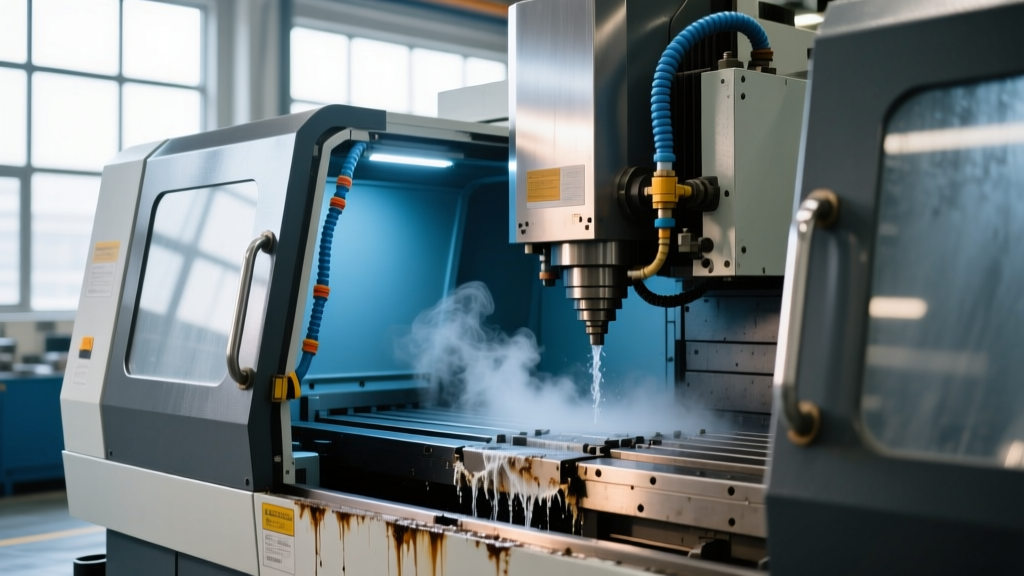
Each way cover leaf utilizes a wiper seal (typically extruded polyurethane or nitrile rubber) and brass or composite glide blocks. If coolant is pooling on the machine bed or chips are accumulating under the covers, the wiper durometer has likely degraded, or the brass glide blocks have worn past their 0.5mm tolerance, allowing the seal to lift off the mating surface during rapid traverses.
| Material | Shore Hardness | Chemical Resistance | Expected Lifespan (2-Shift Operation) |
|---|---|---|---|
| Nitrile Rubber (NBR) | 70A - 80A | Moderate (Degrades with synthetic coolants) | 18 - 24 Months |
| Polyurethane (PU) | 85A - 92A | High (Excellent against semi-synthetics) | 36 - 48 Months |
| PTFE-Coated Fabric | N/A (Fabric) | Extreme (Impervious to most fluids) | 60+ Months |
Repair Protocol: When replacing wiper seals on vertical machining centers (e.g., Haas VF series or DMG Mori CMX V), always upgrade from standard NBR to 90A Polyurethane if using aggressive semi-synthetic coolants. Ensure the seal lip is pre-loaded with a 316 stainless steel garter spring to maintain constant contact pressure as the cover compresses.
Coolant System Troubleshooting: Flow, Pressure, and Chemistry
Coolant management for CNC machine tools extends far beyond topping off the sump. Fluid degradation causes biological growth, corrosion, and misting hazards. According to OSHA's Metalworking Fluids guidelines, poorly maintained fluids pose severe respiratory risks and degrade machining surface finishes.
Concentration and pH Instability
A sudden drop in coolant concentration or a pH shift below 8.5 indicates bacterial proliferation or excessive tramp oil ingress. Semi-synthetic fluids like TRIM MicroSol 585XT require a strictly maintained concentration of 5% to 8%.
- Test with a Refractometer: Do not rely on visual inspection. Use a handheld optical refractometer. Multiply the Brix reading by the fluid's specific multiplier (e.g., 1.5x for many synthetic blends) to get the true concentration percentage.
- Check pH Levels: Use a calibrated digital pH meter. Ideal range is 8.8 to 9.2. If pH drops below 8.5, add a designated pH-up boost (typically an alkanolamine blend) rather than dumping the sump.
- Verify Water Quality: If concentration requires constant adjustment, test the makeup water. Water hardness above 150 ppm causes calcium soaps to form, splitting the emulsion. Install a reverse osmosis (RO) or deionized (DI) water system for sump top-offs.
Tramp Oil Skimmer Sizing and Selection
Way lube and spindle oil inevitably leak into the coolant sump. A layer of tramp oil blocks oxygen, accelerating anaerobic bacteria growth (the source of the 'rotten egg' smell). Belt skimmers are standard, but sizing is critical. A 4-inch belt skimmer removes approximately 1.5 gallons of oil per hour. If your CNC machine tools are equipped with high-volume way lube systems (e.g., large horizontal boring mills), upgrade to an 8-inch belt or a tube skimmer capable of pulling 3 to 5 gallons per hour to stay ahead of the ingress rate.
Fixing High-Pressure Through-Spindle Coolant (TSC) Blockages
Modern CNC machine tools utilize TSC systems operating between 300 PSI and 1,000 PSI to break chips in deep cavity milling and gun drilling. A sudden loss of TSC pressure at the tool tip is rarely a pump failure; it is almost always a filtration or union seal issue.
💡 PRO TIP: Never use 'nominal' rated filters for 1,000 PSI TSC systems. A nominal 10-micron filter allows up to 30% of particles larger than 10 microns to pass through. Always specify absolute rated filters (e.g., Absolute 5-micron Beta 1000) to protect the spindle rotary union seals from abrasive scoring.Diagnosing the Rotary Union
If the pump pressure gauge reads 1,000 PSI but the tool output is a weak trickle, the spindle rotary union is likely bypassing internally. This occurs when micro-fines bypass the primary filter and score the ceramic or tungsten carbide seal faces inside the union. Rebuilding a rotary union requires a cleanroom environment; standard shop-floor replacement of the entire union cartridge ($800 - $1,500) is the only viable repair to prevent spindle contamination.
Way Cover and Fluid Containment Repair Matrix
Use this decision matrix to rapidly isolate the root cause of containment failures on CNC machine tools.
| Symptom | Probable Root Cause | Diagnostic Check | Corrective Action |
|---|---|---|---|
| Coolant misting outside enclosure | Door seal compression set or negative air pressure failure | Perform dollar-bill drag test on door gaskets; check exhaust fan CFM | Replace hollow-bulb EPDM door seals; clean mist collector baffles |
| Axis following error alarms (e.g., Haas Alarm 411) | Swarf packed under way cover binding the axis | Jog axis to full extension; inspect wiper seal lip for chip embedding | Clean guideways, replace wiper seals, adjust gib clearance |
| TSC pressure fluctuating wildly | Cavitation in pump intake or clogged suction strainer | Inspect pump inlet line for air leaks; check sump fluid level | Clean 40-mesh suction strainer; replace cracked PVC intake fittings |
| Emulsion splitting (fluid looks like milk with clear water) | Hard water reaction or extreme pH drop | Test water hardness and fluid pH; check for excessive tramp oil | Skim tramp oil; add emulsion stabilizer; switch to DI water |
Preventative Maintenance Schedule for Fluid and Enclosure Systems
Reactive repairs on CNC machine tools lead to cascading mechanical failures. Implement this strict maintenance cadence to maximize component life and adhere to NIOSH criteria for metalworking fluid exposure.
- Daily: Check coolant concentration via refractometer. Visually inspect way cover wipers for embedded chips. Verify TSC pressure gauge reads within 5% of programmed setpoint.
- Weekly: Run tramp oil skimmer for a minimum of 4 hours. Inspect enclosure door gaskets for tears. Check coolant sump level and top off with pre-mixed fluid (never add straight water or straight concentrate to the sump).
- Monthly: Test coolant pH and adjust if necessary. Inspect telescopic way cover brass glide blocks for excessive wear. Clean mist collector filters and verify airflow.
- Bi-Annually: Perform a complete sump dump and clean. Use a dedicated machine cleaner (e.g., TRIM TC-1) to kill residual bacteria in the plumbing. Replace all TSC inline absolute filters. Inspect and replace way cover wiper seals if durometer has dropped below spec.
"The enclosure and coolant systems are the respiratory and immune systems of CNC machine tools. Neglecting fluid chemistry and seal integrity doesn't just create a mess on the floor—it directly accelerates the wear of the machine's most expensive precision components."
By treating containment and fluid delivery as critical precision systems rather than mere accessories, shops can drastically reduce unplanned downtime, extend tooling life, and maintain the tight geometric tolerances required in modern manufacturing.