CNC Honing Machine Specs: Industrial vs Consumer CNC Limits
Compare CNC honing machine technical specifications with consumer CNC mills. Discover why industrial kinematics are required for precision bore finishing.
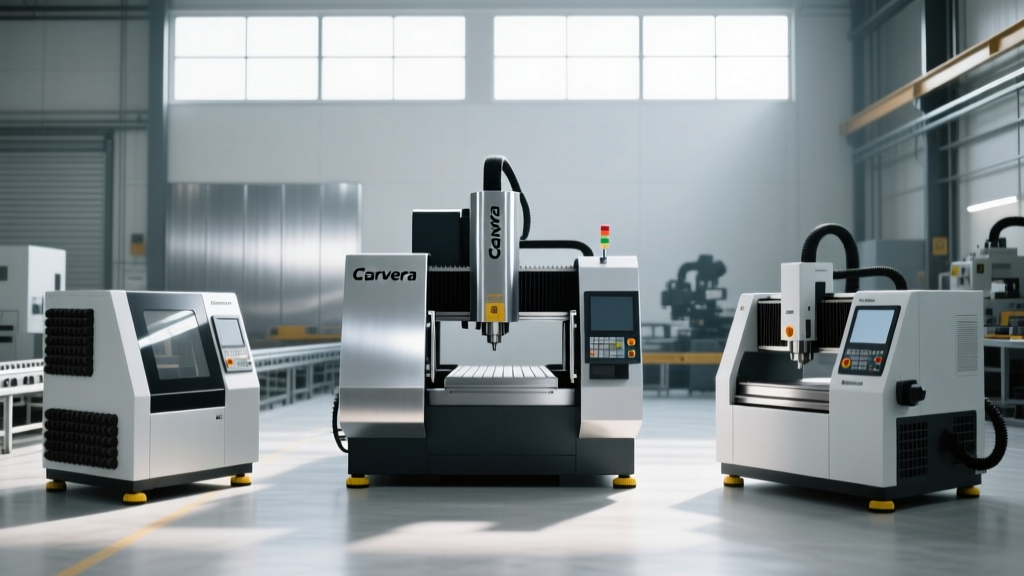
The assumption that a rigid consumer-grade or prosumer CNC mill can replicate the bore finishing capabilities of an industrial CNC honing machine is a fundamental misunderstanding of machining kinematics. While desktop and benchtop CNC mills (such as the Tormach PCNC 1100 series or Haas Desktop Mill) excel at prototyping and light 3-axis milling, they physically lack the mechanical architecture to perform precision internal cylindrical honing. Attempting to finish hydraulic cylinders, engine bores, or valve bodies on a consumer CNC mill results in catastrophic seal failure, improper oil retention, and out-of-tolerance scrap.
⚠️ The 'Bore Finish' Myth in Prosumer CNCs: Many small job shops attempt to use single-point boring bars or helical interpolation with endmills on consumer CNCs to achieve final bore dimensions. While this may achieve size tolerance, it completely fails to generate the non-directional cross-hatch pattern and plateau surface required for dynamic sealing and lubrication.The Kinematics of a CNC Honing Machine
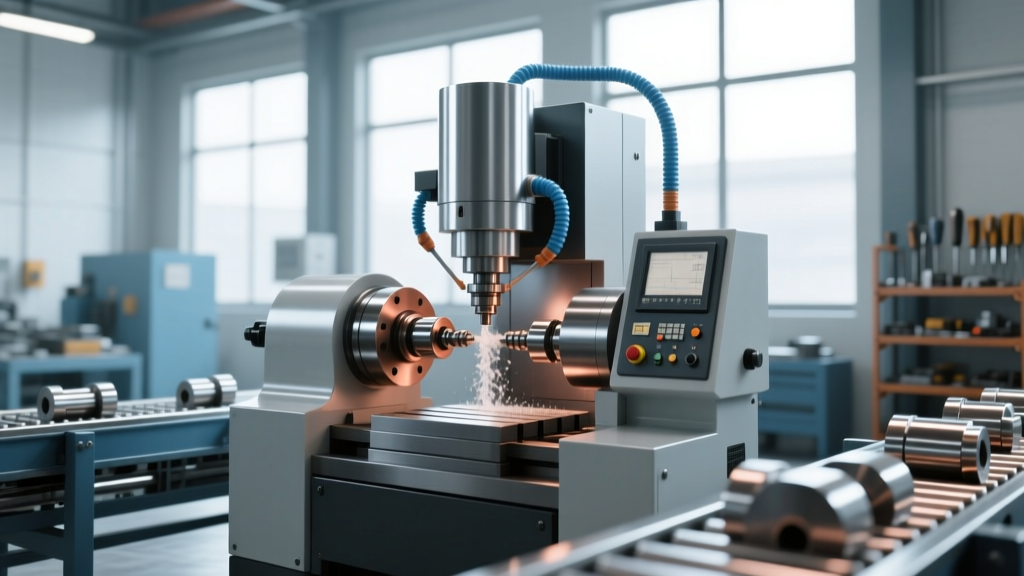
Unlike a standard 3-axis CNC mill where the spindle rotates and the table moves linearly, a true CNC honing machine (such as the vertical Sunnen SV-500 series) relies on simultaneous rotation and reciprocation. The spindle rotates the honing tool at low speeds (typically 50 to 500 RPM) while a secondary servo-driven axis strokes the tool up and down through the bore at 10 to 40 strokes per minute.
This dual-axis synchronization generates a precise cross-hatch pattern on the bore wall. The cross-hatch angle ($\theta$) is dictated by the ratio of the reciprocating stroke speed ($V_s$) to the cutting surface speed ($V_c$). Industrial honing CNCs dynamically adjust the stroke reversal points based on real-time load feedback to prevent over-stroking (bell-mouthing) or under-stroking (barreling) the bore. Consumer CNC mills lack the low-end spindle torque and synchronized Z-axis reciprocation mapping required to execute this motion without stalling or chattering.
Technical Specifications: Industrial Honing vs. Consumer CNC Mills
The table below contrasts the hard specifications of an industrial vertical CNC honing system against a high-end consumer/prosumer CNC mill attempting bore finishing operations.
| Specification / Feature | Industrial CNC Honer (e.g., Sunnen SV-500) | Consumer CNC Mill (e.g., Tormach 1100MX) |
|---|---|---|
| Primary Kinematics | Simultaneous Rotation & Reciprocation | 3-Axis Linear + Spindle Rotation |
| Bore Tolerance Capability | ±0.0001" (2.5 µm) | ±0.0005" to ±0.001" (12-25 µm) |
| Surface Finish (Ra) | 0.1 - 0.4 µm (Plateau capable) | 1.6 - 3.2 µm (Boring bar limit) |
| Spindle Torque @ Low RPM | High (Direct-drive servo, 100% duty at 100 RPM) | Low (Belt/chain drive, stalls < 500 RPM) |
| In-Process Gauging | Integrated air/pneumatic closed-loop | Manual post-process probe or none |
| Tool Expansion Mechanism | Mechanical/hydraulic micro-adjustment (µm increments) | Fixed geometry tooling |
In-Process Gauging and Closed-Loop Feedback
The most critical differentiator between an industrial CNC honing machine and a consumer CNC mill is in-process gauging. During honing, abrasive stones remove material at a microscopic level. Industrial machines utilize a pneumatic or air-jet gauge mounted directly behind the honing stones. As the bore diameter expands, the air pressure changes, feeding closed-loop data to the CNC controller. The machine automatically retracts the stones the exact micron the target size is reached, compensating for thermal expansion of the workpiece and tool wear.
Consumer CNC mills rely on post-process measurement. The operator must stop the machine, remove the part, measure with a bore gauge, adjust the tool offset, and re-cut. This open-loop process makes holding a ±0.0001" tolerance impossible in a production environment due to ambient temperature fluctuations and spindle thermal growth.
Tooling Mechanics: Abrasive Stones vs. Fixed Geometry
Honing does not use fixed-geometry carbide inserts. It relies on abrasive stones that expand outward via a precision wedge or ball-screw pushrod inside the tool body. Selecting the correct abrasive is highly material-dependent:
- Metal-Bond Diamond: Required for hardened steels (>45 HRC), such as hydraulic cylinder tubes and fuel injection bodies. Diamond stones maintain their form and cut aggressively without loading.
- Vitrified CBN (Cubic Boron Nitride): Used for aerospace alloys like Inconel and tough stainless steels where diamond would chemically react or degrade.
- Aluminum Oxide / Silicon Carbide: Reserved for soft cast iron and non-ferrous aluminum engine blocks, though diamond is increasingly replacing these due to longer tool life.
According to Sunnen Products Company, modern CNC honing tools expand in increments as fine as 0.00005" (1.2 µm), allowing for precise plateau honing—a process that removes the microscopic peaks of the cross-hatch while leaving the deep valleys intact for oil retention.
"Surface roughness (Ra) alone is an inadequate metric for bore finishing. A consumer CNC mill might achieve a 0.8 µm Ra using a polished boring bar, but the directional lay marks will destroy piston rings. A CNC honing machine achieves a 0.4 µm Ra with a 20-degree cross-hatch, ensuring hydrodynamic lubrication and dynamic seal integrity."
— Adapted from surface metrology guidelines via Keyence Surface Roughness Measurement resources.
Coolant Filtration Requirements
An often-overlooked technical limitation of consumer CNCs is coolant filtration. Honing generates microscopic abrasive swarf. If this swarf is not removed, it embeds into the soft workpiece material, ruining the surface finish and acting as a lapping compound that destroys the final assembly.
Industrial CNC honing machines utilize specialized coolant systems with 5-micron to 10-micron centrifugal or paper-band filtration, alongside magnetic separators to pull ferrous particles. Consumer CNC mills typically use 50-micron skimmers or basic settling tanks. Running a honing tool in a standard consumer CNC flood coolant environment will result in immediate surface scratching and tool loading.
Capital Expenditure and ROI Decision Framework
The financial barrier to entry for true CNC honing is substantial, reflecting the precision engineering required. As of 2026, machine tool pricing reflects the following market realities:
Cost Breakdown
- Consumer CNC Mill (e.g., Tormach 1100MX): $12,000 – $16,000 (Base machine, tooling, and basic enclosure).
- Industrial CNC Honing Machine (e.g., Sunnen SV-500): $260,000 – $340,000 (Including automation, air gauging, and 5-micron filtration).
- Consumable Tooling: Diamond honing stones cost $800 – $1,500 per set but yield thousands of parts per set in hardened steel.
When to Invest vs. Outsource
Use the following framework to determine if your shop requires an in-house CNC honing machine or if you should outsource to a specialized facility:
- Volume Threshold: If you are honing more than 500 bores per month, the per-part cost of outsourcing (typically $15–$45 per bore depending on diameter and depth) justifies the CapEx of an industrial machine.
- Liability & NDA Constraints: Aerospace and defense contractors machining proprietary valve bodies or actuator cylinders often cannot outsource due to ITAR restrictions or IP protection, mandating in-house capability regardless of volume.
- Turnaround Time: If your consumer CNC mill is bottlenecked waiting for outsourced honing to return, bringing the process in-house eliminates the 2-to-4 week lead time typical of specialized job shops.
For further technical reading on abrasive machining processes and bore finishing standards, the Society of Manufacturing Engineers (SME) provides extensive literature on the tribology of plateau honing and abrasive tool selection.