Choosing a Manufacturer of CNC Machines for Field Work
Learn how to evaluate a manufacturer of CNC machines for portable field work, focusing on safety standards, ISO compliance, and on-site machining specs.
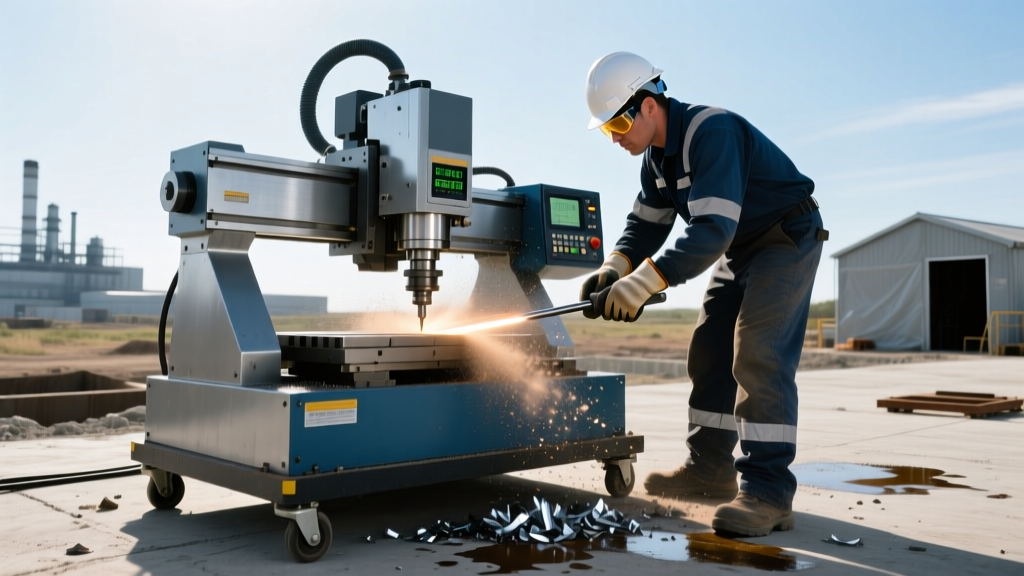
Deploying portable CNC equipment for on-site flange facing, line boring, or milling strips away the controlled safety infrastructure of a traditional machine shop. When repairing heavy mining excavators, maintaining offshore wind turbine monopiles, or executing emergency pipeline hot-taps, the operational environment is inherently hostile. Selecting a manufacturer of CNC machines that engineers specifically for field compliance is not merely a procurement preference; it is a critical risk-management decision. In 2026, the regulatory landscape for on-site automated machining has tightened, demanding rigorous adherence to international safety directives that many legacy vendors still fail to meet.
Compliance Gap Warning: Standard shop-grade CNC enclosures and control pendants do not meet OSHA 1910.212(a)(1) requirements when adapted for field use. Portable mounting bases introduce dynamic vibration hazards and uneven load distributions that require specialized guarding and redundant E-Stop topologies.Core Safety Directives for Portable CNC Manufacturers
A reputable manufacturer of CNC machines designed for field deployment must anchor their engineering process in ISO 12100:2010 (Safety of machinery — General principles for design). This standard mandates a hierarchical risk reduction approach. For portable CNCs, the primary hazards are not just entanglement or swarf ejection, but catastrophic base-mount failure due to pipe corrosion or structural yielding.
Top-tier manufacturers conduct finite element analysis (FEA) on their split-frame mounting systems to ensure they can withstand 3G dynamic vibration loads without clamping yield. When evaluating a vendor, request their Technical Construction File (TCF). The TCF must contain documented risk assessments specifically addressing uneven mounting surfaces, which are ubiquitous in field repairs. If the manufacturer only provides risk assessments for flat, rigid factory floors, their equipment is non-compliant for heavy field work.
OSHA and Machine Guarding in Uncontrolled Environments
Under OSHA 1910.212 (General Requirements for All Machines), point-of-operation guarding is mandatory. In a factory, this means polycarbonate enclosures. In the field, a portable CNC flange facer might be mounted 200 feet in the air on a crane boom. Manufacturers must supply modular, interlocked guarding systems that prevent machine operation if a guard panel is removed, utilizing RFID-coded safety switches (such as Pilz PSENcode) rather than easily defeated mechanical limit switches.
ATEX and Hazardous Location Engineering
The most stringent test for a manufacturer of CNC machines is designing for explosive atmospheres, particularly in oil and gas or chemical processing facilities. Standard electric servo motors and control cabinets will ignite volatile gases. To operate in Zone 1 or Zone 2 hazardous areas, the equipment must comply with the ATEX Directive (2014/34/EU) or North American HazLoc standards. According to guidelines outlined by the UK Health and Safety Executive (HSE) regarding ATEX compliance, equipment must be certified by a recognized Notified Body.
Manufacturers achieve this through two primary drive architectures:
- Pneumatic Drive Systems: Utilizing high-torque air motors (often sourced from specialized suppliers like Atlas Copco or Ingersoll Rand) that eliminate electrical arcing. The CNC control logic is housed in a purged and pressurized Ex-p enclosure, maintaining a positive pressure of inert gas or clean air to prevent explosive gas ingress.
- Hydraulic Drive Systems: Preferred for heavy-duty line boring where pneumatic torque density is insufficient. The hydraulic power unit (HPU) is located outside the hazardous zone, with only non-sparking hydraulic hoses and motors entering the classified area.
2026 Portable CNC Specifications and Pricing Matrix
The following table compares current flagship portable CNC models from leading manufacturers, highlighting their safety certifications and field capabilities.
| Manufacturer / Model | Primary Application | Drive System | Hazardous Area Rating | Est. Base Price (2026) |
|---|---|---|---|---|
| Climax Portable Machining / BB5000 CNC | Heavy Line Boring (up to 10m) | Hydraulic / Servo | Zone 1 Capable (with remote HPU) | $85,000 - $110,000 |
| Mirage Machining / CNC Flange Facer | Pipeline Flange Facing | Pneumatic | ATEX Certified Zone 1 | $65,000 - $82,000 |
| York Portable Machine Tools / CNC Mill | On-site 3-Axis Milling | Electric / Hydraulic | Non-rated (Standard Industrial) | $55,000 - $75,000 |
Control Topologies and E-Stop Architectures
Field work frequently requires the operator to stand 15 to 30 feet away from the cutting tool to maintain a safe line of sight while avoiding swarf ejection. This necessitates wireless control pendants. However, standard Bluetooth or Wi-Fi pendants used in consumer electronics are entirely unacceptable for industrial safety.
A compliant manufacturer of CNC machines will integrate safety-rated wireless protocols, such as PROFIsafe over Wi-Fi or CIP Safety. These systems must achieve a Performance Level 'e' (PLe) or Safety Integrity Level 3 (SIL 3) under ISO 13849. This requires dual-channel redundant signal transmission. If the wireless link experiences packet loss or interference from nearby welding equipment, the safety relay must instantly default to a Category 0 stop (immediate power removal to the drive motors), locking the spindle and feed axes within milliseconds.
Procurement Tip: Always demand the safety relay schematic for the wireless pendant. Look for hardware from established safety automation brands like Siemens (SIMATIC) or Pilz. If the manufacturer uses proprietary, unbranded logic boards for their E-Stop routing, reject the equipment.Swarf Containment and Environmental Compliance
On offshore rigs or inside confined mining shafts, metallic swarf and cutting fluids cannot be allowed to contaminate the environment. Traditional shop CNCs rely on heavy sheet-metal chip conveyors. Portable CNC manufacturers must engineer flexible, magnetic, or vacuum-assisted swarf extraction systems that integrate directly into the portable guarding.
Advanced 2026 models feature localized high-vacuum extraction hoods mounted directly to the spindle carriage, capturing up to 95% of dry machining particulates before they can fall into sensitive machinery or marine environments. When using flood coolant, the manufacturer must provide closed-loop filtration carts that separate tramp oil and metallic fines, ensuring the coolant discharged or stored on-site meets local environmental protection agency standards.
Step-by-Step Vendor Audit Framework
Before issuing a purchase order for portable CNC equipment, execute this four-point compliance audit:
- Request the TCF and Declaration of Conformity: Verify that the CE or UKCA marking is backed by a complete Technical Construction File, not just a superficial certificate.
- Verify ATEX Notified Body Certificates: If operating in hazardous zones, ensure the specific air motors and Ex-p control cabinets carry valid, unexpired certificates from a recognized body (e.g., TÜV, SGS, or Baseefa).
- Inspect the Mounting Hardware: Evaluate the chain-mounts and split-frames. Ensure the clamping bolts are graded (e.g., ISO 898-1 Class 10.9 high-tensile steel) and that the manufacturer provides specific torque tables for different pipe diameters and wall thicknesses.
- Test the E-Stop Latency: During the factory acceptance test (FAT), trigger the wireless E-Stop at maximum feed rate and measure the spindle deceleration time. It must halt within the manufacturer's documented safety parameters (typically under 0.5 seconds for pneumatic systems).
"The difference between a factory CNC and a field CNC is not just portability; it is the engineering of failure states. In the field, the machine must assume the environment is actively trying to compromise its structural integrity and safety circuits." — Lead Reliability Engineer, Offshore Maintenance Division.
Choosing the right manufacturer of CNC machines for field work requires looking past cutting speeds and axis travel. By rigorously enforcing ISO 12100 risk assessments, demanding SIL 3 wireless safety topologies, and verifying ATEX certifications, procurement teams can ensure their on-site machining operations remain both highly productive and strictly compliant with modern safety mandates.