How to Program CNC Machine Toolpaths for Chip and Dust Control
Learn how to program CNC machine toolpaths to optimize chip evacuation, reduce dust buildup, and extend your extraction system's maintenance intervals.
The CAM-to-Maintenance Pipeline: Why Toolpaths Dictate Service Intervals
Chip accumulation and airborne particulate are not just housekeeping issues; they are primary catalysts for premature CNC spindle failure, way cover degradation, and extraction system burnout. While most maintenance schedules focus on physical cleaning routines, the root cause of excessive debris often originates in the CAM software. When you program CNC machine toolpaths without considering chip morphology and evacuation dynamics, you inadvertently accelerate the wear cycle of your dust collection and chip management hardware.
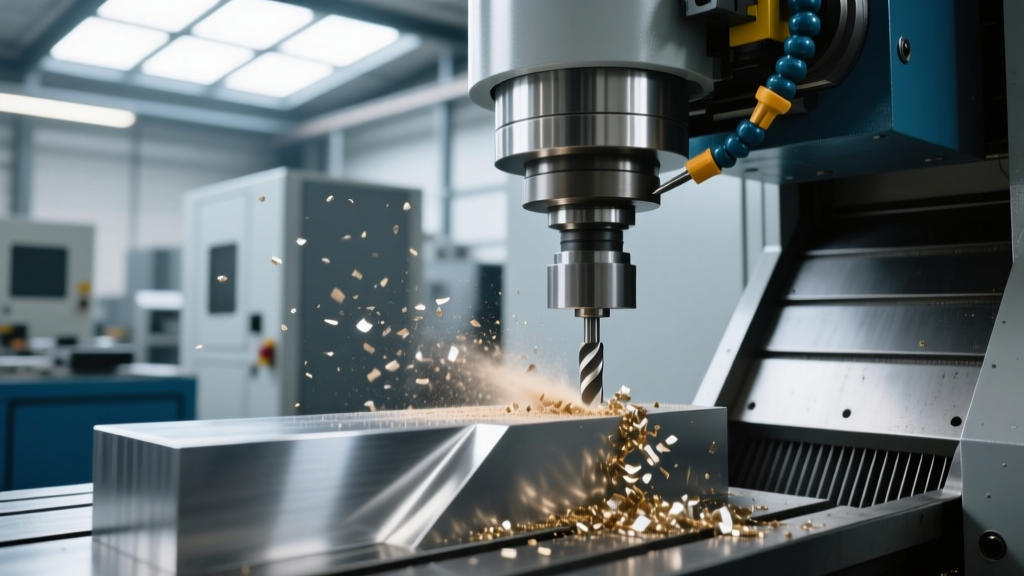
⚠️ Maintenance Warning: Ingress of sub-10-micron abrasive dust into a sealed spindle can degrade ceramic hybrid bearings in under 400 hours of operation, leading to a $12,000–$18,000 replacement cost. Proper toolpath programming and automated vacuum scheduling are your first line of defense against catastrophic mechanical failure.The physical characteristics of the swarf you produce—whether stringy, needle-like, or micro-fine dust—directly determine how often your chip conveyors jam and how quickly your HEPA filters blind. Conventional milling with low feed rates tends to create long, stringy chips that wrap around conveyor hinges and augers. Conversely, high-speed machining (HSM) with excessive rubbing generates micro-dust that bypasses standard cyclonic separators and embeds deep into filter media, dropping static pressure and triggering motor overheating.
How to Program CNC Machine G-Code for Automated Evacuation
Relying on an operator to manually clear chips or toggle the vacuum system introduces human error and inconsistent maintenance loads. Modern CNC controllers allow you to embed specific M-codes directly into your post-processor output, synchronizing chip clearing with the toolpath. According to CNC Cookbook's comprehensive G-Code reference, integrating auxiliary M-codes ensures that evacuation hardware only runs when necessary, extending the lifespan of vacuum pumps and coolant pumps while guaranteeing a clean cutting zone.
Strategic Peck Cycles and Air Blasts
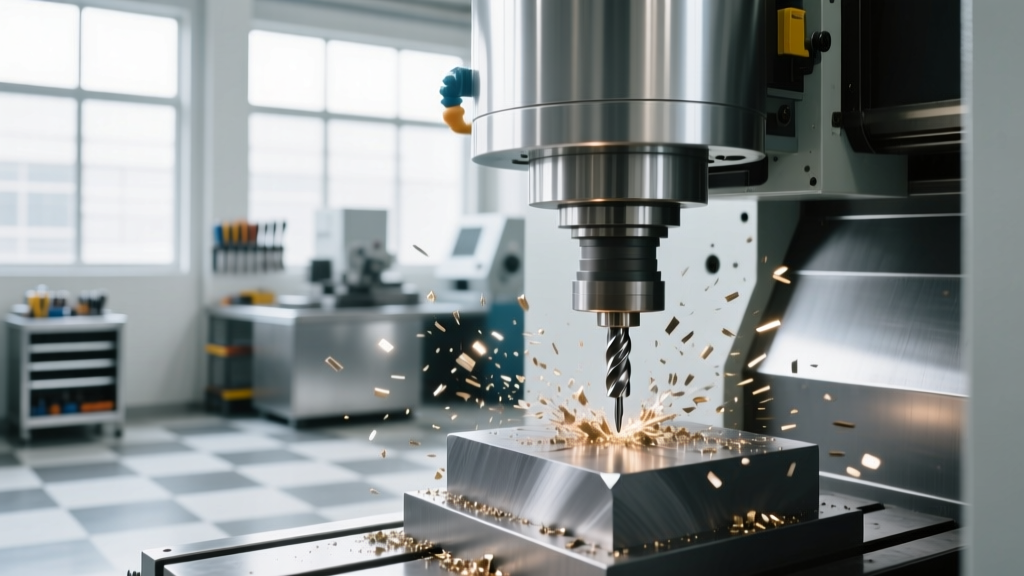
Deep cavity milling and drilling operations are notorious for chip packing, which leads to tool breakage and massive localized dust clouds when the tool finally clears. Instead of standard G81 drill cycles, program G83 (deep hole peck drilling) with a full retract. This brings the chip completely out of the flute. Pair this with an M-code air blast to clear the cavity before the next plunge.
| M-Code | Function | Maintenance Impact |
|---|---|---|
| M08 / M09 | Flood Coolant On/Off | Suppresses airborne mist; reduces mist collector filter loading by up to 60%. |
| M10 / M11 | Air Blast / Vacuum Engage | Clears micro-dust from pockets; prevents abrasive buildup on linear guideways. |
| M25 | Chip Conveyor Forward | Prevents swarf pile-ups at the flume; reduces conveyor belt tension spikes and motor burnout. |
| M31 / M32 | Through-Spindle Coolant (TSC) | Evacuates chips from deep flutes; eliminates secondary manual air-blowing, saving labor hours. |
Scaling Dust Collection Maintenance to Your Programmed MRR
Material Removal Rate (MRR) is the ultimate metric for scheduling extraction maintenance. A static, calendar-based maintenance schedule (e.g., 'clean filters every 30 days') is fundamentally flawed because it ignores the actual volume and type of particulate generated. By auditing your CAM programs for average MRR, you can transition to a dynamic, condition-based maintenance schedule.
Filter Replacement Timelines by Material and Toolpath Strategy
- MDF & Composite Routing (High Dust, Low Chip): Trochoidal toolpaths generate massive volumes of sub-20-micron dust. Schedule: Blow down PTFE-coated filters with compressed air every 40 spindle hours. Replace HEPA cartridges every 6 months. Failure to adhere to this allows dust to cake, dropping suction below the required 4,500 FPM duct velocity.
- 6061-T6 Aluminum (Stringy Chips, High MRR): High-feed adaptive clearing creates long, sharp needles. Schedule: Inspect hinge-belt conveyor cleats weekly for needle impalement. Check coolant skimmer belts every 72 hours, as stringy chips bypass standard drum filters and clog the skimmer mechanism.
- Cast Iron & Steel (Abrasive Micro-Swarf): Conventional finishing passes create abrasive graphite-like dust. Schedule: Check way-cover bellows daily for abrasive ingress. Vacuum extractor cyclonic baffles must be purged bi-weekly to prevent abrasive wear on the exhaust impeller blades.
'The most common cause of dust collection failure isn't a bad motor; it's a programming strategy that creates particulate smaller than the cyclone's separation threshold, forcing the primary filter to do the work of a separator.' — Industrial Ventilation Design Guidelines.
The 4,000 FPM Duct Velocity Rule and OSHA Compliance
When programming toolpaths that yield heavy, dense chips (such as titanium or stainless steel), the extraction system must maintain a minimum duct velocity of 4,000 feet per minute (FPM) to keep the swarf suspended in the airstream. For lighter, combustible materials like wood or certain composites, OSHA's Combustible Dust guidelines and NFPA 664 mandate velocities up to 4,500 FPM to prevent settling, which can lead to catastrophic deflagration events. If your CAM program utilizes micro-milling strategies that produce ultra-fine, highly combustible dust, your maintenance team must verify static pressure drops across the ductwork monthly to ensure FPM thresholds are not compromised by filter blinding.
Diagnostic Matrix: Extraction Failures Linked to Programming Errors
When your chip management hardware fails prematurely, trace the issue back to the G-code before replacing expensive mechanical components.
Troubleshooting Decision Tree
- Symptom: Chip conveyor belt slipping or stalling.
Programming Cause: Low feed-rate finishing passes creating long, stringy chips that wrap around the tail pulley.
Fix: Increase feed rate or switch to a chip-breaking insert geometry; adjust conveyor torque limiter settings. - Symptom: Vacuum system static pressure alarm triggering within 2 hours of startup.
Programming Cause: High RPM, low chip-load 'rubbing' toolpaths generating talcum-powder-fine dust that instantly blinds standard polyester filters.
Fix: Optimize CAM feeds and speeds to ensure proper chip thinning; upgrade to spun-bond PTFE membrane filters which resist micro-dust embedding. - Symptom: Coolant sump overflowing with fine sludge, overwhelming the paper band filter.
Programming Cause: Excessive use of dwell times (G04) and low-pressure coolant in deep pocketing, allowing micro-fines to suspend in the coolant rather than settling or flushing.
Fix: Implement high-pressure through-spindle coolant (M31) to aggressively evacuate fines; install a centrifugal sump cleaner for continuous sludge removal.
Managing Metalworking Fluid Mist at the Source
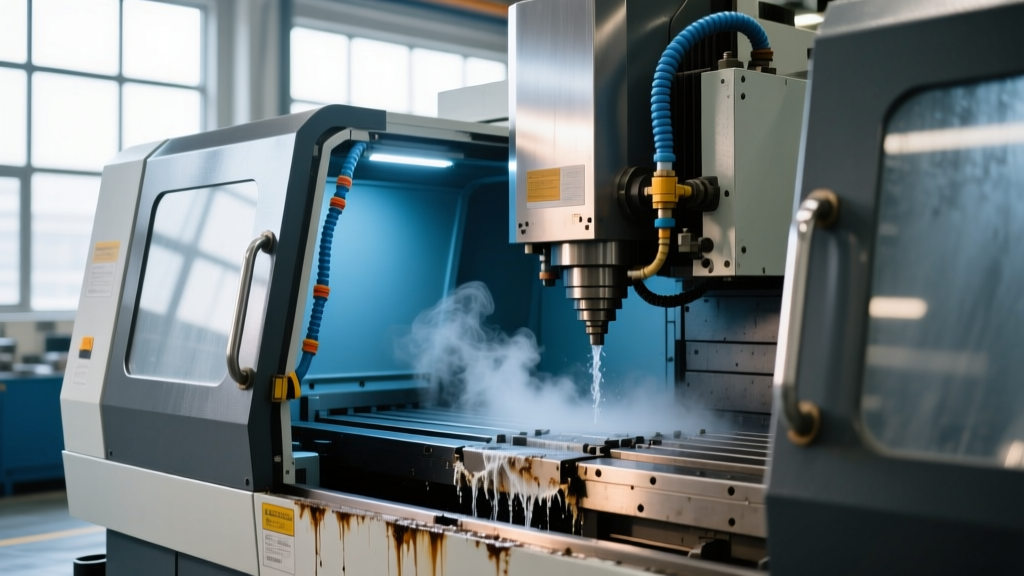
Dust collection isn't limited to dry routing; wet machining generates hazardous aerosolized mist. The NIOSH guidelines on metalworking fluid mist emphasize that prolonged exposure to aerosolized coolant causes severe respiratory issues. When you program CNC machine cycles using aggressive flood coolant (M08) at high spindle speeds, the kinetic energy atomizes the fluid. To mitigate this and reduce the maintenance burden on your mist collectors, program M-code sequences that engage the mist collector before the spindle ramps up, and utilize programmable coolant pressure valves to reduce flow during non-cutting rapid moves (G00). This simple programming adjustment reduces mist generation by up to 35%, significantly extending the service life of your mist collector's electrostatic precipitator plates and HEPA stages.
Summary: Aligning CAM, Hardware, and Maintenance
Effective chip and dust management is a triad of mechanical hardware, rigorous maintenance schedules, and intelligent CAM programming. By embedding automated evacuation M-codes, optimizing toolpaths for favorable chip morphology, and scaling your filter replacement intervals to your actual Material Removal Rate, you transform dust collection from a reactive janitorial chore into a predictable, optimized manufacturing process. Audit your post-processor today, verify your duct velocities, and ensure your maintenance team is armed with the data they need to keep the machines running clean.