Laguna CNC Machine for Small Workshops: 2026 ROI Case Study
Discover how a small custom cabinetry shop achieved a 14-month ROI using a Laguna CNC machine. Includes facility prep, costs, and production metrics.
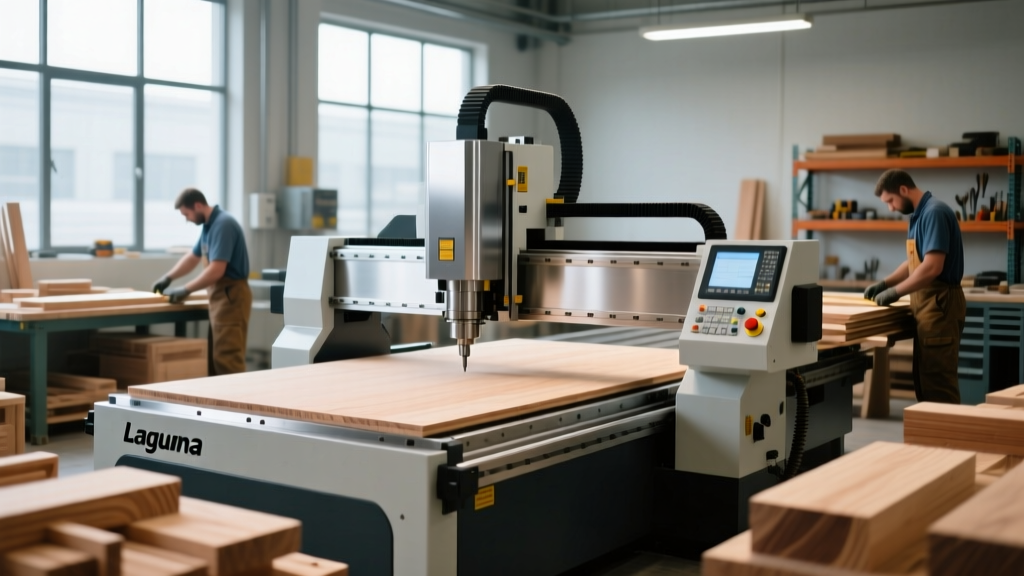
Transitioning a sub-3,000-square-foot custom millwork shop from manual template routing to nested-based CNC manufacturing requires more than just purchasing a router. It demands a rigorous evaluation of footprint, power infrastructure, software integration, and real-world throughput. For small-to-medium enterprise (SME) woodworking environments, the Laguna CNC machine lineup—specifically the SmartShop III series—has emerged as a dominant turnkey solution in 2026. This case study examines the operational and financial impact of integrating a Laguna SmartShop III 4x8 into a high-mix, low-volume custom cabinetry workshop.
Case Study Profile: Apex Custom Millwork
- Facility Size: 2,800 sq. ft. (Leased industrial flex-space)
- Headcount: 4 full-time employees (2 cabinetmakers, 1 finisher, 1 operations manager)
- Previous Bottleneck: Manual edgebanding, template-based hinge boring, and inconsistent part tolerances on melamine and pre-finished plywood.
- Target Output: 15–20 custom residential kitchens per year, plus commercial millwork contracts.
Machine Selection: Why the Laguna SmartShop III Won
When evaluating 4x8 ATC (Automatic Tool Changer) routers, small workshops typically cross-shop three primary contenders: Avid CNC, ShopBot, and Laguna Tools. Apex Custom Millwork required a machine that minimized assembly time, offered robust local technical support, and included a factory-integrated vacuum system.
| Feature | Laguna SmartShop III (4x8) | Avid CNC (Pro Series) | ShopBot Alpha |
|---|---|---|---|
| Drivetrain (X/Y) | Helical Rack & Pinion | Rack & Pinion | Rack & Pinion |
| Spindle | 10HP HSD Italian (ISO30) | 10HP HSD (ISO30) | 10HP HSD (ISO30) |
| Controller | WinCNC (Industrial pendant) | Mach4 / Centroid | ShopBot Control |
| Integration Level | Turnkey (Factory wired/plumbed) | Semi-Kit (Requires field wiring) | Turnkey |
| Approx. 2026 Price | $24,500 - $28,000 | $22,000 - $25,000 | $32,000 - $36,000 |
The Laguna CNC machine secured the purchase order primarily due to its turnkey delivery. Avid CNC offers excellent value but requires significant field assembly, wiring, and tramming—costing a small shop 40 to 60 hours of lost billable production time. ShopBot offers unparalleled support but commands a 30% premium that pushed the ROI timeline beyond Apex’s 18-month threshold. The Laguna SmartShop III arrived fully assembled, requiring only power, air, and dust collection hookups.
Facility Infrastructure: Power, Air, and Extraction
Small workshops often occupy leased flex-spaces with limited electrical infrastructure. The SmartShop III’s 10HP HSD spindle natively requires 3-phase power, which is rarely available in standard 2,800 sq. ft. commercial units.
The 220V Single-Phase Solution
To avoid the $4,000–$8,000 cost of utility-installed 3-phase drops, Apex utilized Laguna’s factory-installed Variable Frequency Drive (VFD). The VFD seamlessly converts 220V single-phase power into the 3-phase output required by the spindle motor. This single feature makes the Laguna CNC machine highly viable for small workshop environments where electrical upgrades are prohibited by landlords or cost-prohibitive for tenants.
Pneumatics and Dust Collection
The 11-position ATC carousel relies on a pneumatic drawbar to release and clamp ISO30 tool holders. This requires a consistent 120 PSI at 5 CFM. Apex upgraded from a standard 30-gallon pancake compressor to an 80-gallon, 5HP two-stage reciprocating air compressor ($2,200) to prevent pressure drops during rapid tool changes, which can cause tool holder seating failures and catastrophic runout.
Furthermore, nested-based routing generates massive volumes of fine MDF and melamine dust. According to OSHA Woodworking Guidelines, combustible dust accumulation poses severe deflagration risks. Apex installed a 3HP cyclone dust collector rated at 1,800 CFM with 6-inch ducting directly to the machine’s 4-inch dust shroud and the vacuum table’s waste plenum.
Production Metrics and 14-Month ROI Breakdown
The true value of a CNC router in a small shop is measured by its ability to compress lead times and reduce material waste. By adopting a nested-based manufacturing (NBM) workflow using Mozaik software, Apex optimized sheet yield from 72% (manual saw cutting) to 89%.
| Financial Metric | Pre-CNC (Manual) | Post-CNC (Laguna) | Delta / Savings |
|---|---|---|---|
| Material Yield (3/4" Melamine) | 72% | 89% | +$4,100 / year |
| Cabinet Box Machining Time | 4.5 hours / kitchen | 1.2 hours / kitchen | +$38,500 / year (Labor) |
| Rework / Scrap Rate | 8% | 1.5% | +$6,200 / year |
| Total Annual Financial Gain | Net Increase in Margin & Labor Efficiency | $48,800 | |
With a total capital expenditure of $32,500 (including the Laguna SmartShop III, Mozaik software license, tooling, and air compressor), the machine achieved a hard payback period of roughly 8.5 months. Factoring in the 220V electrical panel upgrades and dust collection ducting, the realistic ROI extended to 14 months—a highly favorable metric for 2026 manufacturing investments.
Real-World Edge Cases: Vacuum Hold-Down and Tooling
Operating a Laguna CNC machine in a high-mix environment introduces specific technical edge cases that small shops must navigate. The most critical is vacuum hold-down physics on porous materials.
Warning: Spoilboard DegradationThe SmartShop III utilizes a 10HP Becker vacuum pump. However, if the MDF spoilboard is not surfaced perfectly parallel to the gantry, or if it becomes clogged with resin and dust, vacuum pressure drops below the 15 inHg threshold required to hold thin 1/4" backing materials. As detailed in the CNC Cookbook Vacuum Table Guide, regular fly-cutting of the spoilboard is mandatory. Apex schedules a 46mm Amana Tool fly-cutter resurfacing pass every 40 hours of spindle runtime, removing exactly 0.010" of material to expose fresh, porous fibers.
Tooling Strategy for Pre-Finished Plywood
Routing pre-finished maple plywood without chipping the delicate veneer requires precise tool geometry and feed rates. Apex standardized on Onsrud 52-308 up/down compression bits. By maintaining a spindle speed of 18,000 RPM and a feed rate of 650 IPM (inches per minute), the compression geometry pushes the top and bottom veneers inward toward the core, resulting in zero tear-out on both faces. Slowing the feed rate below 400 IPM generates excessive friction heat, which melts the PVA glue lines in the plywood core and causes premature tool failure.
"The assumption that a 10HP spindle allows you to take massive 1-inch depth passes in hardwood is a beginner mistake. In a production environment, we take two 3/8" passes at 800 IPM. It saves the spindle bearings from lateral deflection and extends the life of our $150 solid carbide end mills by 300%."
— Operations Manager, Apex Custom Millwork
Final Verdict for 2026 Shop Expansions
For small workshops constrained by space, single-phase power, and limited technical assembly bandwidth, the Laguna SmartShop III remains a premier tier-1 investment. While open-architecture machines like Avid offer deeper customization for hobbyists and tech-savvy tinkerers, a commercial millwork shop requires a machine that functions as a reliable production asset from day one. The inclusion of the VFD for single-phase power, the robust helical rack-and-pinion drivetrain, and the integrated Becker vacuum system provide a compelling, high-yield foundation for scaling custom manufacturing operations.