Top CNC Machines: Industrial vs Consumer-Grade Technical Specs
Compare industrial and consumer-grade top CNC machines. We break down spindle specs, rigidity, tolerances, and controller architectures to guide your buy.
The search for the top CNC machines often leads buyers to a confusing crossroads: the vast technical chasm between industrial vertical machining centers (VMCs) and consumer-grade desktop routers. While a $2,500 hobbyist machine and a $75,000 industrial mill may both interpret G-code to move a cutting tool along three axes, their underlying mechanical architectures, kinematic truths, and spindle dynamics are fundamentally different. Understanding these technical specifications is critical for manufacturing engineers and shop owners to avoid catastrophic tool breakage, tolerance stack-up errors, and unprofitable cycle times.
The Mechanical Chasm: Mass, Damping, and Frame Rigidity
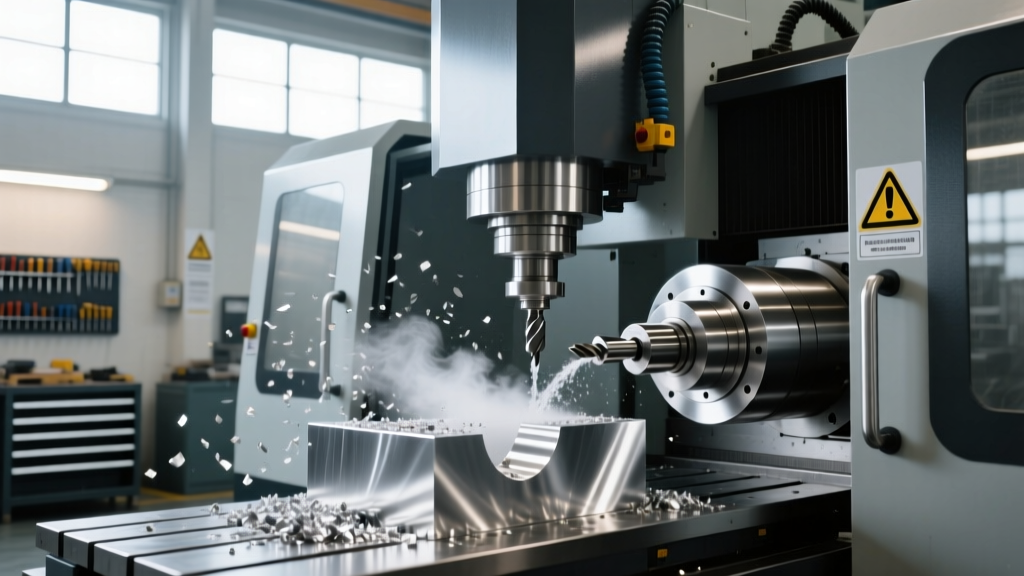
The most defining technical difference between industrial and consumer CNC equipment is structural mass and vibrational damping. Industrial machines, such as the Haas VF-Series VMCs, utilize heavy ribbed Meehanite cast iron or welded steel frames filled with epoxy granite. Cast iron possesses a damping coefficient approximately 10 times greater than aluminum. When a 1-inch carbide endmill engages titanium at high radial depths of cut, the cutting forces generate high-frequency chatter. The massive cast iron frame absorbs these harmonic vibrations, preventing them from reflecting back into the cutting zone and micro-chipping the tool edge.
Technical Insight: Resonance FrequenciesConsumer machines built from 80/20 T-slot extruded 6061-T6 aluminum lack this mass. Aluminum's low damping capacity means vibrational energy travels through the frame, causing the spindle to oscillate at its natural resonance frequency. This limits consumer machines to light radial engagements and requires significantly lower chip loads, drastically increasing cycle times on hard materials.
Spindle Architecture: Torque Curves and Toolholding
Spindle specifications dictate a machine's ability to remove material. The divergence here lies in torque delivery at low RPMs and the mechanical interface of the toolholder.
Industrial: Vector Drives and Tapered Interfaces
Industrial VMCs utilize heavy-duty vector or servo-driven spindles paired with standardized tapered toolholding systems like BT40, CAT40, or HSK63. A 30-HP vector drive spindle delivers peak torque at relatively low RPMs (often below 1,500 RPM), which is mandatory for driving large-diameter face mills or indexable drills through steel. The BT40 taper provides a massive surface area for friction-grip, while a pneumatic drawbar pulls the retention knob with up to 2,500 lbs of force, ensuring absolute axial rigidity under heavy thrust loads.
Consumer: High-Frequency VFDs and Collet Grips
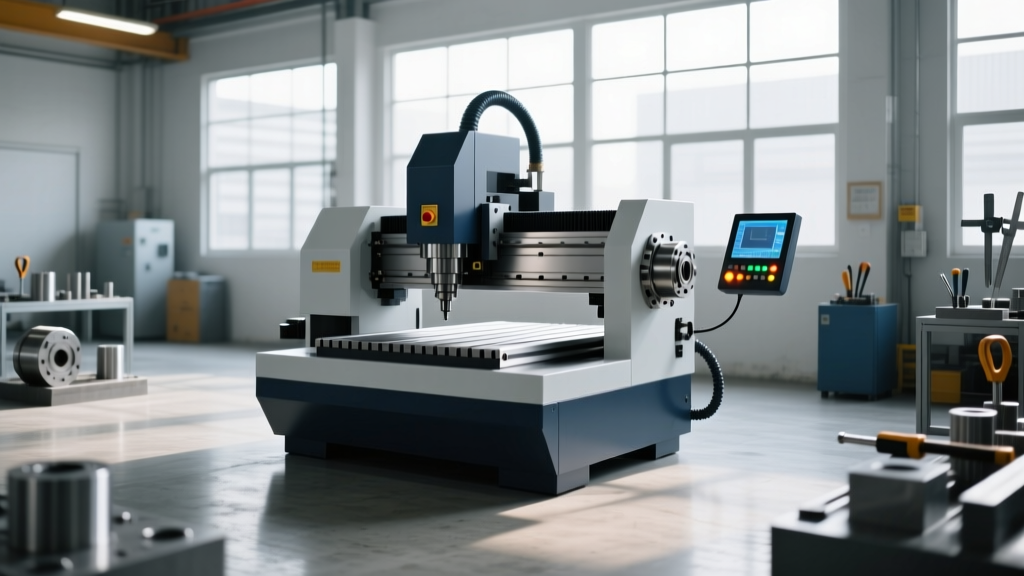
Consumer and prosumer machines, such as the Shapeoko HDM or standard desktop routers, typically rely on 1.5kW to 2.2kW high-frequency VFD spindles or standard trim routers. These spindles generate minimal torque below 10,000 RPM, forcing operators to use small-diameter tools and high spindle speeds. Toolholding is relegated to ER collets (ER11 or ER20). While ER collets offer excellent concentricity for round shanks, they lack the axial pull-force and radial grip of a flanged V-flange toolholder, making them prone to tool pull-out during aggressive Z-axis plunge operations.
Kinematic Matrix: Head-to-Head Specification Comparison
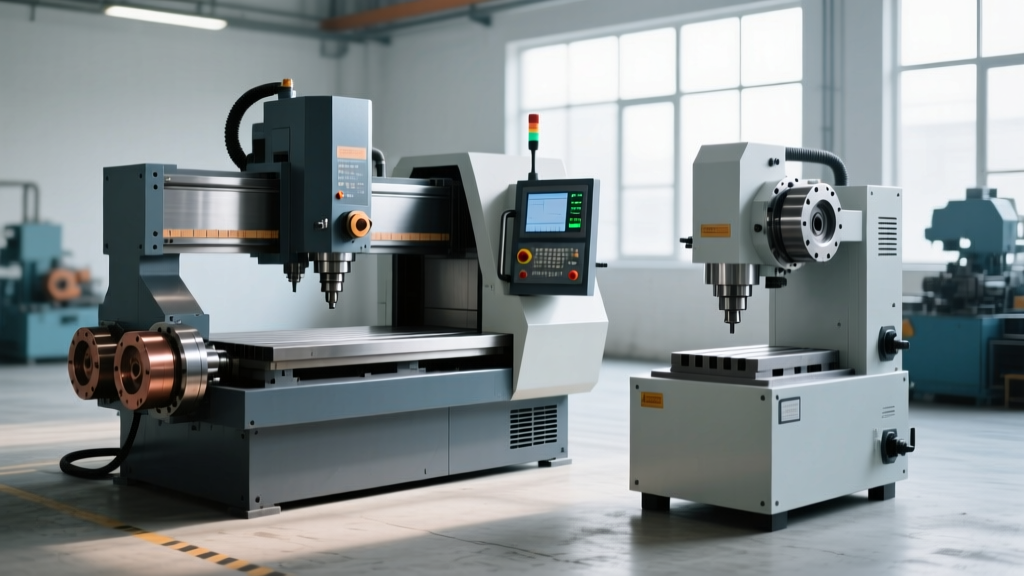
To contextualize the engineering gap, the following matrix compares the technical specifications across three distinct tiers of the top CNC machines currently dominating the market.
| Specification | Industrial (Haas VF-2SS) | Prosumer (Tormach 15L) | Consumer (Shapeoko 5 Pro) |
|---|---|---|---|
| Base Price Range | $65,000 - $85,000+ | $11,000 - $15,000 | $2,000 - $2,800 |
| Frame Material | Meehanite Cast Iron | Cast Iron Column / Steel Base | 6061-T6 Aluminum / Steel Tube |
| Spindle Power & Torque | 30 HP Vector / High Low-RPM Torque | 2.25 HP Belt-Driven / Moderate Torque | 1.5 kW VFD / Low-RPM Starved |
| Toolholding Interface | CAT40 / BT40 (Pneumatic Drawbar) | R8 / TTS (Manual Drawbar) | ER11 Collet (Manual Nut) |
| Drive System | Closed-Loop Servos / Ground C3 Ballscrews | Closed-Loop Steppers / Rolled Ballscrews | Open-Loop Steppers / HTD Belts |
| Positional Repeatability | ±0.0002' (5 microns) | ±0.0005' (12 microns) | ±0.002' to ±0.005' (Under load) |
| Machine Weight | ~6,200 lbs | ~1,100 lbs | ~160 lbs |
Drive Systems and Positional Truth
Positional accuracy in CNC machining is not just about the controller sending a pulse; it is about the mechanical drive system executing that pulse without deflection or backlash.
Industrial machines utilize precision-ground C3 or C5 class ballscrews driven by closed-loop AC servomotors (e.g., Yaskawa or Fanuc). Ground ballscrews guarantee a lead accuracy of ±0.0002 inches per 12 inches of travel. Furthermore, closed-loop servos utilize rotary encoders that continuously verify rotor position, instantly correcting for any missed steps caused by sudden cutting load spikes.
The Belt-Drive Deflection Problem: Many consumer machines rely on steel-reinforced HTD timing belts for the X and Y axes. While belts allow for high rapid traverse rates, they introduce elastic stretch under heavy cutting loads. When a consumer router takes a full-width slotting pass in aluminum, the belt stretch can cause the tool to lag behind the commanded position, resulting in out-of-tolerance bore diameters and poor surface finishes on internal corners.
Prosumer machines like the Tormach CNC Mills bridge this gap by utilizing rolled ballscrews and closed-loop steppers, offering a middle ground that eliminates belt stretch while keeping capital expenditure under $15,000.
Controller Interpolation: Look-Ahead and Jerk Control
The computational architecture of the CNC controller dictates how smoothly the machine transitions between complex 3D contouring vectors. According to Autodesk's CNC machining design guidelines, achieving tight tolerances on complex 3D surfaces requires advanced kinematic algorithms.
- Industrial Controllers (Fanuc, Haas NGC, Siemens): These systems feature 1,000+ block look-ahead capabilities and advanced S-curve acceleration (jerk control). The controller analyzes the upcoming G-code trajectory, automatically decelerating the axes before sharp directional changes to prevent overshoot and maintain a constant chip load.
- Consumer Controllers (GRBL, Mach4, FluidNC): Most open-source or hobbyist controllers operate with minimal look-ahead (often 16 to 24 blocks) and rely on trapezoidal acceleration profiles. This results in 'jerk'—sudden changes in acceleration that induce mechanical shock, causing the lightweight aluminum frame to vibrate and leaving visible dwell marks or facet lines on 3D contoured surfaces.
The Crossover Framework: When to Upgrade to Industrial
Determining when to transition from a consumer-grade setup to an industrial VMC requires analyzing your specific manufacturing constraints. Use the following technical decision matrix to evaluate your needs:
Upgrade to Industrial If:
- Material Hardness: You routinely machine materials above 35 HRC (e.g., Inconel, tool steels, titanium). Consumer spindles lack the low-end torque and frame rigidity to maintain chip load without catastrophic tool failure.
- Tolerance Stack-Up: Your parts require true position tolerances tighter than ±0.001' across multiple features. Thermal growth and belt stretch on consumer machines make holding these GD&T callouts statistically impossible over a 50-part run.
- Production Volume: You are running batch sizes over 100 units. Industrial machines feature 20+ tool automatic tool changers (ATC) and high-pressure through-spindle coolant (TSC), reducing non-cutting time and clearing chips from deep cavities automatically.
Conversely, if your shop primarily machines 6061 aluminum, Delrin, or wood for prototyping, sign-making, or low-volume custom brackets where tolerances of ±0.005' are acceptable, a high-end consumer or prosumer machine offers a vastly superior ROI. The key to selecting among the top CNC machines is matching the machine's mechanical damping, spindle torque curve, and drive kinematics directly to the physical realities of your intended cutting operations.