CNC Machine Technician Guide: Industrial vs Consumer Machine Specs
Explore the technical specs and mechanical differences between industrial and consumer CNC machines from a professional CNC machine technician's perspective.
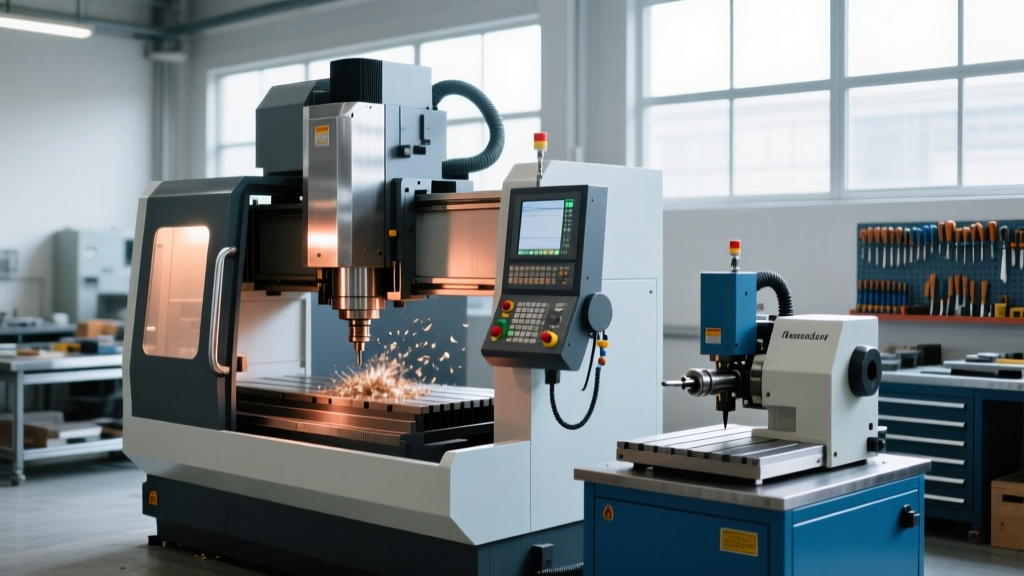
When evaluating the transition from consumer-grade desktop routers to industrial Vertical Machining Centers (VMCs), a professional CNC machine technician must look far beyond the physical work envelope. The fundamental differences lie in tribology, structural dynamics, and closed-loop kinematics. This guide dissects the exact mechanical and electrical specifications that separate a $4,000 prosumer machine from a $95,000 industrial workhorse, providing the technical baseline required for advanced maintenance, retrofitting, and process optimization.
The Core Divide: Mass, Damping, and Structural Rigidity
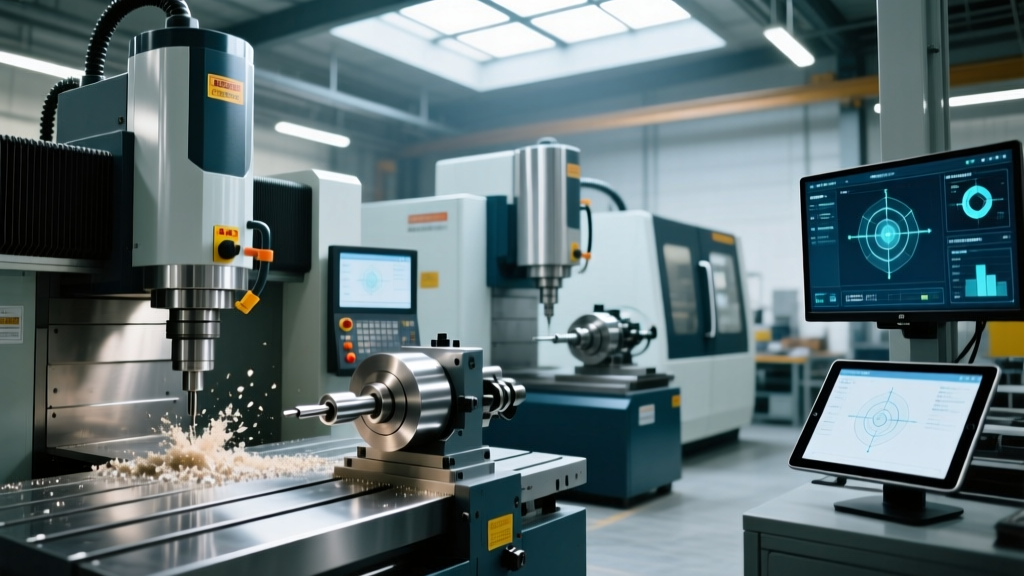
The most critical differentiator between industrial and consumer CNC equipment is structural damping. Industrial VMCs, such as the Haas VF series, utilize heavy, ribbed Meehanite cast iron bases and columns. Cast iron possesses a high damping coefficient (approximately 0.05 to 0.10) due to its flake graphite microstructure, which absorbs high-frequency chatter vibrations generated during aggressive material removal.
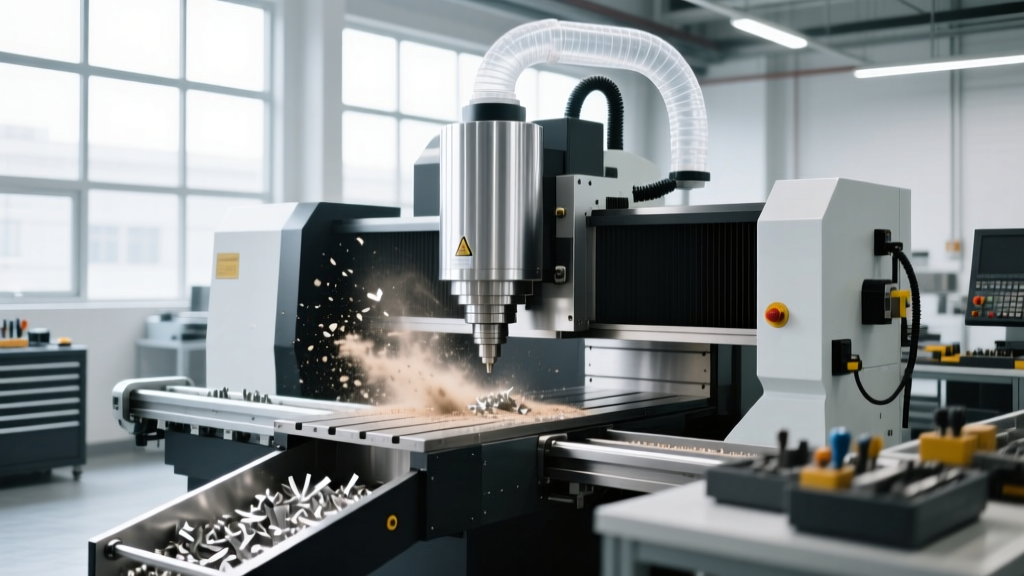
Conversely, consumer and prosumer machines (like the Shapeoko or X-Carve lines) rely on extruded 6061-T6 aluminum profiles bolted to steel or MDF plates. Aluminum has a drastically lower damping coefficient (roughly 0.001). When a consumer machine encounters harmonic vibration during hard metal milling, the frame acts as a tuning fork, amplifying chatter, accelerating tool wear, and degrading surface finish. A technician cannot simply increase feed rates on an aluminum frame to compensate; the structural resonance must be managed through conservative chip loads and specialized tool geometries.
Spindle Architecture: Runout, Thermal Growth, and Torque
Spindle design dictates the ultimate precision and material removal rate (MRR) of the machine. Industrial spindles utilize inline direct-drive or heavy-duty belt-driven architectures with precision matched angular contact bearings (typically ABEC-7 or ABEC-9 class). These spindles maintain a strict thermal equilibrium, often requiring a dedicated chiller unit to manage heat expansion. Total indicated runout (TIR) at the tool holder taper is held to less than 0.0002 in.
Consumer machines typically employ off-the-shelf compact routers (like Makita or DeWalt) or lightweight 2.2 kW VFD-controlled water-cooled spindles. While VFD spindles offer quiet operation, their bearing preload is often fixed and non-adjustable. Under heavy side-loading, the bearings can deflect, pushing TIR out to 0.001 in. or 0.005 in. at the cutting edge. This runout causes uneven flute engagement, drastically reducing end mill lifespan when machining stainless steel or titanium.
Technician Warning: The VFD Upgrade TrapMany hobbyists attempt to upgrade consumer routers with 2.2kW water-cooled VFD spindles to cut aluminum faster. However, mounting a 15 lb spindle on a lightweight Z-axis extrusion shifts the center of gravity and induces Z-axis nodding during X/Y rapid traverses. Always verify the Z-axis linear guide preload before attempting high-mass spindle retrofits.
Motion Control: Closed-Loop Servos vs. Open-Loop Steppers
The motion control architecture defines how accurately a machine tracks complex 3D contours. Industrial CNCs rely on closed-loop AC synchronous servos (e.g., Yaskawa Sigma-7 or Fanuc alpha-i series) paired with high-resolution absolute encoders (often 24-bit or higher). These systems continuously monitor rotor position and adjust current to maintain a following error of less than 0.0001 in., even under sudden load spikes.
Consumer machines predominantly use open-loop NEMA 23 or NEMA 34 stepper motors. Steppers operate by moving in discrete microsteps. If the cutting force exceeds the motor's holding torque, the motor stalls or skips steps without alerting the controller, resulting in a scrapped part. While some modern prosumer machines now feature closed-loop steppers (which add an encoder to detect stalls), they still lack the continuous torque curve and high-RPM velocity of an AC servo, severely limiting rapid traverse rates and contouring accuracy.
Technical Specification Matrix: Industrial vs. Prosumer
| Specification | Industrial VMC (e.g., Haas VF-2SS) | Prosumer Benchtop (e.g., Tormach PCNC 440) | Consumer Router (e.g., Shapeoko 5 Pro) |
|---|---|---|---|
| Base Material | Meehanite Cast Iron | Cast Iron / Steel Composite | 6061-T6 Aluminum Extrusion |
| Spindle TIR | < 0.0002 in. | ~ 0.0005 in. | 0.001 in. - 0.005 in. |
| Motion Drive | Closed-Loop AC Servos | Closed-Loop Steppers / DC Servos | Open-Loop NEMA 23 Steppers |
| Guideway Type | Hiwin/THK Linear Rails or Box Ways | Linear Rails (Light Preload) | Delrin V-Wheels on Extrusions |
| Positional Accuracy | +/- 0.0002 in. | +/- 0.001 in. | +/- 0.005 in. (varies by temp) |
| Typical Price Range | $65,000 - $120,000+ | $5,000 - $12,000 | $2,000 - $4,000 |
Guideways and Tribology: Friction Management
The interface between the moving axes and the static frame dictates stick-slip behavior and long-term wear. Industrial machines use recirculating ball linear guideways (such as the THK HSR or Hiwin HG series) with factory-applied preload. This preload eliminates internal clearance, ensuring the carriage does not lift or shift under heavy cutting forces. Larger, older, or heavy-duty industrial machines may use hardened and ground box ways coated with Turcite-B, providing massive load-bearing surface areas and superior vibration damping.
Consumer CNC routers almost universally rely on polycarbonate or Delrin V-wheels rolling on the V-slots of aluminum extrusions. While inexpensive and easy to assemble, V-wheels suffer from elastic deformation under load. As a technician, you will frequently encounter 'flat spots' on these wheels caused by leaving the machine parked under tension for extended periods, resulting in periodic surface finish artifacts on long toolpaths.
Diagnostic Realities for the CNC Machine Technician
Troubleshooting geometric errors requires vastly different metrology approaches depending on the machine class. For industrial VMCs, technicians utilize laser interferometers and wireless ballbar systems, such as the Renishaw QC20-W. A ballbar test evaluates circular interpolation by measuring radial deviations down to 0.1 microns, instantly diagnosing servo mismatch, axis backlash, stick-slip, and squareness errors.
On consumer machines, the lack of structural repeatability makes laser interferometry largely impractical. Instead, technicians must rely on dial indicators mounted on magnetic bases to sweep the table, check tram, and measure Z-axis deflection. Because aluminum frames expand and contract significantly with ambient room temperature changes (aluminum's coefficient of thermal expansion is roughly 13 µm/m-°C), a consumer machine calibrated perfectly at 68°F (20°C) may exhibit 0.003 in. of positional drift if the shop temperature rises to 80°F. Technicians advising prosumer shops must mandate strict climate control and frequent mechanical tramming to maintain acceptable tolerances.
The Verdict on Capability
Understanding these mechanical realities allows a CNC machine technician to set realistic expectations for part quality and cycle times. While consumer machines are exceptional for prototyping, woodworking, and light non-ferrous milling, achieving aerospace-grade AS9100 tolerances requires the mass, closed-loop kinematics, and thermal stability inherent only in industrial-grade architecture.