How to Run a CNC Machine: Entry-Level Router & Mill Alternatives
Compare entry-level CNC machines for hobbyists. Learn how to run a CNC machine with our Shapeoko, LongMill, and Bantam alternatives analysis.
The Hardware Reality: Belt vs. Lead-Screw vs. Spindle
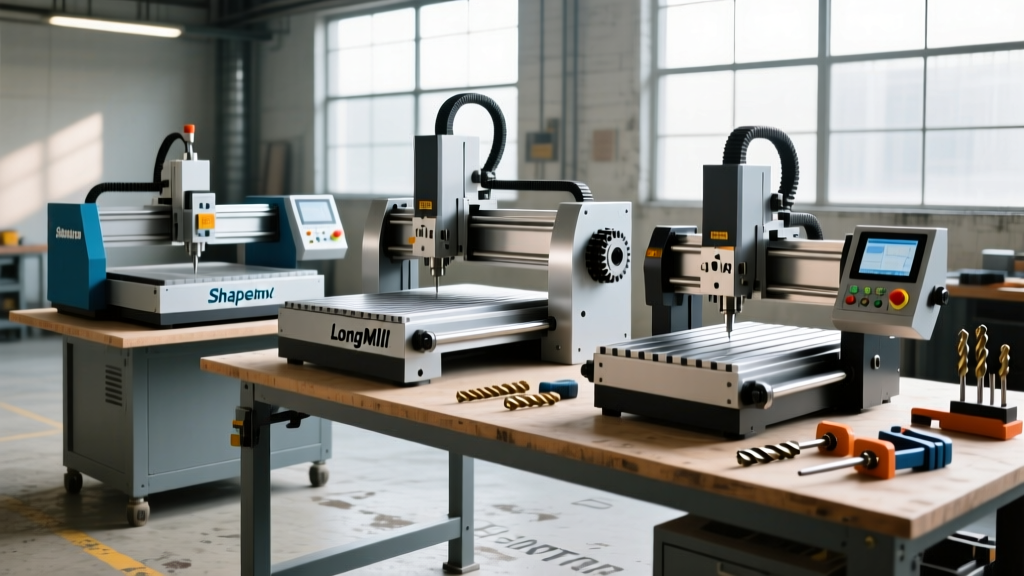
Before generating G-code, you must understand the mechanical drive system of your machine. The drive system dictates rigidity, backlash, and the materials you can cut. Hobbyists generally choose between three architectures:
| Feature | Belt-Driven Router (e.g., Shapeoko) | Lead-Screw Router (e.g., LongMill) | Desktop Spindle Mill (e.g., Bantam) |
|---|---|---|---|
| Drive Mechanism | Neoprene timing belts | Acme lead-screws with anti-backlash nuts | Ballscrews / precision linear guides |
| Rigidity | Low to Medium (flexes under heavy Z-load) | Medium (resists Z-flex, prone to X/Y whip) | High (cast iron/heavy aluminum extrusions) |
| Ideal Materials | Wood, MDF, Acrylic, Plastics | Hardwoods, deep 3D carves, soft metals | PCBs, Brass, 6061 Aluminum, Steel |
| Avg. Entry Price (2026) | $1,800 - $2,300 | $2,000 - $2,600 | $3,800 - $4,500 |
Alternative 1: Carbide 3D Shapeoko 5 Pro
The Shapeoko 5 Pro remains the benchmark for belt-driven desktop CNC routers. It utilizes a Makita-style trim router (or the proprietary Carbide Compact Router) mounted to an aluminum extrusion frame. It is the default choice for makers focused on sign-making, cabinetry, and acrylic fabrication.
Operational Quirks & Failure Modes
Learning how to run a CNC machine with a belt-drive system requires managing belt tension and harmonic vibration.
- The Belt Stretch Failure: Neoprene belts stretch under high lateral loads. If you attempt to pocket 1/2-inch birch plywood in a single pass at 100 IPM, the belt will deflect, causing your final dimensions to be undersized by 0.010" to 0.020". Fix: Use a 1/4" compression bit (e.g., Whiteside 6210) and take multiple step-downs of 0.200".
- Router Runout: Standard trim routers have a collet runout of 0.003" to 0.005". This destroys the lifespan of 1/8" endmills. Upgrade to the Carbide Compact Router (71mm body) which reduces runout to roughly 0.001".
Alternative 2: Sienci LongMill MK2 48x48
The Sienci LongMill MK2 replaces belts with lead-screws on all axes. This design choice fundamentally changes the machine's torque delivery and accuracy profile, making it a superior alternative for deep 3D relief carving and slow, heavy cuts in dense hardwoods.
The Lead-Screw Advantage (and its limits)
Lead-screws provide massive holding torque when the machine is stationary and resist the Z-axis plunging forces that cause belt-driven machines to lose steps. However, they introduce a new physical limitation: screw whip.
Warning: Lead-Screw WhipAt travel speeds exceeding 150 IPM on a 48-inch X-axis, the lead-screw acts like a jump rope, vibrating violently and causing surface finish chatter. When running a LongMill MK2, cap your rapid traverse rates (G0) at 120 IPM in your CAM software to prevent mechanical resonance.
Alternative 3: Bantam Tools Desktop CNC Mill
If your goal is machining functional metal parts, PCBs, or precision aluminum enclosures, routers are the wrong tool. The Bantam Tools Desktop CNC Milling Machine utilizes a high-frequency spindle (up to 20,000 RPM) and an ER-11 collet system, moving away from the 1/4" router bit standard.
Machining 6061 Aluminum on a Desktop
Running a desktop mill for metals requires strict adherence to feeds, speeds, and chip evacuation. According to CNC Cookbook, maintaining the correct chip load is critical to prevent work-hardening aluminum.
Expert Setup for Bantam Aluminum Milling:
Use a 3-flute, 1/4" carbide endmill with a ZrN (Zirconium Nitride) coating. Set spindle speed to 14,000 RPM, feed rate to 45 IPM, and a depth of cut (DOC) of 0.050". You must use a mist coolant system (like the Bantam Mist attachment) to prevent chips from re-welding to the flutes.
The Universal Workflow: How to Run a CNC Machine
Regardless of whether you choose a Shapeoko, LongMill, or Bantam, the operational workflow follows a strict four-step pipeline. Skipping steps guarantees crashed bits and ruined stock.
- CAD (Computer-Aided Design): Model your part. For 2.5D sign making, Carbide Create or Easel is sufficient. For complex 3D surfaces or metal parts with tight tolerances, use Autodesk Fusion 360.
- CAM (Computer-Aided Manufacturing): Select your tooling and define toolpaths. This is where you input your feeds, speeds, and step-overs. Critical step: Always verify your tool database matches the exact physical endmill you have loaded.
- Post-Processing: The CAM software translates toolpaths into G-code specific to your controller. A Shapeoko requires a GRBL post-processor. A Bantam uses its proprietary Bantam post. Using the wrong post will result in syntax errors or dangerous rapid movements.
- Workholding & Zeroing: Secure the material. Use a digital touch probe to set your X, Y, and Z zero points. Manual paper-thickness Z-zeroing introduces a 0.1mm variance that will ruin V-carve inlays or PCB traces.
The Hidden Costs: Entry-Level Tooling Budget
Beginners often allocate their entire budget to the machine, forgetting that a CNC router is useless without proper tooling and workholding. Budget an additional $400 to $600 for your initial consumables.
| Item Category | Specific Recommendation | Estimated Cost |
|---|---|---|
| Bits / Endmills | Whiteside 1/4" Compression, Harvey Tool 1/8" Ballnose (Pack of 5) | $120 - $180 |
| Workholding | Yonico 1/2" Spoilboard Surfacing Bit, T-Track clamps, double-sided tape | $80 - $120 |
| Dust Collection | Makita 440 Dust Hood + 2.5" hose + inline dust separator | $110 - $150 |
| Measurement | Digital Calipers (Mitutoyo or iGaging) for stock thickness verification | $40 - $60 |
Decision Framework: Which Machine Fits Your Garage?
Do not buy a machine based on brand loyalty; buy based on your primary material output.
- IF your primary output is plywood cabinetry, MDF signs, and acrylic templates AND you need fast traverse speeds THEN buy the Shapeoko 5 Pro. The belt drive is faster and quieter for 2.5D wood routing.
- IF your primary output is deep 3D hardwood carves, cutting boards, or you plan to cut soft aluminum (6061) with very conservative step-overs THEN buy the LongMill MK2. The lead-screws provide the Z-axis rigidity required for deep pocketing without chatter.
- IF your primary output is functional engineering prototypes, aluminum enclosures, or custom PCBs THEN buy the Bantam Desktop Mill. Routers lack the spindle RPM and ER-collet precision required for metal machining.
Mastering how to run a CNC machine is 20% software and 80% mechanical empathy. Understand the physical limits of your drive system, respect your feed rates, and invest heavily in quality workholding.