How Much Is a CNC Machine for Stainless Steel? 2026 Cost Guide
Discover exactly how much a CNC machine for stainless steel costs in 2026. We break down VMC, lathe, and Swiss pricing, tooling, and hidden budget factors.
The True Cost of Machining Stainless Steel: Beyond the Base Price
When shop owners and manufacturing engineers ask how much is a cnc machine capable of reliably milling 316 or 17-4PH stainless steel, the answer requires looking far past the base MSRP. Stainless steel is notoriously unforgiving. Its low thermal conductivity, high ductility, and rapid work-hardening rates demand extreme machine rigidity, high low-end torque, and advanced coolant delivery systems.
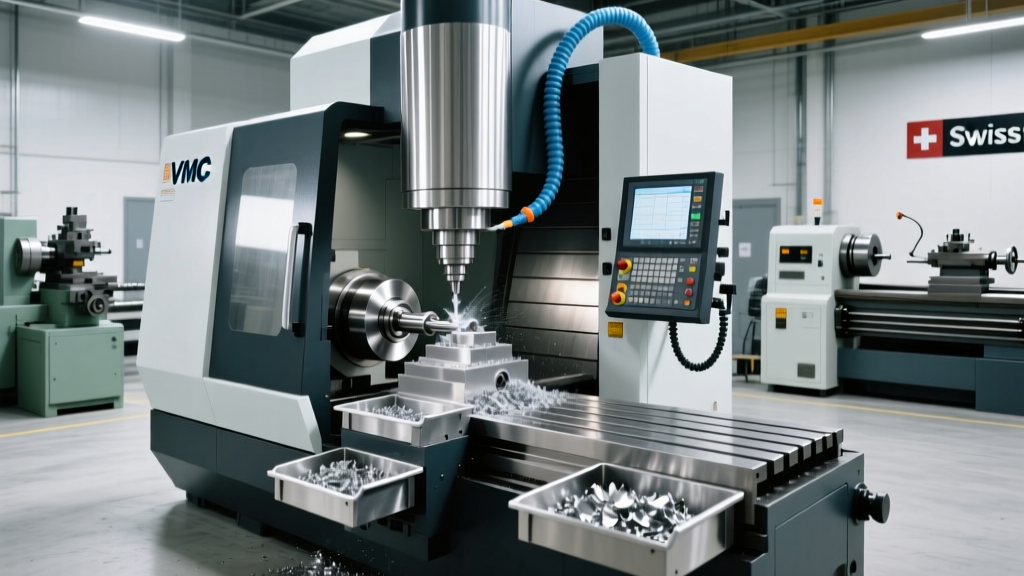
In 2026, a production-ready CNC Vertical Machining Center (VMC) configured specifically for stainless steel will cost between $85,000 and $160,000 fully loaded. However, entry-level prototyping machines start around $18,000, while high-end Swiss-type lathes for medical implants easily exceed $350,000. This guide breaks down the exact capital expenditure, mandatory upgrades, and recurring tooling costs required to build a profitable stainless steel machining cell.
⚠️ Warning: The Work-Hardening TrapAustenitic stainless steels (like 304 and 316) work-harden rapidly if the cutting tool dwells, rubs, or operates at incorrect surface speeds. A machine lacking sufficient spindle torque at low RPMs or high-pressure coolant will destroy $500 worth of carbide tooling in a single shift and yield scrapped parts. Budgeting for rigidity and coolant pressure is non-negotiable for production environments.
2026 CNC Machine Pricing Matrix for Stainless Steel
The following matrix outlines the realistic budget required to field a stainless-steel-capable machine in 2026, factoring in the mandatory options that bare-bones catalog prices omit.
| Machine Tier | Typical Models | Base Price (2026) | Mandatory SS Upgrades | Total Estimated Budget |
|---|---|---|---|---|
| Entry-Level / Prototyping | Tormach 1100MX, Haas Mini Mill | $15,000 - $55,000 | $2,000 - $5,000 | $17,000 - $60,000 |
| Mid-Range Production VMC | Haas VF-2SS, DMG Mori CMX 600V | $65,000 - $95,000 | $15,000 - $25,000 | $80,000 - $120,000 |
| High-End 5-Axis / Medical | Mazak VARIAXIS, Tsugami Swiss | $180,000 - $300,000 | $40,000 - $80,000 | $220,000 - $380,000+ |
Tier 1: Entry-Level & Prototyping ($17,000 – $60,000)
For job shops doing low-volume prototyping or machining free-machining stainless grades like 303, entry-level machines are viable. The Tormach 1100MX (approx. $18,500 base) offers a rigid enough cast-iron frame for light passes on 304 stainless. However, these machines typically lack the 20+ horsepower and 150+ ft-lbs of torque required for heavy material removal rates (MRR) in tougher grades like 316L or 17-4PH. Expect to run smaller diameter tooling (under 1/2 inch) and take conservative step-downs to avoid stalling the spindle.
Tier 2: Mid-Range Production VMCs ($80,000 – $120,000)
This is the sweet spot for dedicated production. The Haas VF-2SS Super Speed VMC remains a benchmark in this category. While the base price sits around $65,000 in 2026, machining stainless steel requires the 30-hp vector drive option for low-end torque. According to Sandvik Coromant's stainless steel machining guidelines, maintaining consistent cutting speeds without dwelling is critical to prevent work hardening; a high-torque spindle ensures the cutter pushes through the material rather than rubbing against it.
Tier 3: High-End Swiss-Type & 5-Axis Medical ($220,000 – $380,000+)
Machining orthopedic implants, bone screws, and aerospace fasteners from 17-4PH or Titanium-blended stainless requires Swiss-type lathes or ultra-rigid 5-axis trunnion tables. Brands like Tsugami, Citizen, and Mazak dominate this space. These machines feature hydrostatic guideways, thermal compensation, and 1,500+ PSI coolant systems to break the stringy chips characteristic of austenitic alloys.
Mandatory Upgrades: Where Stainless Steel Budgets Break
If you are budgeting for a production VMC, the base price is merely the entry fee. Stainless steel demands specific factory-installed options. Attempting to retrofit these later is either impossible or cost-prohibitive.
- Through-Spindle Coolant (TSC) / High-Pressure Coolant (HPC): Adding a 300 PSI TSC system costs roughly $4,500 - $6,000. For deep cavity milling in 316SS, upgrading to a 1,000 PSI ChipBLASTER system adds $15,000 - $22,000 but is mandatory to evacuate chips and prevent re-cutting, which instantly snaps carbide endmills.
- Hinge-Belt Chip Conveyor: Stainless steel produces long, stringy, bird-nesting chips. A standard auger conveyor will jam and burn out its motor within a week. Budget $4,500 for a heavy-duty hinge-belt conveyor with an auto-reverse function to clear tangles.
- Spindle Chiller / Thermal Stability: Stainless steel cutting generates immense heat at the spindle bearings. A dedicated spindle chiller ($3,000) prevents thermal growth that ruins tight tolerances on long-running medical parts.
- Rigid Tapping & Synchronized Retract: Tapping 304 SS generates high axial forces. Ensure the machine control supports high-speed rigid tapping with synchronized retract to prevent tearing the threads.
Standard aluminum or mild steel vise jaws will not grip stainless steel securely enough to withstand the cutting forces without the part lifting. Budget an additional $2,500 - $4,000 for dedicated serrated, nitride-coated steel vise jaws and high-torque hydraulic workholding systems.
Tooling and Consumables: The Recurring Cost Factor
The capital cost of the machine is only half the equation. Stainless steel eats standard carbide tooling. To maintain profitability, your tooling budget must reflect the specific metallurgical challenges of the material.
| Tooling Type | Required Specification | Avg. Cost (2026) | Expected Tool Life (304 SS) |
|---|---|---|---|
| Roughing Endmill | Variable Helix, AlTiN Coating, 5-Flute | $85 - $140 | 90 - 120 minutes of cut time |
| Drilling (1/2" Dia) | Coolant-Through Carbide Drill (145° split point) | $110 - $160 | 300 - 500 holes |
| Form Taps | TiN Coated, Spiral Point (No flutes to clog) | $45 - $75 | 800 - 1,200 holes |
Information Gain: Never use standard 4-flute AlTiN endmills for heavy roughing in 316 stainless. The gummy nature of the alloy causes chip packing in the flutes, leading to catastrophic tool failure. Always specify variable helix and variable pitch endmills with a polished rake face and a specialized stainless coating (like ZrN or advanced nano-composite AlTiN) to reduce friction and built-up edge (BUE).
ROI Framework: Calculating Your Break-Even Point
To justify a $110,000 investment in a mid-range production VMC for stainless steel, you must calculate your fully burdened cost-per-part.
"Shops often underestimate the cycle time penalty of work-hardened stainless. If your machine lacks the torque to maintain a 0.004-inch chip load, you are essentially rubbing the material. This doubles your cycle time and triples your insert cost. Investing $15,000 in a high-torque spindle option pays for itself in the first 10,000 parts through tooling savings alone."
The Break-Even Formula:
Calculate your hourly shop rate (e.g., $125/hr). If a legacy machine takes 12 minutes per part due to conservative feeds and frequent tool changes, and a new, high-pressure-coolant-equipped VMC reduces cycle time to 7 minutes while doubling tool life, you save roughly $10.40 per part in machine time and $2.50 per part in tooling. At a volume of 2,000 parts per month, the machine pays for its premium upgrades in under 6 months.
Frequently Asked Questions (FAQ)
Can a hobbyist CNC router machine stainless steel?
No. Standard CNC routers lack the mass, rigidity, and low-RPM torque required. Attempting to mill 304 or 316 stainless on a router will result in severe chatter, work-hardened scrap parts, and broken tooling. You need a cast-iron or polymer-concrete VMC or milling machine.
Is 303 stainless steel cheaper to machine than 304?
Yes, significantly. 303 is a "free-machining" grade with added sulfur, which breaks chips and reduces cutting forces. If your application allows for 303 instead of 304, you can reduce your tooling costs by up to 40% and increase cycle speeds by 25%, drastically altering your ROI timeline.
Do I need a chip conveyor for stainless steel?
For any production run exceeding 4 hours, yes. Austenitic stainless steels produce long, tough, stringy chips that wrap around the tool and workholding. Manual clearing is a safety hazard and destroys profitability through spindle downtime.