True Cost of CNC Machines for Home Use: Machining Stainless Steel
Budgeting for CNC machines for home use to cut stainless steel? Discover the true CapEx, tooling, and coolant costs for prosumer mills in 2026.
The Physics Problem: Why Stainless Steel Breaks Home CNC Budgets
When evaluating cnc machines for home use, the vast majority of the market is engineered for wood, plastics, and soft 6061 aluminum. Desktop routers and hobbyist mills rely on high RPM and low torque, utilizing lightweight ball screws and NEMA 23 stepper motors. Stainless steel—specifically austenitic grades like 304 and 316—demands the exact opposite: high torsional rigidity, massive low-end torque, and aggressive thermal management.
Attempting to machine stainless steel on a standard $300 desktop router is not just inefficient; it is a fast track to catastrophic tool failure and ruined workpieces. Austenitic stainless steels possess low thermal conductivity and a severe tendency to work-harden. If your machine lacks the mass and rigidity to maintain a consistent chip load, the cutter will rub instead of shear. This friction instantly hardens the material surface and snaps the endmill.
⚠️ Critical Machining Warning: Never use climb milling on a machine with excessive backlash when cutting stainless steel. The cutting forces will pull the table into the cutter, causing a sudden spike in chip thickness that will shatter solid carbide tooling and potentially damage the machine's lead screws.To successfully machine stainless steel in a home or garage environment, you must graduate from 'hobby' routers to 'prosumer' micro-mills. This transition fundamentally alters your budget. Below is a comprehensive cost analysis for setting up a home-based stainless steel CNC operation in 2026.
Base Machine CapEx: Prosumer Mills That Actually Work
Capital expenditure (CapEx) for a stainless-capable home CNC starts at the machine casting. You need a heavy, ribbed cast-iron frame, precision ground linear guideways (or heavily preloaded dovetails), and a spindle capable of delivering high torque at lower RPMs (2,000–6,000 RPM for standard endmills).
| Machine Model | Base Price (2026) | Required Upgrades for SS | Total Ready-to-Cut Cost |
|---|---|---|---|
| Tormach PCNC 440 | $5,595 | Stand, Enclosure, Coolant System, 3-Phase VFD | $9,200 - $10,500 |
| Syil X7 Combo | $7,800 | Flood Coolant Retrofit, Way Covers | $8,900 - $9,500 |
| Precision Matthews PM-940 (CNC Conversion) | $3,500 (Manual) | CNC Kit, Servo Motors, Ball Screws, VFD Spindle | $7,500 - $8,800 |
While the initial machine cost hovers between $7,500 and $10,500, the base mill is only the beginning of your financial commitment. The operational expenditure (OpEx) for stainless steel is where home machinists frequently underestimate their budgets.
The Hidden OpEx: Tooling, Workholding, and Coolant
Tooling: The AlTiN Tax
Standard high-speed steel (HSS) and uncoated carbide endmills are useless for production stainless steel machining. You must invest in specialized solid carbide tooling featuring variable helix designs and high-temperature coatings like Aluminum Titanium Nitride (AlTiN) or Titanium Silicon Nitride (TiSiN). These coatings maintain hardness at the extreme cutting temperatures generated by 304 and 316 stainless.
- Standard 4-Flute Carbide (Uncoated): $25 - $35 per tool. Result: Rapid edge wear, tool life under 15 minutes.
- Specialized SS Endmills (e.g., Harvey Tool or Helical Solutions): $65 - $110 per tool. Result: Optimized chip evacuation, tool life of 60-120 minutes.
- Drilling: Carbide-tipped stub drills or coolant-through drills are mandatory to prevent work-hardening the bottom of the hole. Expect $40-$80 per drill.
Budget Allocation: Plan to spend at least $800 to $1,200 on your initial library of roughing and finishing endmills, spot drills, and chamfer mills specifically rated for stainless steel.
Workholding: Holding the Unforgiving
Stainless steel generates cutting forces up to 40% higher than mild steel. Standard aluminum milling vises will flex, allowing the workpiece to lift and ruin the surface finish. You need high-precision, heavy-duty steel vises.
- Kurt DX4 or D688: $450 - $600. The industry standard for rigidity and repeatability.
- Glacern GSV-4: $250 - $300. An excellent prosumer alternative with high clamping force.
- Mitee-Bite Toe Clamps: $80 - $120 per set. Essential for 5-sided machining where vise jaws interfere with the toolpath.
Coolant: Mist vs. Flood Economics
Because stainless steel retains heat in the cutting zone rather than dissipating it into the chips, thermal management is non-negotiable. While mist coolant (like AccuLube) is popular for home CNCs due to low mess, it is entirely insufficient for deep pocketing or heavy roughing in stainless steel.
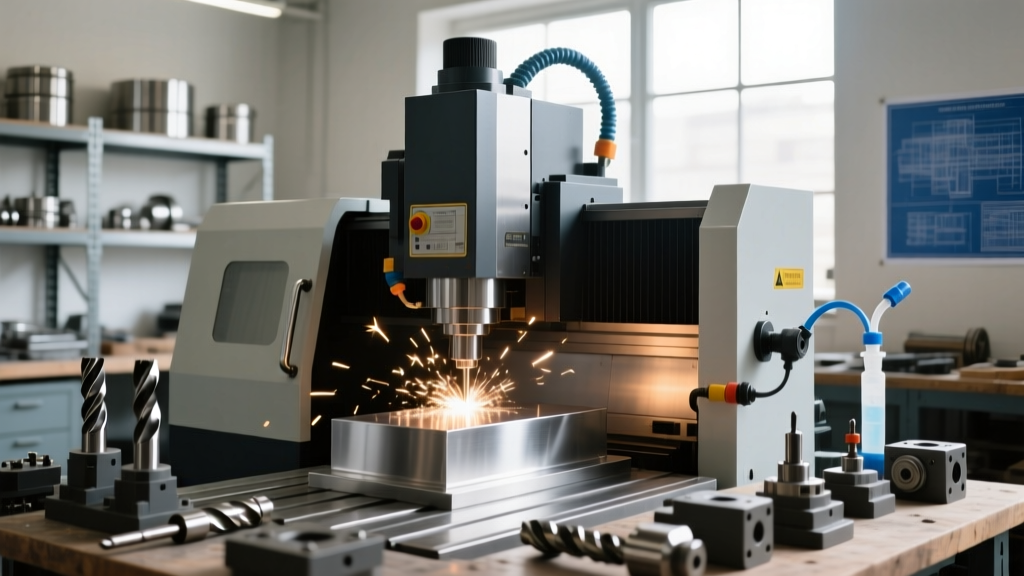
You must budget for a flood coolant system. This includes a 10-to-20-gallon sump, a high-pressure pump (minimum 1/4 HP), flexible loc-line nozzles, and an enclosure to contain the splash. A high-quality synthetic coolant formulated for stainless steel, such as Rustlick 28800 or Master Chemical TRIM, costs approximately $45 to $60 per gallon of concentrate, which yields 5 to 10 gallons of working fluid.
3-Year Total Cost of Ownership (TCO) Matrix
To understand the true financial barrier to entry, we must project the costs over a 3-year period, assuming a moderate production volume of 20 hours of spindle time per month cutting 304 stainless steel.
| Cost Category | Year 1 (Setup) | Year 2 (OpEx) | Year 3 (OpEx + Maint.) |
|---|---|---|---|
| Machine & Enclosure | $9,500 | $0 | $0 |
| Workholding (Vises/Clamps) | $750 | $150 | $100 |
| Tooling (Endmills/Drills) | $1,200 | $850 | $900 |
| Coolant System & Fluid | $650 | $120 | $150 |
| Scrap Material Allowance (10%) | $400 | $450 | $500 |
| Annual Total | $12,500 | $1,570 | $1,650 |
Feeds, Speeds, and the Financial Impact of Scrap
In stainless steel machining, your feed rate and spindle speed directly dictate your profitability. Running a 1/4-inch AlTiN coated endmill in 304 stainless steel on a Tormach PCNC 440 typically requires a spindle speed of roughly 1,800 RPM and a feed rate of 12 to 15 inches per minute (IPM), with a radial depth of cut (RDOC) not exceeding 50% of the tool diameter during roughing.
If you attempt to push the feed rate to 25 IPM to save time on a prosumer machine, the spindle will stall, the tool will deflect, and you will experience catastrophic chatter. This doesn't just break a $75 endmill; it ruins the workpiece. With 304 stainless steel plate costing between $4.00 and $8.00 per pound in 2026, a single 10x10x1 inch block weighs nearly 29 pounds, representing $150 to $200 in raw material. A single crashed toolpath due to aggressive feeds costs you the price of the tool plus the material.
Expert Verdict: Is It Worth It?
Machining stainless steel on CNC machines for home use is entirely feasible, provided you abandon the 'desktop router' mindset and embrace the 'prosumer micro-mill' reality. A budget of $12,000 to $14,000 is required to establish a capable, safe, and profitable home-based stainless steel machining cell. If your budget is strictly under $3,000, you are better served outsourcing your stainless steel parts to a job shop and reserving your home CNC for aluminum, brass, and engineering plastics.