Training on Controller Types for a CNC Machine for Guitar Making
Master CNC machine for guitar making controllers. Compare GRBL, Mach4, and Centroid interfaces for precise fret slotting and 3D archtop carving.
The Luthier’s Dilemma: Why Controller Choice Dictates Tonewood Survival
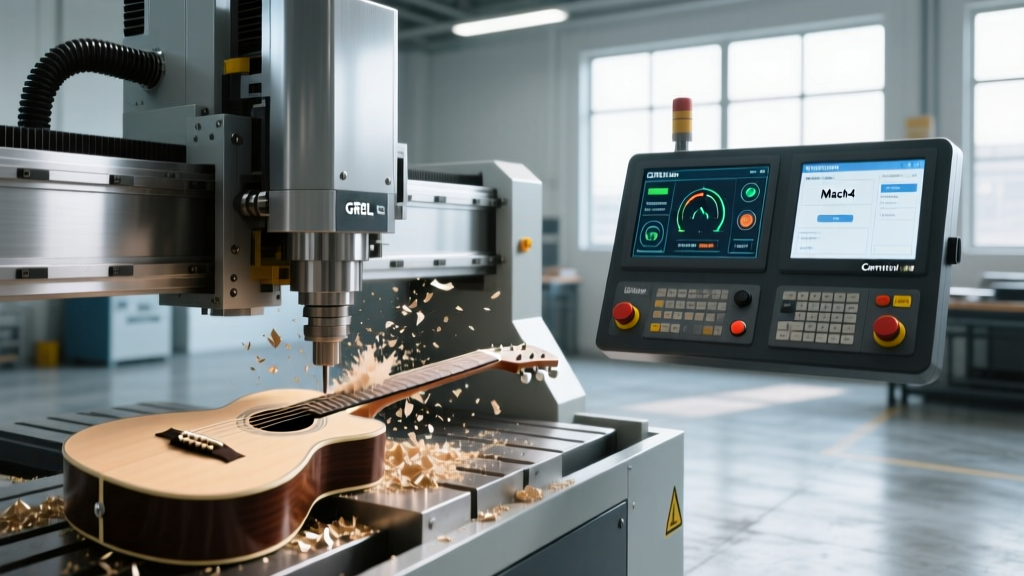
When configuring a cnc machine for guitar making, the physical rigidity of the router and the RPM of the spindle often dominate the conversation. However, the CNC controller and its software interface are the actual determinants of precision. In luthiery, a dropped step during fretboard slotting or a micro-stutter during 3D archtop surfacing does not just ruin a toolpath; it destroys AAAA flamed maple or Brazilian rosewood stock that can cost upwards of $300 per board foot.
Operator training must begin at the interface level. Understanding how different controllers process G-code, manage look-ahead buffers, and handle tool length offsets is critical for maintaining the 0.001-inch tolerances required for professional fretwork and seamless binding channels. This guide breaks down the dominant controller ecosystems in modern guitar manufacturing and provides actionable training protocols for operators.
⚠️ Tonewood Risk Warning: Standard 8-bit Arduino-based GRBL controllers are obsolete for professional luthiery as of 2026. Their limited look-ahead buffer (typically 16-18 lines) causes deceleration stutters on complex 3D G-code, leaving visible dwell marks on spruce and cedar soundboards. Always specify 32-bit controllers (GRBLHAL, FluidNC, or Ethernet-based DSPs) for any machine carving instrument tops.Breakdown of Dominant CNC Interfaces in Luthiery
The interface dictates the operator's workflow, from setting work coordinates to executing macro routines for automatic tool changers (ATC). Below is a comparative matrix of the primary controller systems used in guitar manufacturing.
| Controller System | Approx. Cost (2026) | Best Luthiery Application | Look-Ahead Buffer | Operator Learning Curve |
|---|---|---|---|---|
| GRBLHAL / FluidNC (32-bit) | $50 - $150 | Hobbyist builds, inlay routing, flat fretboard slotting | High (256+ lines) | Moderate (Requires CLI or third-party UI like OpenBuilds) |
| UCCNC (with UC300ETH) | $180 - $240 | Mid-tier production, 3D archtop carving, Avid CNC retrofits | Very High (Ethernet streaming) | High (Highly customizable UI, complex macro setup) |
| Mach4 (Industrial/Hobby) | $200 - $350 | High-volume production, ATC integration, complex macro scripting | High (Lua scripting dependent) | Very High (Requires Lua programming for custom screens) |
| Centroid Acorn | $450 - $600 | Custom luthier CNCs, 4th-axis rotary carving, closed-loop systems | Exceptional (DSP handled) | Moderate (Polished, intuitive out-of-the-box UI) |
Operator Training: Mastering the Interface for Fretboard Slotting
Fretboard slotting is the most unforgiving operation in guitar CNC routing. Standard fret wire tangs require a slot width of exactly 0.023 inches (readily sourced from luthier suppliers like Stewart-MacDonald). If the controller sends erratic pulse signals to the stepper drivers, the slot widens, resulting in loose frets that require expensive epoxy glue-ups to salvage.
Step-by-Step Fret Slotting Workflow
- Tool Verification: Operators must measure the 0.022" or 0.023" carbide endmill with a micrometer before loading. Never trust the manufacturer's stamped diameter.
- Spindle Tramming Check: Use a dial indicator in the collet. If the Z-axis is out of tram by more than 0.001" over a 6-inch sweep, fret slots will be deeper on one side of the fingerboard, causing fret rock.
- Interface Probing Routine: Execute a 3-point surface probe in your controller software. Fretboards (especially ebony and roasted maple) often have slight warps. The controller must dynamically map the Z-height across the X/Y plane to maintain a consistent 0.250" slot depth.
- Feed Rate Override: Set the controller's feed rate override to 80% for the initial plunge into dense woods like Ziricote or Gaboon Ebony to prevent endmill deflection, then return to 100% for the lateral cut.
3D Surfacing and Archtop Carving: Interface Best Practices
Carving an archtop guitar or a violin belly generates massive G-code files, often exceeding 50MB when using a 1/8" ball nose endmill with an 8% stepover in Fusion 360 or VCarve Pro. The controller's ability to stream this data without starving the motion planner is paramount.
"When carving a 16-inch archtop out of Sitka spruce, a micro-second buffer starvation in the controller causes the spindle to dwell. Even a half-second dwell at 18,000 RPM will burnish the spruce, creating a hardened spot that ruins the acoustic tap-tone and requires aggressive hand-sanding to remove."
— Master Luthier & CNC Integrator
Best Practice for UCCNC and Mach4 Users: Always utilize Ethernet-based motion controllers (like the UC300ETH or Warp9 ESS) rather than USB connections. USB polling rates in Windows are subject to OS-level interruptions. Ethernet streaming ensures the controller's internal DSP buffer remains saturated, eliminating dwell marks on delicate soundboards. Operators should monitor the 'Buffer Status' bar in the interface; if it drops below 30% during a 3D roughing pass, the PC's background processes are bottlenecking the data stream.
Essential Safety and Tool Setting Protocols
When operating a cnc machine for guitar making equipped with an Automatic Tool Changer (ATC) or manual collets, establishing repeatable Z-axis zero points is non-negotiable. High-end luthier shops utilizing Avid CNC or custom Centroid rigs rely on automated touch plates.
Pro-Tip: The Double-Tap Probe MethodConfigure your controller's probing macro to use a 'double-tap' routine. The first approach to the Z-plate happens at a rapid 40 IPM to save time. The tool retracts 0.1", then approaches a second time at 2 IPM for the final trigger. This eliminates the momentum-overtravel error inherent in rapid Z-axis movements, guaranteeing your binding channel depth is accurate to within 0.0005".
Troubleshooting Common Controller Errors During Inlay Work
Pearl and abalone inlay work requires spindle speeds upwards of 24,000 RPM and feed rates exceeding 60 IPM to achieve a glassy finish on the shell material. Operators must know how to diagnose interface errors before they scrap a $400 headstock veneer.
| Controller Error / Symptom | Root Cause in Luthiery Context | Operator Resolution |
|---|---|---|
| GRBL Alarm:9 (Homing Fail) | Vibration from roughing dense maple loosened the limit switch bracket. | Recalibrate limit switches; apply medium-strength threadlocker to mounting bolts. |
| Mach4: Feedhold Unresponsive | USB motion controller buffer locked up during a high-node-count 3D inlay toolpath. | Switch to Ethernet motion plugin; reduce G-code file size by increasing stepover from 3% to 5%. |
| UCCNC: Following Error Limit | Stepper driver current set too low for rapid directional changes in intricate rosette carving. | Increase driver DIP switch current to 75% of the NEMA 23 motor's rated max; check for mechanical binding. |
Final Calibration Directives for the Shop Floor
The interface is only as accurate as the mechanical calibration it commands. Before any operator is cleared to run production batches of electric guitar bodies or acoustic bracing patterns, they must perform a ballbar test. Using the controller's circular interpolation G-codes (G2/G3), cut a 6-inch circle in MDF and measure the diagonals. If the X and Y axes exhibit backlash exceeding 0.002", the controller's backlash compensation settings must be adjusted in the motor tuning menu. Mastering these interface nuances transforms a generic woodworking router into a precision instrument manufacturing tool.