CNC Machine for Lease vs Buying: Entry-Level Hobbyist Guide
Exploring if a CNC machine for lease makes sense for hobbyists. We compare entry-level router financing, makerspaces, and outright buys for makers.
The B2B Lease Illusion for Desktop CNC Routers
Searching for a cnc machine for lease as a hobbyist or independent maker often leads to a frustrating dead end. The commercial equipment leasing industry is built around B2B transactions, typically requiring minimum equipment costs between $5,000 and $10,000 to justify the underwriting process. Because premium entry-level desktop CNC routers—such as the Shapeoko 5 Pro or Onefinity Woodworker—retail between $1,800 and $2,500, traditional lessors will not underwrite a standalone lease for these assets.
Furthermore, commercial lessors require established business credit, D-U-N-S numbers, and proof of commercial insurance. Hobbyists operating out of home garages do not fit this risk profile. Therefore, the traditional 'lease-to-own' or Fair Market Value (FMV) lease models are effectively unavailable for entry-level maker equipment.
Warning: Predatory Micro-LeasingSome third-party 'rent-to-own' platforms target consumers with weekly payment models. These agreements often carry implied Annual Percentage Rates (APRs) exceeding 150%. A $2,000 CNC router can easily cost $4,500+ over a 24-month term through these predatory micro-lease structures. Always calculate the total cost of capital before signing.
Real Acquisition Alternatives: Consumer Financing vs. Makerspaces
Since traditional leasing is off the table, hobbyists must evaluate alternative acquisition models. The three viable paths for funding an entry-level CNC setup are Consumer Buy Now, Pay Later (BNPL) financing, personal maker loans, and the 'shared lease' model of local makerspaces.
1. Consumer BNPL (Affirm, Klarna, PayPal Credit)
Most direct-to-consumer CNC manufacturers integrate BNPL at checkout. These loans are based on personal credit scores. While promotional 0% APR offers occasionally appear, standard APRs for maker equipment range from 10% to 36%. For a $2,200 router financed at 15% APR over 24 months, the monthly payment is roughly $106, bringing the total cost to $2,549.
2. The Makerspace 'Shared Lease'
If your goal is access to CNC capabilities without the burden of maintenance, dust collection, and software licensing, a makerspace membership is the functional equivalent of a lease. According to the American Library Association's makerspace initiatives and independent maker guilds, monthly memberships range from $125 to $350. This grants access to industrial 4x8 routers (like ShopBot PRSalpha) that would cost $35,000+ to purchase outright.
3. Personal Unsecured Loans
Credit unions and online lenders offer personal loans for 'hobby equipment' or 'home improvement' (if framing the CNC as a garage workshop upgrade). Rates in 2026 average 8% to 14% for excellent credit, making this cheaper than point-of-sale BNPL for terms exceeding 36 months.
| Acquisition Method | Upfront Cost | Monthly Cost | Total 2-Year Cost | Asset Ownership |
|---|---|---|---|---|
| Cash Purchase | $2,200 | $0 | $2,200 | Yes |
| BNPL (15% APR, 24 mo) | $0 - $200 | ~$106 | $2,549 | Yes |
| Makerspace Membership | $50 (Initiation) | $175 | $4,250 | No (Shared Access) |
| Predatory Rent-to-Own | $0 | ~$195 | $4,680 | Yes (Eventually) |
Top Entry-Level CNC Routers for Home Shops
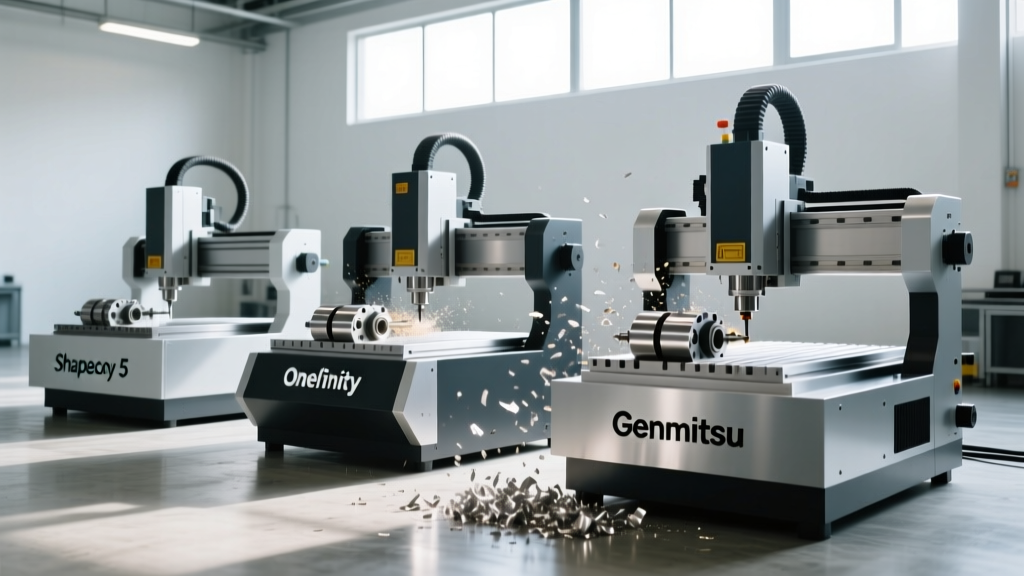
If you decide to finance or purchase outright, selecting the right chassis is critical. The entry-level market has consolidated around three dominant platforms that offer the rigidity required for aluminum milling and hardwood carving.
Carbide 3D Shapeoko 5 Pro
Priced at $2,199 for the standard 16x16 inch model, the Shapeoko 5 remains the benchmark for hobbyists. It features a 15mm belt drive system and an integrated hybrid table. The primary advantage is the ecosystem: Carbide Create (CAD/CAM) is free, eliminating the $350+ software tax required by competitors. However, it ships with a Makita RT0701C trim router, which is loud (85+ dB) and requires manual speed adjustment.
Onefinity Woodworker
Retailing at $2,099, the Onefinity Woodworker offers a 32x32 inch cutting area, significantly outperforming the base Shapeoko in workspace. It utilizes ball screw linear motion on the Z-axis and heavy-duty steel rails, providing superior Z-axis rigidity for deep pocketing in dense materials like walnut or aluminum 6061. The foldable design makes it ideal for makers who need to store the machine when not in use.
Inventables X-Carve
The X-Carve starts around $1,399 but requires upgrades to reach the rigidity of the Shapeoko or Onefinity. Its main selling point is Easel, a cloud-based CAD/CAM platform that drastically lowers the learning curve for absolute beginners. According to Inventables' official platform specs, the X-Carve is optimized for softwoods, plastics, and PCB milling rather than heavy aluminum work.
The Hidden Ecosystem Costs of Desktop CNC Ownership
When budgeting for a CNC machine, the router itself is only 60% of the initial capital requirement. Hobbyists frequently underestimate the peripheral tooling required to achieve acceptable surface finishes and maintain a safe home workshop environment.
- Dust Collection ($250 - $600): CNC routing generates microscopic particulate, especially in MDF and composites. You need a minimum of 400 CFM at a 4-inch port. Standard shop vacs will quickly clog and burn out. A dedicated dust collector like the WEN 3401 or a upgraded Dust Deputy cyclone system is mandatory.
- Software Licensing ($0 - $700): While Carbide Create is free, advanced 3D V-carving and rotary indexing require VCarve Desktop ($349) or VCarve Pro ($699).
- Workholding & Sacrificial Boards ($100 - $200): You will need T-track clamps, double-sided CNC tape (Nitro tape), and replacement MDF or phenolic spoil boards. Plan to replace an MDF spoil board every 6 to 12 months depending on usage.
- End Mills & Collets ($150+): Entry-level routers use ER11 collets. You will need a starter set of carbide end mills (1/8 inch and 1/4 inch shanks) specifically rated for your target materials. Aluminum requires single-flute ZrN coated bits to prevent chip welding.
'The biggest mistake new makers make is spending their entire budget on the router and leaving nothing for workholding and dust extraction. A $2,500 machine held down by cheap tape in a dusty garage will yield worse results than a $1,000 machine properly fixtured with mechanical clamps and a cyclone dust separator.'
— Master Maker & Tooling Analyst, 2026 Fabrication Report
Decision Matrix: Which Acquisition Path Fits Your Shop?
Use this framework to determine whether you should finance a desktop unit, pay cash, or utilize a makerspace.
- Choose a Makerspace IF: You only need CNC access 2-4 times a month, you want to cut full 4x8 sheets of plywood, or you lack the physical space and 220V electrical infrastructure for industrial dust collection.
- Choose Consumer Financing (BNPL) IF: You are prototyping a product and need daily, iterative access to the machine at 2 AM, but your current cash reserves are tied up in material inventory.
- Choose Cash Purchase IF: You are strictly a hobbyist making personal projects, you have adequate garage space, and you want to avoid paying 15%+ interest on a depreciating asset.
A Note on Depreciation and Resale
Unlike manual milling machines (like the Precision Matthews PM-25MV) which hold their value for decades, desktop CNC routers depreciate rapidly. The secondary market for used Shapeoko and X-Carve models is saturated. Expect to recover only 45% to 55% of your initial purchase price if you sell the machine on Facebook Marketplace or eBay after two years of use. Factor this residual value loss into your total cost of ownership calculations when comparing against the 'sunk cost' of a makerspace membership.
Ultimately, while a traditional commercial cnc machine for lease is out of reach for the home hobbyist, leveraging smart consumer financing or tapping into local maker guilds provides the exact operational flexibility needed to bring your CAD designs to life without crippling your personal finances.