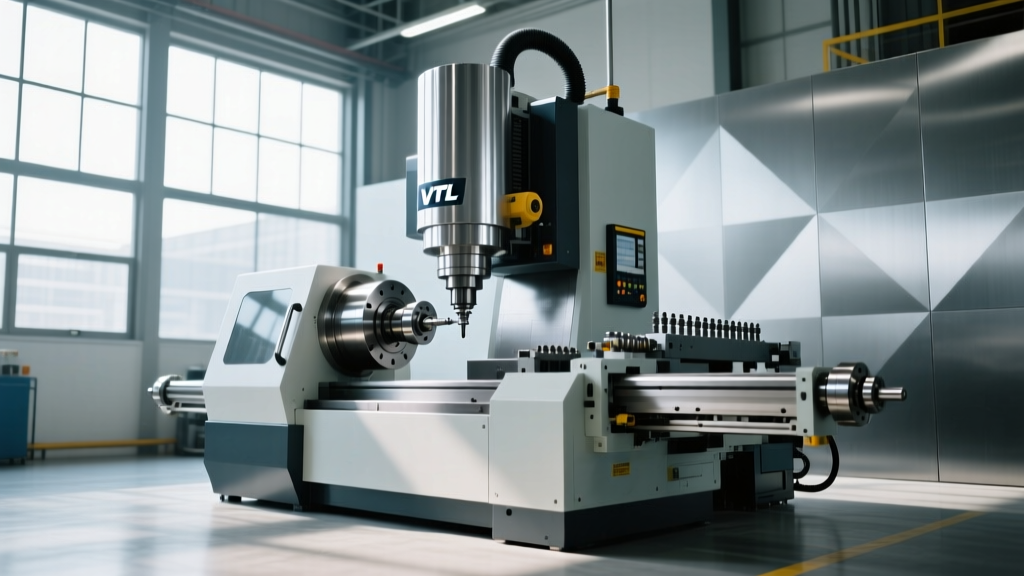
Compact Aerospace CNC Machine Setups for Small Workshops
Discover how small job shops use compact aerospace CNC machines to produce Ti-6Al-4V and Inconel parts. Explore machine models, costs, and setups.
The Tier-3 Aerospace Shift for Small Job Shops
Historically, aerospace manufacturing has been dominated by massive Tier-1 contractors operating 5-axis gantry mills and multi-spindle lathes in climate-controlled, 100,000-square-foot facilities. However, the 2026 aerospace supply chain is undergoing a aggressive decentralization. Prime contractors are increasingly offloading small, complex, high-mix components—such as bleed air valves, fuel metering manifolds, and sensor housings—to Tier-3 micro-manufacturers. For a small workshop operating under 3,000 square feet, capturing these contracts requires a highly specific class of equipment: the compact aerospace CNC machine.
A compact aerospace CNC machine must bridge a difficult engineering gap. It requires the footprint of a standard job-shop mill (under 80 square feet) to fit through standard commercial doors and navigate tight shop floors, yet it must possess the structural rigidity, low-end torque, and thermal stability required to machine exotic superalloys like Ti-6Al-4V and Inconel 718. Standard 3-axis vertical machining centers (VMCs) designed for aluminum lack the mass-to-power ratio and high-pressure coolant infrastructure necessary for aerospace-grade titanium milling.
Industry Insight: The Margin OpportunityTier-3 aerospace machine shops producing complex, low-volume titanium and Inconel components are currently seeing gross margins between 38% and 45%, compared to the 12% to 18% typical of high-volume commercial aluminum job shops. The barrier to entry is no longer floor space; it is machine capability and metrology.
Machine Selection Matrix: Compact 5-Axis vs. Turn-Mill
When outfitting a small workshop for aerospace work, the primary decision is between a compact 5-axis universal machining center and a multi-tasking turn-mill. The choice depends entirely on the geometry of the target parts. Actuator brackets and sensor housings favor 5-axis mills, while complex hydraulic fittings and landing gear pins require turn-mill capabilities.
| Machine Model | Footprint (Sq Ft) | Spindle Torque (Low-End) | Max RPM | 2026 Est. Loaded Price |
|---|---|---|---|---|
| Haas UMC-500SS | 68 | 150 ft-lb @ 2,200 RPM | 12,000 | $235,000 |
| DMG MORI DMU 50 3rd Gen | 75 | 200 Nm (Torque Spindle Option) | 15,000 | $340,000 |
| Mazak INTEGREX i-150ST | 82 | 325 ft-lb (Milling Spindle) | 12,000 | $415,000 |
For a small shop entering the aerospace sector, the Haas UMC-500SS offers the most accessible entry point, provided it is equipped with the mandatory 1,000 PSI through-spindle coolant (TSC) option and a high-capacity chip conveyor. However, for shops targeting tight-tolerance hydraulic manifolds where turning and milling must occur in a single setup to maintain concentricity, the Mazak INTEGREX i-150ST is the superior, albeit more expensive, investment.
Case Study: Machining Ti-6Al-4V Bleed Air Valves in a 1,200 Sq Ft Shop
To understand the practical application of a compact aerospace CNC machine, consider the production of a bleed air valve body. This component requires machining deep, intersecting internal cavities from a solid 3-inch diameter hex bar of Ti-6Al-4V. In a large facility, this might be done on a massive horizontal boring mill. In a small workshop, it requires a highly optimized 5-axis setup on a machine like the DMG MORI DMU 50.
Workholding and Tooling Strategy
Titanium work hardens rapidly and generates immense cutting forces. Standard aluminum vises will deflect, causing chatter and scrapping the part. Small aerospace shops must invest in force-optimized workholding. The Schunk TANDEM plus hydraulic vise provides 40 kN of clamping force with a minimal footprint, crucial for maximizing travel on a compact 500mm table.
Tooling selection is equally critical. According to the Sandvik Coromant Aerospace Machining Guide, machining titanium requires specialized substrate geometries to prevent edge chipping. For the roughing passes of the valve cavity, a Sandvik CoroMill 316 exchangeable head end mill with a titanium-specific grade (GC1620) is utilized. This tool features a variable helix angle to disrupt harmonic frequencies, effectively eliminating the chatter that plagues lighter, compact machines.
Cutting Parameters and Coolant Delivery
Running titanium on a compact machine requires strict adherence to low surface speeds and high feed rates to push the heat into the chip rather than the workpiece or the spindle bearings.
- Roughing Parameters: 150 SFM (Surface Feet per Minute), 0.004 IPR (Inches Per Revolution) feed rate, 0.500" axial depth of cut.
- Coolant Pressure: 1,000 PSI minimum through the tool. Flood coolant is insufficient for deep cavity titanium milling; the high-pressure jet is required to break the chip and clear it from the cutting zone to prevent re-welding.
- Thermal Management: Because compact machines have less cast-iron mass to absorb heat, the shop must run a chilled coolant system maintaining the coolant at exactly 68°F (20°C) to prevent thermal growth of the machine casting during the 4-hour cycle time.
"The biggest mistake small shops make when buying a compact aerospace CNC machine is under-specifying the coolant system. You can have the most rigid 5-axis machine on the market, but if you are running 300 PSI flood coolant on Inconel 718, you will burn up $400 end mills in four minutes and destroy your spindle bearings from heat transfer."
— M. Vance, Lead Manufacturing Engineer, Micro-Aero Dynamics
Overcoming the AS9100 Hurdle on a Budget
Securing aerospace contracts requires AS9100 Rev D certification, which mandates rigorous First Article Inspection (FAI) and statistical process control. Large shops use dedicated Coordinate Measuring Machines (CMMs) in temperature-controlled metrology labs. Small workshops rarely have the floor space or the $150,000 budget for a dedicated CMM.
The solution is integrating high-accuracy on-machine probing. By equipping a compact 5-axis mill with a Renishaw OMP600 spindle probe, small shops can perform in-cycle verification. The OMP600 uses modulated optical transmission to resist interference from the high-pressure coolant environment.
Actionable Framework: On-Machine Metrology for Small Shops- Pre-Machining: Use the probe to map the raw titanium forging, automatically updating the work coordinate system (WCS) to account for casting variations.
- In-Cycle Verification: Program a probing routine after the semi-finishing pass. If the bore diameter measures 0.0005" undersized due to tool deflection, the control automatically updates the tool wear offset before the finish pass.
- Final FAI: Generate a digital inspection report directly from the machine control, satisfying AS9100 traceability requirements without moving the part to a secondary inspection table.
Chip Evacuation in Tight Footprints
A frequently overlooked challenge in small workshop environments is chip management. Aerospace alloys produce stringy, work-hardened chips that are notoriously difficult to clear. In a compact machine enclosure, chips can quickly wrap around the spindle or jam the tool changer, leading to catastrophic crashes.
When configuring a compact aerospace CNC machine, you must specify a steep-slope stainless steel base casting and a high-volume hinge-belt chip conveyor. Avoid auger-style conveyors, which will jam instantly when faced with a bird's nest of titanium stringers. Furthermore, install programmable coolant nozzles that can be directed at the chip flutes of the tool to aggressively wash chips down into the conveyor trough before they have a chance to wrap around the tool holder.
By strategically selecting high-torque, compact 5-axis platforms and pairing them with aerospace-grade tooling, high-pressure coolant, and on-machine probing, small workshops can successfully compete in the lucrative Tier-3 aerospace supply chain without the need for massive industrial infrastructure.