CNC Sparking Machine Bed Size and Work Envelope Innovations in 2026
Compare CNC sparking machine bed sizes and work envelopes. Explore 2026 EDM innovations, effective Z-axis travel, and dielectric footprint requirements.
The Shift from Physical Bed to Effective Envelope
When procuring electrical discharge machining (EDM) equipment, shop floor managers historically fixated on the physical X-Y table dimensions. However, evaluating a modern CNC sparking machine requires a paradigm shift toward the effective work envelope. In 2026, the integration of automated tool changers (ATCs), robotic part loaders, and multi-axis rotary tables has fundamentally altered how much usable space exists within the machine's dielectric tank. The physical bed size no longer dictates capacity; the unobstructed volumetric space between the ram, the tank walls, and the filtration plumbing does.
Data Highlight: Physical vs. Effective Envelope
Physical Bed Size: The literal cast-iron or granite table dimensions (e.g., 800 x 600 mm).
Effective Work Envelope: The maximum volumetric space (X, Y, Z) available for the workpiece and fixturing without interfering with the ram, ATC arm, or dielectric fluid level sensors. On average, a 2026 CNC sparking machine yields an effective envelope that is 22% to 35% smaller than its physical bed footprint.
2026 CNC Sparking Machine Work Envelope Comparison Matrix
To understand how different classes of sparking machines handle spatial constraints, we must compare leading models across Sinker, Wire, and Micro-EDM categories. The following matrix contrasts physical bed sizes against true machining envelopes and weight capacities.
| Machine Model & Type | Physical Bed (X-Y) | Effective Travel (X-Y-Z) | Max Workpiece Weight | Est. Price Range (USD) |
|---|---|---|---|---|
| Sodick AG60L (Sinker EDM) | 800 x 600 mm | 600 x 400 x 350 mm | 1,000 kg | $180,000 - $220,000 |
| GF Machining FORM P 350 (Sinker) | 700 x 450 mm | 350 x 250 x 300 mm | 700 kg | $150,000 - $190,000 |
| Mitsubishi MV2400R (Wire EDM) | 920 x 730 mm | 400 x 300 x 220 mm | 500 kg | $250,000 - $310,000 |
| Sarix SX-200 (Micro-Sparking) | 250 x 150 mm | 200 x 100 x 100 mm | 5 kg | $120,000 - $160,000 |
As demonstrated by the GF Machining Solutions EDM portfolio, a larger physical bed does not strictly correlate to a proportionally larger Z-axis travel. The FORM P 350 features a robust bed designed to absorb the thermal expansion of heavy molds, yet its Z-axis is intentionally constrained to maintain ram rigidity and prevent arcing inaccuracies during deep-cavity burning.
Dielectric Fluid Dynamics and Shop Floor Load Constraints
The most overlooked variable in CNC sparking machine bed size selection is the dielectric fluid displacement ratio. When a 1,000 kg workpiece is submerged in a Sinker EDM tank, it displaces hundreds of liters of dielectric oil. If the physical bed and tank walls are not sized to accommodate this displacement without overflowing or triggering safety shutoffs, the machine becomes unusable for large parts.
Calculating the Submersion Envelope
To calculate the true submersion capacity, apply the following formula used by aerospace tooling engineers:
- Tank Volume (Liters) - Workpiece Displacement (kg / specific gravity) = Usable Dielectric Volume.
- The fluid level must remain at least 50 mm above the highest point of the workpiece to prevent localized boiling and maintain consistent spark gap ionization.
Furthermore, the combined weight of the machine, the dielectric fluid, and the workpiece creates massive point-loads on the shop floor. A fully loaded Sodick AG60L can exceed 4,500 kg. According to structural guidelines referenced by Sodick Sinker EDM technology documentation, this requires a reinforced concrete pad with a minimum bearing capacity of 3,000 kg/m² and a thickness of at least 150 mm. Failing to verify floor load limits before installing a large-bed sparking machine results in bed leveling drift, destroying micron-level accuracy.
The Z-Axis Squeeze: Ram Travel vs. ATC Interference
In 2026, unattended machining is the standard for high-volume mold making. This necessitates Automated Tool Changers (ATCs) and robotic pallet systems. However, these innovations severely impact the Z-axis work envelope.
Warning: The ATC Z-Axis Tax
Adding a 20-station ATC to a CNC sparking machine typically reduces the effective Z-axis travel by 80 mm to 120 mm. The ram must retract higher to allow the changer arm to rotate without colliding with the workpiece. When quoting deep-die molds, always subtract the ATC clearance requirement from the machine's advertised Z-axis travel.
Manufacturers like MC Machinery have addressed this in their MC Machinery Sinker EDM specifications by introducing drop-down ATC designs that store electrodes below the workplane, thereby preserving 100% of the upward Z-axis ram travel. When comparing bed sizes, always request the 'Z-axis with ATC deployed' metric from the OEM, rather than the bare-ram specification.
5-Axis CNC Sparking: The Spherical Envelope Paradigm
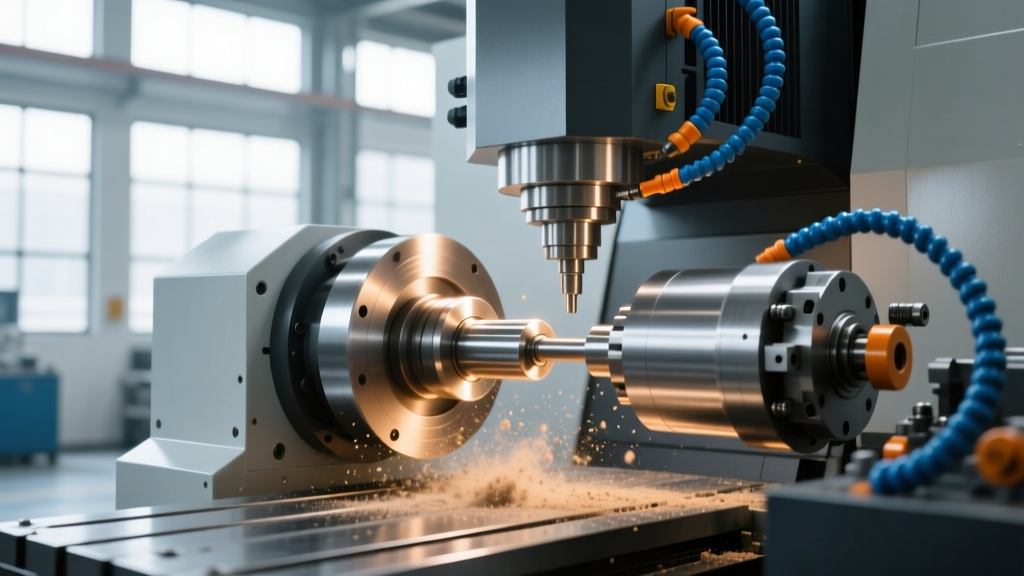
The integration of 5-axis rotary tables (such as the System 3R MacroMagnum) onto Sinker EDM beds has shifted the work envelope from a rectangular prism to a spherical intersection. When a part is tilted at a 45-degree angle to burn complex turbine blade root forms, the corners of the workpiece swing outward.
If the physical bed and tank walls are not oversized by at least 40% compared to a standard 3-axis setup, the workpiece will collide with the tank doors or the dielectric flush lines during rotation. Therefore, a 5-axis CNC sparking machine requires a significantly wider physical bed to accommodate the same base workpiece size as a 3-axis machine. Buyers must map the 'swing diameter' of their largest intended part and ensure it clears the tank's internal width minus 100 mm for flushing nozzles.
Decision Framework: Sizing Your Machine for 2026 Production
Use this actionable framework to select the correct bed size and work envelope configuration based on your specific manufacturing vertical:
1. Aerospace Turbine & Blisk Manufacturing
- Requirement: High Z-axis travel, 5-axis swing clearance, massive dielectric volume.
- Bed Size Target: Minimum 1000 x 800 mm physical bed.
- Key Feature: Drop-down ATC to preserve Z-axis; programmable dielectric level controls to manage fluid displacement during extreme part tilting.
2. High-Volume Micro-Molding & Medical Implants
- Requirement: Extreme thermal stability, minimal footprint, high-speed ATC.
- Bed Size Target: 300 x 200 mm physical bed (Micro-EDM class).
- Key Feature: Integrated temperature-controlled dielectric chillers. In micro-sparking, a 1°C fluctuation in the fluid causes thermal expansion that exceeds the 2-micron tolerance of the workpiece. Smaller beds allow for faster, more precise thermal regulation.
3. Automotive Stamping Dies
- Requirement: Extreme weight capacity, wide X-Y travel, deep cavity burning.
- Bed Size Target: 1200 x 900 mm or larger.
- Key Feature: Zero-point clamping systems (like EROWA) integrated directly into the cast-iron bed. This allows crane operators to drop 3,000 kg die blocks onto the bed and achieve repeatability within 0.005 mm without manual indicator sweeping.
Conclusion: Beyond the Spec Sheet
The specification sheet of a CNC sparking machine provides only the theoretical boundaries of its capabilities. In 2026, true capacity is defined by the intersection of dielectric fluid dynamics, automated tooling clearances, and multi-axis swing radii. By calculating the effective work envelope and verifying shop floor structural limits, manufacturing engineers can eliminate costly collision risks and ensure their EDM investments deliver uninterrupted, lights-out production.