Sizing CNC Power: Electrical Loads for CNC Machine Coolant Oil
Learn how to size CNC machine electrical setups by calculating the hidden amperage draws of high-pressure coolant oil pumps, chillers, and IoT sensors.
The Hidden Amperage of Coolant Oil Systems
When manufacturing engineers plan the electrical infrastructure for a new CNC machining cell, the primary focus is almost always on the spindle motor, the axis servos, and the main control cabinet. However, one of the most common causes of nuisance breaker trips and voltage sags in modern machine shops stems from a severely underestimated auxiliary system: the CNC machine coolant oil delivery network. As machining tolerances tighten and exotic alloys like Inconel and titanium become standard in aerospace and medical manufacturing, the shift from standard flood coolant to high-pressure (HP) coolant systems has radically altered facility power requirements.
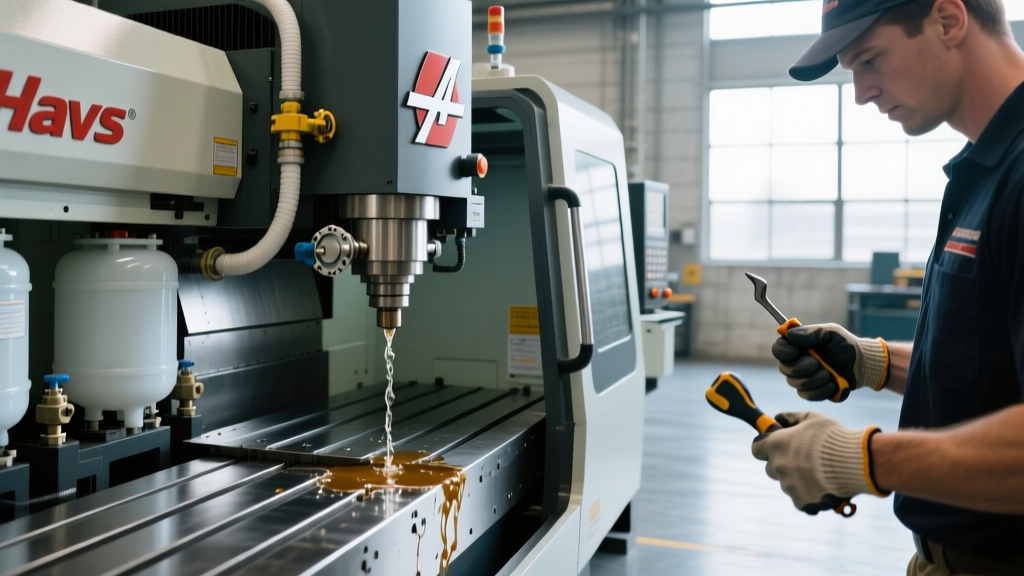
A standard flood coolant pump typically operates on a 1 HP to 3 HP motor, drawing a relatively benign 5 to 10 amps at 230V. In contrast, modern high-pressure coolant oil systems—capable of delivering 1,000 to 4,000 PSI directly to the cutting zone through the spindle—require massive 10 HP to 25 HP pumps. These systems do not just consume more continuous power; they introduce severe transient electrical loads that can destabilize an entire shop's localized power grid if the electrical panel is not sized correctly.
⚠️ CRITICAL WARNING: Inrush Current MiscalculationDo not size your CNC machine's auxiliary breaker based solely on the Full Load Amps (FLA) printed on the coolant pump motor nameplate. High-pressure coolant oil pumps have massive starting inertia. The Locked Rotor Amperage (LRA) can be 6 to 8 times the FLA. If your breaker is not sized to accommodate this momentary inrush, the breaker will trip every time the M-code triggers the pump, halting production and potentially damaging the machine's main control transformer.
Calculating Inrush: NEC Article 430 Compliance
To properly integrate a high-pressure CNC machine coolant oil system into your power setup, facility electricians must adhere to the National Electrical Code (NEC), specifically NFPA 70 (NEC) Article 430, which governs motors, motor circuits, and controllers. Sizing the circuit requires a multi-step calculation that accounts for both the base machine and the fluid management peripherals.
Base Machine vs. Fluid Management Loads
Consider a typical 5-axis vertical machining center. The base machine might require a 60-amp, 480V 3-phase drop. If you add a 15 HP high-pressure coolant oil pump (such as those manufactured by ChipBLASTER or MP Systems) and a 5 HP chiller unit to maintain the oil's viscosity, the continuous load calculation changes dramatically.
- Base Machine (Spindle, Axes, Control): ~45A continuous draw.
- 15 HP High-Pressure Pump (460V): ~21A Full Load Amps (FLA).
- 5 HP Chiller/Heat Exchanger (460V): ~7.5A FLA.
- Tramp Oil Separator & Skimmer: ~2A FLA.
Under NEC guidelines, the branch circuit short-circuit and ground-fault protective device (the breaker) must be sized to handle the starting current of the largest motor plus the sum of the full-load currents of the other motors. For a 15 HP pump, the inverse-time breaker multiplier is typically 250% of the FLA. This means the breaker must handle a transient spike of over 50 amps just for the coolant pump startup, pushing the total required panel capacity well beyond a standard 100-amp machine drop. Upgrading a shop's localized drop from 100A to 200A to support these fluid systems typically costs between $4,500 and $8,500 in electrical contractor fees.
2026 Innovation: IoT Sensors and VFD EMI Mitigation
The electrical setup for CNC machine coolant oil systems is no longer just about raw amperage; it is now deeply intertwined with data integrity. In 2026, smart fluid management is standard. Modern coolant loops are embedded with IoT sensors that continuously monitor pH levels, refractometer concentration, temperature, and tramp oil contamination in real-time.
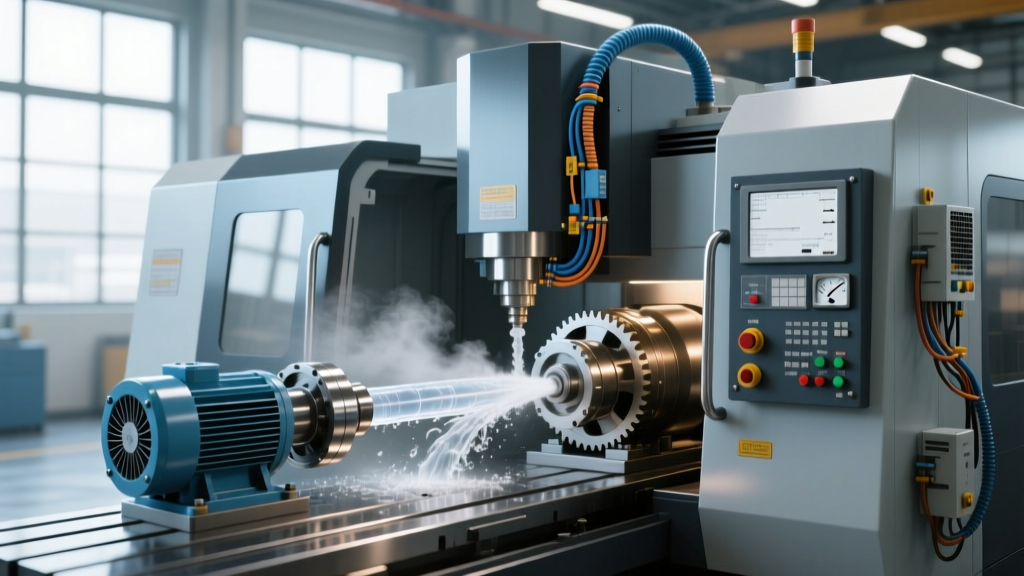
The primary electrical challenge here is Electromagnetic Interference (EMI). High-pressure coolant pumps are almost exclusively driven by Variable Frequency Drives (VFDs) to allow the CNC controller to modulate pressure based on the specific tool in the spindle. VFDs generate severe high-frequency electrical noise. If the low-voltage DC wiring for your IoT coolant sensors shares the same conduit or grounding plane as the VFD power cables, the sensor data will spike erratically, leading to false alarms and automated machine shutdowns.
Best Practices for Signal Isolation
To protect your coolant oil monitoring data, the electrical setup must enforce strict physical and galvanic isolation:
- Separate Conduits: Run VFD power cables and 24VDC sensor cables in completely separate, grounded metallic conduits. Maintain a minimum physical separation of 12 inches where they must cross.
- Shielded VFD Cables: Use specialized, symmetrically grounded shielded VFD cables (e.g., Belden 313505 or equivalent) to contain the harmonic noise generated by the pump motor.
- Isolated Power Supplies: Power the IoT coolant sensors using a dedicated, isolated 24VDC DIN-rail power supply inside the control cabinet, rather than tapping into the machine's main 24VDC logic supply.
Wire Sizing and Conduit Routing for Fluid Zones
The physical environment surrounding a CNC machine is highly hostile to standard electrical insulation. Coolant oil, whether straight, semi-synthetic, or fully synthetic, acts as a slow-acting solvent on many common wire jackets. Furthermore, the constant presence of moisture and metal fines creates a high risk for ground faults.
Standard THHN (Thermoplastic High Heat-resistant Nylon-coated) wire is frequently used in commercial building wiring, but its nylon outer jacket is highly susceptible to degradation when exposed to the chemical compounds found in CNC machine coolant oil. Once the nylon breaks down, the underlying PVC insulation becomes brittle, leading to micro-shorts against the machine chassis.
| Wire Insulation Type | Chemical Resistance to Coolant Oil | Moisture Rating | Application Verdict |
|---|---|---|---|
| THHN / THWN-2 | Poor (Nylon degrades) | Wet/Dry | Avoid inside machine enclosure |
| XHHW-2 | Excellent (XLPE jacket) | Wet/Dry | Mandatory for pump & reservoir zones |
| MTW (Machine Tool Wire) | Very Good | Dry Only | Use only inside sealed control cabinets |
For all external wiring connecting the main CNC electrical cabinet to the coolant oil reservoir, high-pressure pump, and filtration units, XHHW-2 (Cross-linked Polyethylene) is the absolute minimum standard. Its thermoset XLPE insulation provides superior resistance to the hydrocarbon chains present in cutting oils and maintains flexibility even when coated in swarf and sludge.
Dielectric Hazards: Grounding with Straight Cutting Oils
While water-soluble synthetic coolants are highly conductive, many shops machining aerospace titanium or medical-grade stainless steel rely on straight cutting oils (neat oils) for their superior lubricity and lack of rust-promoting water content. Electrically, straight CNC machine coolant oil acts as a dielectric fluid—an insulator.
This creates a unique and dangerous electrical hazard. As the high-pressure oil is forced through the spindle and impacts the workpiece at 1,000+ PSI, it generates significant static electricity. Because the oil itself is an insulator, this static charge cannot dissipate through the fluid stream back to the reservoir. Instead, the charge builds up on the workpiece, the tooling, and the machine spindle housing. If the machine's equipotential bonding is inadequate, an operator touching the workpiece or the machine door can receive a severe static shock, or the accumulated charge can arc across the spindle bearings, causing microscopic pitting and premature bearing failure.
'When utilizing high-pressure straight oil systems, the machine chassis, the tool presetter, and the coolant reservoir must be bonded together using a minimum 6 AWG bare copper grounding conductor, tied directly to the facility's main grounding electrode system. Relying solely on the equipment grounding conductor inside the power cable is insufficient for dissipating high-voltage static buildup in dielectric fluid environments.'
Compliance with OSHA electrical safety standards and proper equipotential bonding ensures that any stray currents or static discharges are safely routed to earth ground, protecting both the operator and the multi-million-dollar spindle assembly.
Summary: Future-Proofing Your Fluid Power Setup
The era of treating the coolant system as a simple 'plug-and-play' auxiliary component is over. As CNC machine coolant oil systems evolve into high-pressure, IoT-monitored, thermally regulated networks, they demand rigorous electrical engineering. By calculating true inrush currents per NEC Article 430, specifying XHHW-2 wiring for chemical resistance, isolating VFD noise from smart sensors, and implementing robust static grounding for dielectric oils, manufacturing facilities can eliminate nuisance trips, protect sensitive electronics, and ensure uninterrupted production in 2026 and beyond.