Upgrading CNC Machines Parts: Bed Size & Envelope Innovations
Explore 2026 innovations in CNC machine bed sizes and work envelopes. Learn how upgrading specific CNC machines parts maximizes machining volume.
The Shift from Footprint to Volumetric Efficiency
In 2026, the manufacturing mandate is clear: maximize the work envelope without expanding the factory footprint. As aerospace and medical device geometries grow more complex, the physical bed size and volumetric capacity of a machine tool dictate its utility. However, simply buying a larger machine is no longer the default solution. Instead, shops are leveraging advanced material science and sourcing specialized cnc machines parts to push the boundaries of existing envelopes. According to ongoing research tracked by NIST Advanced Manufacturing, modern machine tool calibration and thermal stability protocols now allow manufacturers to safely utilize 94% of a machine's stated work envelope, up from 82% a decade ago, provided the base casting and linear motion components are correctly matched to the payload.
2026 Data Highlight: Footprint-to-Envelope Ratios
- Standard C-Frame VMC: 18% envelope-to-footprint ratio (limited by Z-axis overhang).
- Trunnion Table 5-Axis: 24% ratio (optimized rotational clearance).
- Polymer Concrete Gantry: 31% ratio (minimal floor space required for massive X/Y travels).
Material Science: Cast Iron vs. Polymer Concrete Beds
The foundation of any work envelope is the bed casting. The mass and material of the bed determine how much weight the table can support while maintaining micron-level accuracy at the extreme edges of the X and Y axes. When evaluating base architectures, manufacturers must choose between traditional Meehanite cast iron and modern polymer concrete composites.
Thermal Expansion and Damping Characteristics
Meehanite cast iron remains the industry standard for heavy-cutting horizontal machining centers (HMCs) due to its high mass and superior compressive strength. However, its thermal expansion rate of approximately 10 µm/m/°C means that in a 2,000mm bed, a 3°C shop floor temperature swing can induce 60 µm of linear growth. This thermal drift severely limits the usable envelope in non-climate-controlled facilities.
Conversely, polymer concrete beds (such as Studer's Granitan S100) offer a thermal expansion rate of just 4 µm/m/°C and possess damping characteristics up to ten times greater than cast iron. For high-speed 5-axis machines where the spindle reaches the extreme limits of the envelope at high feed rates, polymer concrete absorbs the vibrational harmonics that would otherwise cause chatter at the tool tip. The trade-off is a lower maximum static load capacity; polymer beds are generally limited to 2,500 kg table loads, whereas heavily ribbed cast iron beds in machines like the Makino a99nx can support upwards of 5,000 kg.
2026 Work Envelope Comparison Matrix
The following matrix compares three dominant machine architectures, illustrating how bed design directly impacts the usable work volume and part weight limits. Data reflects current 2026 OEM specifications.
| Machine Architecture | Reference Model | Max Envelope (X, Y, Z) | Max Table Load | Primary Bed Material |
|---|---|---|---|---|
| Vertical Trunnion (5-Axis) | Haas UMC-750SS | 762 x 508 x 508 mm | 500 kg (platter) | Meehanite Cast Iron |
| Horizontal Pallet (HMC) | DMG MORI NHX 5000 | 730 x 730 x 880 mm | 800 kg (pallet) | High-Grade Cast Iron |
| Mill-Turn Gantry | Mazak INTEGREX i-400 | 1,070 x 2,000+ mm (Z) | 1,200 kg (chuck) | Cast Iron Base / Steel Weldment |
Sourcing CNC Machines Parts for Envelope Optimization
Expanding or optimizing a work envelope rarely involves replacing the entire machine. Instead, precision upgrades to specific cnc machines parts can reclaim lost travel, reduce deflection at the envelope's edges, and allow for heavier off-center loads. As detailed in ongoing industry analyses by Modern Machine Shop, retrofitting legacy machines with modern motion components is a primary strategy for maximizing volumetric efficiency.
1. Upgrading Linear Guides and Ball Screws
Standard C-frame vertical mills suffer from Z-axis yaw when the spindle head extends to the maximum Y-axis travel. To counteract this without buying a new machine, shops are upgrading to oversized, pre-loaded linear roller guides (e.g., THK SRG series or Rexroth Roller Rail systems). Replacing standard ball bearing ways with roller guides increases rigidity by up to 45% at the extreme edges of the envelope. Furthermore, swapping a standard single-nut ball screw for a dual-nut, pre-tensioned NSK HMC series screw eliminates backlash and thermal growth along the X-axis, effectively adding 15-20 mm of reliable, high-accuracy travel to the envelope's boundaries.
2. Absolute Linear Scales for Envelope Calibration
Rotary encoders on servo motors cannot account for the physical stretch of a 2-meter ball screw or the thermal expansion of the bed. Installing absolute linear scales (such as Heidenhain LC 400 or Renishaw RESOLUTE) directly measures the table's position. While this does not physically enlarge the bed, it unlocks the 'dead zones' at the edges of the envelope. Previously, programmers had to leave a 20mm safety buffer at the limits of travel to avoid crashes caused by lost position data. Absolute scales reduce this buffer to under 2mm, effectively increasing the usable work envelope by up to 5% on large-format gantry machines.
3. Advanced Telescopic Way Covers
As bed sizes increase, the X-axis way covers must extend further. Traditional steel lamella covers become incredibly heavy, causing sag and increasing the friction on the linear guides. In 2026, upgrading to carbon-fiber reinforced polymer (CFRP) way covers reduces the moving mass by 60%. This reduction in parasitic mass allows the servo motors to accelerate the table faster, and more importantly, prevents the covers from binding when the table reaches the absolute physical limit of the bed casting.
Warning: The Z-Axis Deflection Trap
When modifying a machine to accommodate taller parts (expanding the Z-envelope via riser blocks), the center of gravity shifts drastically forward. A 150mm cast iron riser block on a standard 40-taper VMC can increase Z-axis deflection by 35 µm under a moderate 500N cutting force. If you must expand the Z-envelope, you must simultaneously upgrade the Z-axis servo motor to a higher torque rating (e.g., upgrading from a 2.5kW to a 4.0kW Fanuc alpha-i series motor) and install a nitrogen gas strut to counterbalance the added head weight.
Decision Framework: Matching Bed Mass to Part Geometry
Selecting the right bed size and envelope architecture requires a strict adherence to part mass and geometry, rather than just the physical dimensions of the raw material. Use the following decision framework to specify your machine bed requirements:
- Calculate the Payload Moment: Do not just look at the maximum table load (e.g., 1,000 kg). Calculate the moment of inertia. A 500 kg part that is 20mm tall exerts vastly less tipping force on a trunnion table than a 300 kg part that is 400mm tall. If the part height exceeds 30% of the X-axis travel, mandate a Horizontal Machining Center (HMC) with a tombstone setup to keep the center of gravity close to the rotary axis.
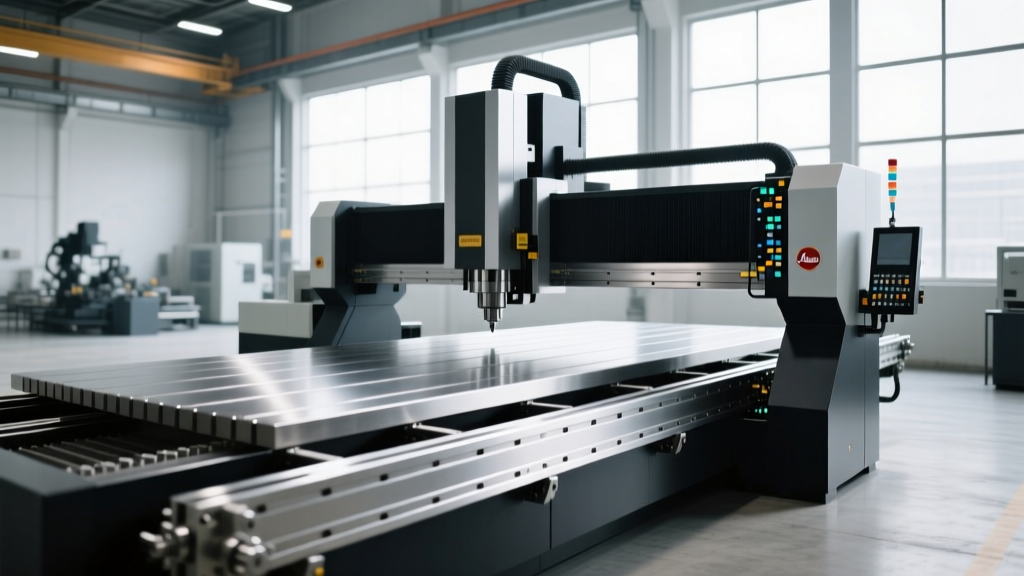
- Evaluate the Footprint Constraint: If factory floor space is constrained to under 8 square meters, rule out standard C-frame machines with large travels. Specify a traveling-column VMC or a bridge-type gantry where the bed remains stationary and only the spindle moves. This requires sourcing specialized cnc machines parts like overhead cable carriers and moving gantry linear scales, but it yields the highest envelope-to-footprint ratio.
- Assess Thermal Mass Requirements: If machining high-hardness alloys (like Inconel 718 or Titanium Ti-6Al-4V) requiring heavy roughing passes, the bed must possess high thermal mass to absorb cutting heat without warping. Specify heavily ribbed Meehanite cast iron beds with integrated coolant jackets. Avoid polymer concrete for heavy, interrupted roughing cuts, as the localized heat can degrade the epoxy binder over time.
The Future of Adaptive Envelopes
Looking toward late 2026 and beyond, the concept of a static work envelope is being challenged by adaptive fixturing and movable bed partitions. OEMs are experimenting with modular bed castings that allow manufacturers to physically bolt on secondary X-axis extensions for specific long-part runs, then remove them to restore the machine's high-speed dynamics for smaller batch work. By standardizing the linear motion interfaces, these modular cnc machines parts promise to make the work envelope a dynamic variable rather than a fixed limitation, fundamentally altering how machine shops calculate ROI on capital equipment.