CNC Machine Moving: Workholding and Fixturing Methods
Explore how CNC machine moving impacts workholding and fixturing methods. Includes aerospace case studies, rigging constraints, and calibration steps.
The Physics of Relocation: Center of Gravity and Fixturing Mass
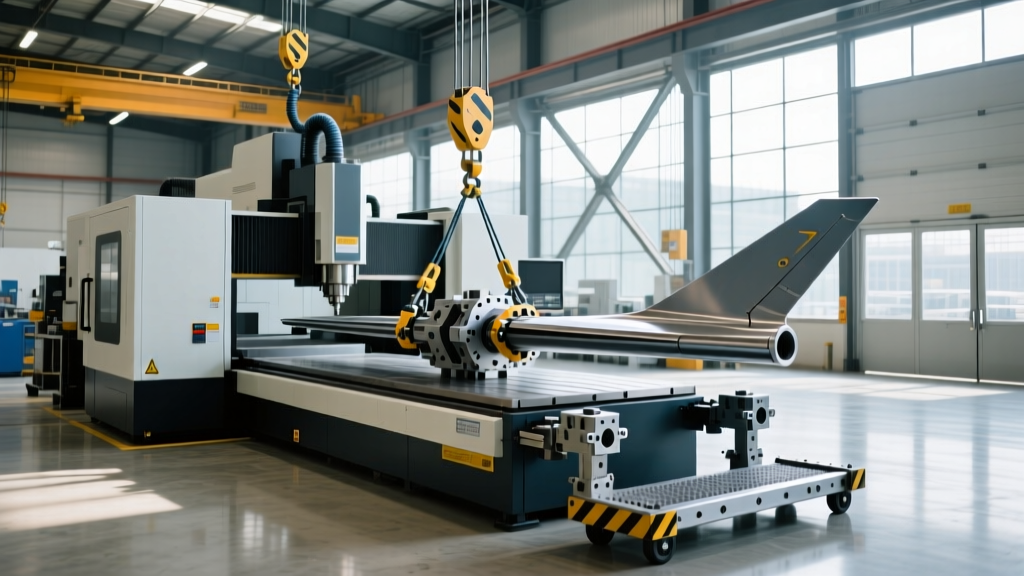
When a manufacturing facility undertakes a CNC machine moving project, the focus typically lands on the machine tool itself—spindle locks, axis braces, and crane rigging points. However, the workholding and fixturing methods attached to or stored within the machine envelope represent a massive, often overlooked variable. As of 2026, modern 5-axis machining centers and multi-tasking lathes are frequently integrated with heavy, high-precision workholding systems that fundamentally alter the machine's mass distribution.
Consider a standard 5-axis trunnion mill, such as a Haas UMC-750SS or a Mazak Variaxis i-700. The base machine may weigh between 18,000 and 26,000 lbs. However, adding a 2,500 lb hydraulic tombstone, 400 lbs of Kurt DX6 double-station vises, and a 1,200 lb System 3R macro pallet pool shifts the machine's center of gravity (CG) forward and upward by up to 14 inches. According to guidelines published by the Material Handling Institute (MHI), failing to account for this CG shift during forklift or crane rigging is a primary cause of transit tip-overs and structural frame twisting.
⚠️ CRITICAL WARNING: Hydraulic Workholding PressureNever transport a CNC machine with active hydraulic pressure in the workholding lines. Moving a machine with 5,000 PSI trapped in tombstone clamping cylinders can cause catastrophic seal blowouts when the fluid expands or contracts due to transit temperature fluctuations. Always depressurize, lock out the hydraulic pump, and cap the quick-disconnect fittings before the machine leaves the foundation.
Case Study: Aerospace 5-Axis Trunnion Relocation
To understand the real-world implications of CNC machine moving on workholding methods, we examined a 2025 facility consolidation project involving an Ohio-based aerospace tier-2 supplier. The shop was relocating a DMG Mori DMU 50 3rd Generation mill, complete with a customized Schunk tandem clamping tower and a 12-station hydraulic rotary manifold.
Pre-Move Audit: What Stays and What Goes
The rigging contractor initially quoted $8,500 to move the machine "as-is" with the workholding attached. However, the shop's manufacturing engineering team conducted a risk assessment and opted for a partial teardown. The decision was driven by the vulnerability of the precision-ground locating pins and the risk of the 800 lb clamping tower acting as a pendulum during crane lifts, which could crack the machine's cast-iron T-slot table.
| Fixturing Component | Weight | Removal Time | Transit Risk | Action Taken |
|---|---|---|---|---|
| Schunk Tandem Tower | 815 lbs | 2.5 Hours | High (CG Shift) | Removed & Crated |
| Hydraulic Rotary Manifold | 140 lbs | 4.0 Hours | Severe (Seal Rupture) | Removed & Drained |
| Kurt DX6 Vises (x2) | 135 lbs ea. | 45 Mins | Low | Secured to Table |
| System 3R Macro Pallets | 45 lbs ea. | 15 Mins | High (Surface Scratch) | Removed & Rack Stored |
By removing the heaviest and most fragile workholding methods prior to the CNC machine moving process, the shop spent an additional $2,200 in labor for teardown and re-setup, but avoided a potential $45,000 repair bill for a cracked trunnion table or damaged rotary union. The final rigging cost with the adjusted CG was $11,200, a justifiable premium for guaranteed geometric integrity.
Transit Protection for Precision Ground Fixturing
Workholding methods rely on extreme surface flatness and parallelism. A standard CNC vise or tombstone base is ground to within 0.0002 inches of flatness. During transit, vibration and airborne moisture are the enemies of these precision surfaces.
The VCI and Shock-Absorption Protocol
For any workholding removed from the machine during a move, standard cardboard and bubble wrap are insufficient. The industry standard for 2026 involves a three-layer protection method:
- Layer 1 (Chemical): Wrap all precision ground surfaces, locating pins, and T-slot keys in Vapor Corrosion Inhibitor (VCI) polyethylene film. VCI molecules form a microscopic protective layer on the ferrous metal, preventing oxidation even in high-humidity transport trailers.
- Layer 2 (Mechanical): Apply closed-cell polyethylene foam (minimum 2-inch thickness) around the VCI-wrapped component to absorb high-frequency transit vibrations that can cause fretting corrosion between mated surfaces.
- Layer 3 (Structural): Bolt the workholding to a dedicated steel or heavy-timber skid. Never stack heavy vises or tombstones directly on top of one another in a crate; the dynamic G-forces of a semi-truck hitting a pothole can exceed 3Gs, crushing the lower components.
If you must leave vises mounted to the machine table during the move, loosen the T-slot nuts by exactly one-half turn. This prevents the massive clamping force from warping the machine table if the cast-iron frame flexes slightly while suspended from a crane. Re-torque to 85 ft-lbs immediately upon setting the machine on its new, leveled foundation.
Post-Move Calibration: Re-Zeroing the Workholding Envelope
The CNC machine moving process is not complete when the riggers drop the equipment on the new concrete pad. Heavy machine tools require a 48- to 72-hour thermal and gravitational settling period before workholding methods can be reliably re-calibrated. The Occupational Safety and Health Administration (OSHA) emphasizes that proper installation and leveling of heavy machinery is critical not just for safety, but for operational integrity.
Laser Interferometry and Touch-Probe Validation
Once the machine has settled and the facility's ambient temperature has stabilized at 68°F (20°C), the workholding must be mapped. Relying on the machine's pre-move work offsets is a critical error; the geometric relationship between the spindle centerline and the T-slots will have shifted microscopically.
Advanced shops utilize a Renishaw XL-80 laser interferometer or a high-precision spindle-mounted touch probe (like the Renishaw OMP60) to execute the following workholding re-validation sequence:
- Sweep the Table: Use a test indicator on a magnetic base to sweep the bare T-slot table. Verify that the move did not introduce a twist exceeding 0.0005 inches across the X-axis travel.
- Map the Tombstone/Trunnion: Probe the four master locating holes of the hydraulic tombstone. Update the machine's G54.1 P1 through P4 rotational work offsets based on the new probe data.
- Verify Vise Parallelism: Indicate the solid jaw of all stationary vises. If a vise was left on the table during the move and the table flexed, the vise jaw may now be out of square with the Y-axis by up to 0.002 inches. Shim the vise base with brass feeler gauges until parallelism is restored before final torquing.
"The biggest mistake we see in CNC machine moving is treating the workholding as an afterthought. A machine is only as accurate as the fixturing holding the part. If you spend $15,000 moving a 5-axis mill but rush the 4-hour tombstone re-calibration process, you might as well be machining on a manual Bridgeport."
— Lead Metrology Engineer, Mid-West Aerospace Contracting
Summary: Integrating Fixturing into the Relocation Plan
Successful CNC machine moving requires a holistic approach that treats workholding and fixturing methods as integral components of the machine's geometry. By auditing the mass and fragility of clamping towers, hydraulic manifolds, and pallet pools prior to the move, shops can prevent catastrophic rigging failures. Furthermore, implementing strict VCI transit protection and executing a rigorous post-move laser calibration protocol ensures that the machine will hold the tight 0.0005-inch tolerances required in modern manufacturing from the very first shift in the new facility.