CNC Machine Dust Collection & Chip Conveyor Maintenance
Optimize your CNC machine dust collection and chip conveyor lifespan with exact maintenance schedules, CFM diagnostics, and filter replacement intervals.
The Hidden Cost of Poor Particulate and Swarf Management
Spindle bearing replacement on a standard VMC costs between $4,500 and $12,000, and the leading culprit is often microscopic particulate ingress past degraded way covers. Effective CNC machine dust collection and chip management are not merely housekeeping tasks; they are critical reliability engineering functions. When a 5-axis machining center or a high-speed CNC router operates with compromised extraction, 5-micron aluminum or cast iron dust bypasses standard labyrinth seals, mixing with way lube to form an abrasive slurry that accelerates linear guideway wear by up to 40%.
⚠️ CRITICAL SAFETY WARNING: Combustible DustMachining aluminum, titanium, or magnesium generates highly combustible dust. According to OSHA combustible dust guidelines, accumulated swarf and fine particulate in collector hoppers can ignite from a single static discharge or mechanical spark. Facilities machining these alloys must strictly adhere to NFPA 484 standards, mandating wet collectors or specialized dry collectors with explosion venting and daily hopper evacuation.
Dust Collection System Maintenance Matrix
Industrial CNC dust collectors, such as Donaldson Torit or Camfil units, rely on pulse-jet cleaning systems to maintain airflow. A drop in CFM (Cubic Feet per Minute) directly reduces capture velocity at the tool enclosure, allowing dust to escape into the shop environment. Maintain your extraction system using this strict service schedule.
| Interval | Component | Action & Specification |
|---|---|---|
| Daily | Hopper / Dust Drawer | Evacuate completely. Never allow dust to reach the bottom of the filter cartridges. |
| Weekly | Differential Pressure Gauge | Log readings. Optimal range is 4.0" to 6.0" w.c. (water column). Readings above 8.0" w.c. indicate blinded filters. |
| Monthly | Pulse-Jet Solenoids | Test firing sequence. Listen for the sharp 'crack' of the diaphragm valve. Replace diaphragm kits ($45-$80) if hissing occurs. |
| 500 Hours | Compressed Air Supply | Drain moisture separators. Pulse-jet air must be clean and dry (90-120 PSI). Moisture cakes dust onto filter media. |
| Annual | Filter Cartridges | Replace media. Standard cellulose ($120/ea) or upgrade to spunbond polyester with PTFE membrane ($280/ea) for longer life. |
Filter Media Selection and Airflow Diagnostics
Standard cellulose filters are adequate for dry, non-hygroscopic dust like MDF or specific plastics. However, if your CNC machine utilizes mist coolant or machines materials that generate oily swarf (like 6061 aluminum with flood coolant), cellulose fibers will absorb the moisture and blind permanently within weeks. For these environments, specify spunbond polyester filters with a PTFE (polytetrafluoroethylene) membrane. The PTFE coating provides a non-stick surface that allows the pulse-jet system to dislodge oily dust cakes efficiently. While the upfront cost is roughly 2.3x higher, the service life extends from 1,000 hours to over 4,000 hours, yielding a net positive ROI.
To verify system health, do not rely solely on the sound of the blower motor. Use a hot-wire anemometer at the capture hood. A standard CNC router enclosure requires a minimum capture velocity of 150 FPM (feet per minute) across the open door area to prevent particulate escape. If velocity drops below 120 FPM and the differential pressure gauge reads below 3.0" w.c., inspect the ductwork for internal swarf buildup or flexible hose collapse.
Chip Conveyor Service Schedules by Type
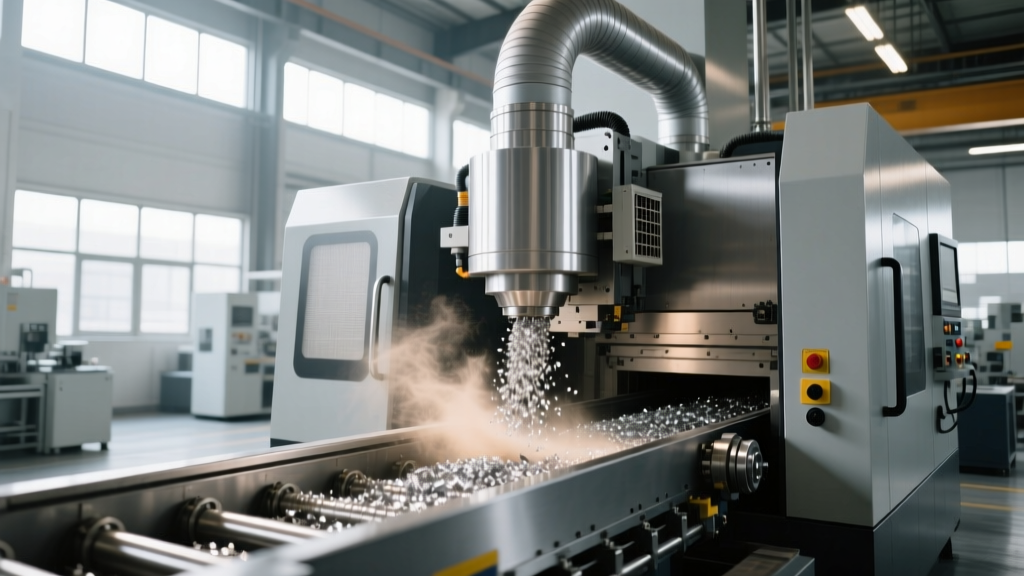
Chip conveyors are subjected to extreme mechanical shock, abrasive wear, and constant coolant immersion. The two most common types in CNC machining centers are hinge belt and scraper conveyors. Neglecting their service schedules leads to catastrophic jamming, which can shear drive chains and burn out 3-phase AC motors ($800 to $1,500 replacement cost).
Hinge Belt Conveyors: Shear Pin and Torque Limiter Maintenance
Hinge belt conveyors (common in Mayfran and Hennig systems) are designed to handle long, stringy chips from steel and titanium turning operations. The critical safety mechanism is the mechanical torque limiter or shear pin assembly, which prevents motor burnout if a jam occurs.
🛠️ Step-by-Step: Monthly Torque Limiter Calibration- Power down and lock out the conveyor motor (LOTO).
- Locate the torque limiter assembly on the main drive shaft.
- Using a calibrated torque wrench, verify the slip clutch setting. For standard 1/2 HP conveyor motors, the slip torque should be set to 45-55 ft-lbs.
- If using a shear pin design, inspect the pin for micro-fractures. Never replace a hardened steel shear pin with a standard hardware store bolt; a Grade 8 bolt will not shear at the engineered threshold, resulting in a torn conveyor belt and destroyed gearbox.
- Grease the drive bearings with a water-resistant polyurea grease (NLGI Grade 2), applying exactly 2-3 pumps to avoid blowing out the seals.
Scraper Conveyors: Chain Tension and Wear Plate Inspection
Scraper conveyors excel at moving fine, sandy chips typical of cast iron milling and aluminum high-speed machining. They utilize a continuous loop of chain with attached flight bars that drag the chips along a steel trough. The primary maintenance failure is chain stretch, which causes the chain to skip sprocket teeth or bind at the tail pulley.
Check chain tension every 250 operating hours. The correct tension allows for 1% to 2% sag (roughly 1/4 inch of vertical play per 10 feet of conveyor length) on the return side. To adjust, loosen the tail shaft bearing blocks and turn the take-up adjustment bolts equally on both sides to maintain parallel alignment. Misalignment by even 3 degrees will cause asymmetric wear on the UHMW (Ultra-High Molecular Weight) polyethylene wear strips, requiring premature replacement.
Troubleshooting Common Extraction and Conveyor Failures
When systems deviate from normal operating parameters, use this diagnostic matrix to identify the root cause before ordering replacement parts.
| Symptom | Root Cause | Corrective Action |
|---|---|---|
| Dust collector pulses continuously but pressure remains high (>8" w.c.) | Filters are blinded by oil mist or moisture; PTFE membrane is compromised. | Replace filters. Install a pre-separator or mist eliminator upstream of the main collector. |
| Hinge belt conveyor motor hums but belt does not move | Shear pin broken or torque limiter slipping due to jammed wad of chips. | Clear the jam at the discharge chute. Replace shear pin or reset torque limiter to spec. |
| Scraper conveyor making rhythmic 'clicking' or grinding noise | Chain has stretched and is riding the tips of the sprocket teeth. | Take up slack via tail shaft adjusters. If max adjustment is reached, remove two chain links. |
| Coolant returning to machine sump is cloudy and low concentration | Conveyor is not removing fines; tramp oil is emulsifying into the coolant. | Check scraper flight clearance. Service the tramp oil skimmer and verify refractometer readings. |
Coolant Filtration and Chip Flushing Integration
Chip management does not end at the conveyor discharge. Fine particulate that bypasses the conveyor settles in the CNC machine's coolant sump, acting as a lapping compound that degrades surface finishes and ruins high-pressure coolant pump seals. Modern machining centers utilize drum filters or centrifugal separators to maintain coolant clarity below 20 PPM (parts per million) of suspended solids.
Inspect the coolant return screen daily. If your CNC machine utilizes a paper band filter, monitor the coolant flow rate. A rising fluid level above the filter paper indicates the media is clogged or the indexing motor has failed. Maintain coolant concentration strictly between 6% and 8% using a digital refractometer. Low concentration accelerates corrosion on the conveyor chain and internal machine castings, while high concentration causes excessive foaming, which reduces the fluid's ability to flush chips away from the cutting zone. By integrating strict dust collector maintenance with rigorous conveyor and coolant schedules, shops can eliminate up to 85% of unscheduled downtime related to way cover failures and spindle contamination.