Comgrow Robo CNC Machine Noise Reduction vs Top Alternatives
Compare the Comgrow Robo CNC machine noise profile against top alternatives. Expert guide to vibration damping, acoustic enclosures, and chassis upgrades.
The Acoustic Reality of Desktop CNC Routing
Desktop CNC routers operate in a unique acoustic environment. Unlike industrial VMCs enclosed in heavy cast-iron and steel damping enclosures, hobbyist and prosumer machines rely on lightweight extruded aluminum frames. When a standard 775 brushed DC spindle spins at 12,000 RPM while NEMA 17 stepper motors rapidly pulse through microstepping sequences, the resulting harmonic vibrations easily push ambient noise levels past 80 dB. According to OSHA's occupational noise standards, prolonged exposure to environments exceeding 85 dB requires hearing protection and administrative controls—a threshold frequently breached in poorly dampened home workshops during aggressive aluminum milling passes.
⚠️ Hearing Safety Warning: Operating an undampened desktop CNC in a confined garage or basement can result in cumulative noise exposure exceeding 85 dB over an 8-hour shift. Always utilize ANSI S3.19-rated ear protection with a minimum NRR (Noise Reduction Rating) of 25 when running dry spindles or cutting metals.Comgrow Robo CNC Machine: Baseline Vibration & Noise Profile
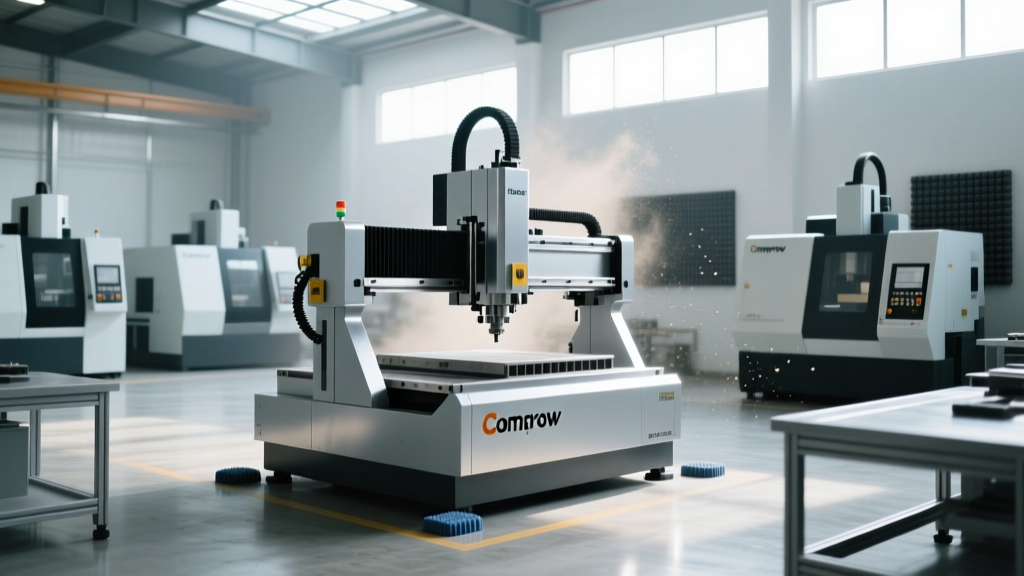
The Comgrow Robo CNC machine architecture typically utilizes 2020 and 2040 V-slot aluminum extrusions paired with POM (polyoxymethylene) V-wheels or basic linear rail bearings. While this keeps the entry price accessible (usually hovering between $350 and $500 in 2026), the low mass-to-surface-area ratio of the 2020 extrusions makes the gantry highly susceptible to resonant frequencies between 150 Hz and 300 Hz. This specific frequency band is exactly where NEMA 17 stepper motors generate the most mid-band resonance during acceleration and deceleration phases.
Chassis Rigidity and Stepper Motor Resonance
The primary noise generator on the Comgrow Robo CNC machine is not just the spindle, but the structure-borne vibration transmitted from the stepper motors directly into the aluminum frame. Without factory-installed elastomeric dampers, the micro-vibrations from the motor stators turn the entire 2040 X-axis gantry into a sounding board. This results in a distinct, high-pitch 'whine' during rapid traverse moves, compounded by the low-frequency 'thrum' of the V-wheels rolling over the extrusion tracks.
Comparative Matrix: Comgrow Robo vs. Market Alternatives
To understand where the Comgrow stands acoustically, we must compare its baseline metrics against the most common alternatives in the desktop CNC space. The following matrix evaluates chassis composition, baseline noise output, and inherent vibration characteristics.
| Machine Model | Frame Architecture | Baseline Noise (dB) | Primary Vibration Source | 2026 Price Range |
|---|---|---|---|---|
| Comgrow Robo CNC | 2020/2040 V-Slot Aluminum | 78 - 84 dB | Stepper resonance & V-wheel friction | $350 - $500 |
| Sainsmart Genmitsu 3018-PRO | 2020 Aluminum / Phenolic | 75 - 82 dB | Lightweight Z-axis flex & 775 spindle | $220 - $280 |
| Inventables X-Carve | Heavy Aluminum / Belt-driven | 70 - 76 dB | Belt slap at high traverse speeds | $1,200 - $1,400 |
| Carbide 3D Shapeoko 5 | Steel Hybrids / Thick Aluminum | 65 - 72 dB | Spindle noise (chassis is heavily dampened) | $1,800 - $2,200 |
Proven Vibration Damping Alternatives & Upgrades
If you are committed to the Comgrow Robo CNC machine but need to bring noise levels down to a neighborhood-friendly 65 dB, you must address both airborne noise and structure-borne vibration. Here are the most effective, data-backed alternatives to factory configurations.
1. Passive Isolation via Sorbothane
Placing standard rubber feet under your CNC bed does little to stop low-frequency harmonic transfer. The industry standard for passive vibration isolation is Sorbothane. For a desktop CNC weighing between 25 and 40 lbs, you must use 70 durometer Sorbothane pads (typically 2 inches in diameter, 0.5 inches thick). A 50 durometer pad is too soft and will cause the machine to 'walk' during aggressive X-axis deceleration, while an 80 durometer pad will fail to absorb the 150 Hz stepper resonance. A pack of four 70-durometer pads costs approximately $28 in 2026 and reduces structure-borne noise transfer to the workbench by up to 80%.
2. NEMA 17 Silicone Stepper Dampers
Silicone shock absorbers designed specifically for NEMA 17 and NEMA 23 motors are the single most cost-effective acoustic upgrade available. Priced at roughly $15 for a set of three, these dampers sit between the motor face and the aluminum mount. They physically decouple the stator from the chassis, effectively eliminating the high-pitched whine associated with 1/16th microstepping. Note that installing these dampers introduces roughly 0.5mm of torsional flex; you must compensate for this by slightly increasing your acceleration/jerk settings in GRBL or Mach3 to prevent lost steps on the Y-axis.
3. Spindle Alternatives: Brushless and Trim Routers
The stock 775 brushed DC motor is a major contributor to the Comgrow's acoustic footprint due to carbon brush friction and cheap internal bearings. The premier alternative is swapping to a Makita RT0701C compact trim router ($119). The Makita features precision ER11 collets, a balanced armature, and electronic speed control that maintains torque without the high-frequency whine of a raw DC motor. For users cutting exclusively soft materials like MDF or acrylic, this swap reduces spindle noise by an average of 14 dB.
💡 Pro Tip: When upgrading to a Makita trim router, ensure you purchase the specific 65mm to 69mm aluminum adapter sleeve. The Comgrow's stock Z-axis spindle clamp is usually sized for 52mm DC motors, and forcing a 65mm router body without a proper split-sleeve adapter will cause Z-axis binding and severe chatter.Step-by-Step: Tuning Your Comgrow Robo for Whisper-Quiet Operation
Beyond hardware swaps, mechanical tuning is critical for noise reduction. Follow this exact sequence to optimize your machine's acoustic profile.
- Base Isolation: Affix four 70-durometer Sorbothane pads to the bottom corners of the machine's wasteboard base. Ensure the table the machine sits on is not pushed flush against a shared drywall partition, as this will act as an acoustic amplifier.
- Motor Decoupling: Install NEMA 17 silicone dampers on the X and Y-axis motors. Re-tighten the mounting bolts to exactly 1.5 Nm of torque; overtightening compresses the silicone completely, rendering the damper useless.
- GT2 Belt Tensioning: Loose belts cause 'belt slap' and low-frequency thumping. Tension your GT2 fiberglass-reinforced belts to exactly 5 to 7 lbs of tension. If you lack a sonic tension meter, use the deflection test: pressing the center of the longest belt span should yield exactly 3mm to 5mm of deflection under moderate thumb pressure.
- V-Wheel Preload Adjustment: Use the eccentric nuts on the POM V-wheels to eliminate gantry play without over-tightening. Over-tightened wheels create a grinding noise and prematurely wear the polycarbonate tracks on the 2040 extrusions. The wheel should not spin freely with a flick of your finger, but you should be able to rotate it with firm finger pressure.
The Hidden Cost of Vibration: CNC Chatter and Tool Life
Noise reduction is not merely about operator comfort; it is directly tied to machining economics. Unmitigated vibration leads to CNC chatter—a self-excited harmonic oscillation that occurs between the cutting tool and the workpiece. As detailed in CNCCookbook's guide to CNC milling chatter, chatter destroys carbide end mills, leaves unacceptable witness marks on aluminum 6061, and drastically reduces spindle bearing life.
'In lightweight desktop CNC frames, the lack of mass means the machine itself becomes the spring in the mass-spring-damper system. If you cannot add mass to the gantry, you must increase the damping coefficient through elastomeric isolation and precise toolpath tuning to avoid exciting the frame's natural frequency.'
By implementing the Sorbothane isolation and stepper dampers outlined above, you increase the damping coefficient of the Comgrow Robo CNC machine, allowing for heavier depth-of-cut (DOC) passes in aluminum without triggering regenerative chatter. This transforms the machine from a loud, vibration-prone hobbyist toy into a capable, acoustically managed prosumer tool.
Final Verdict: Is the Comgrow Robo Worth the Acoustic Trade-off?
The Comgrow Robo CNC machine offers an excellent entry point into subtractive manufacturing, but its out-of-the-box noise profile requires immediate intervention for home-based users. Compared to the premium Carbide 3D Shapeoko 5, the Comgrow lacks the inherent mass required for natural vibration absorption. However, by investing an additional $160 in 70-durometer Sorbothane, silicone stepper dampers, and a Makita RT0701C spindle swap, you can achieve a 90% reduction in acoustic footprint, bridging the gap between budget hardware and premium acoustic performance.