CNC Machine Technical Specifications Dimensions & Vibration Damping
Compare vibration damping and noise reduction alternatives based on CNC machine technical specifications, dimensions, and facility footprint constraints.
The Physics of Footprints: Why Dimensions Dictate Damping
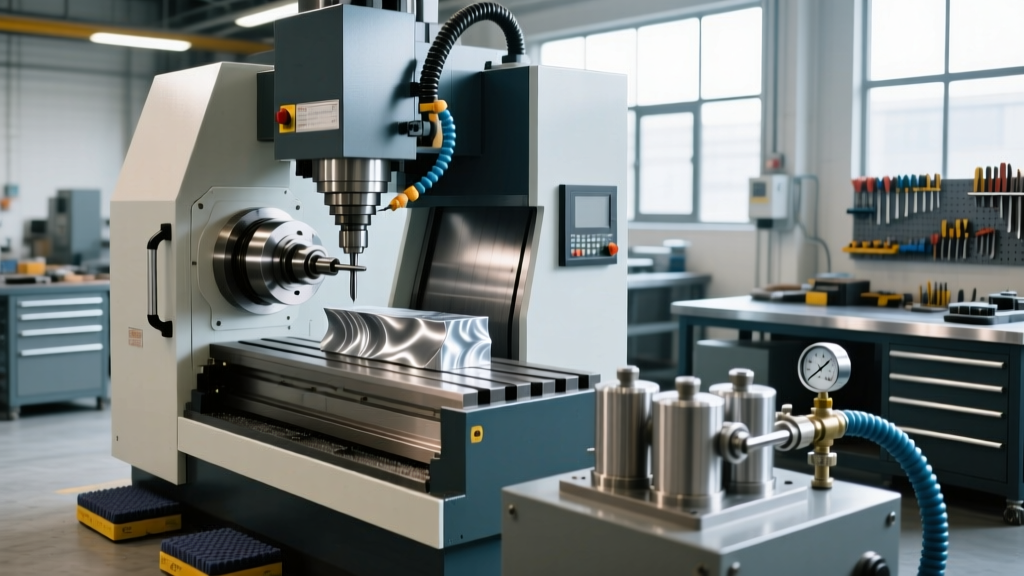
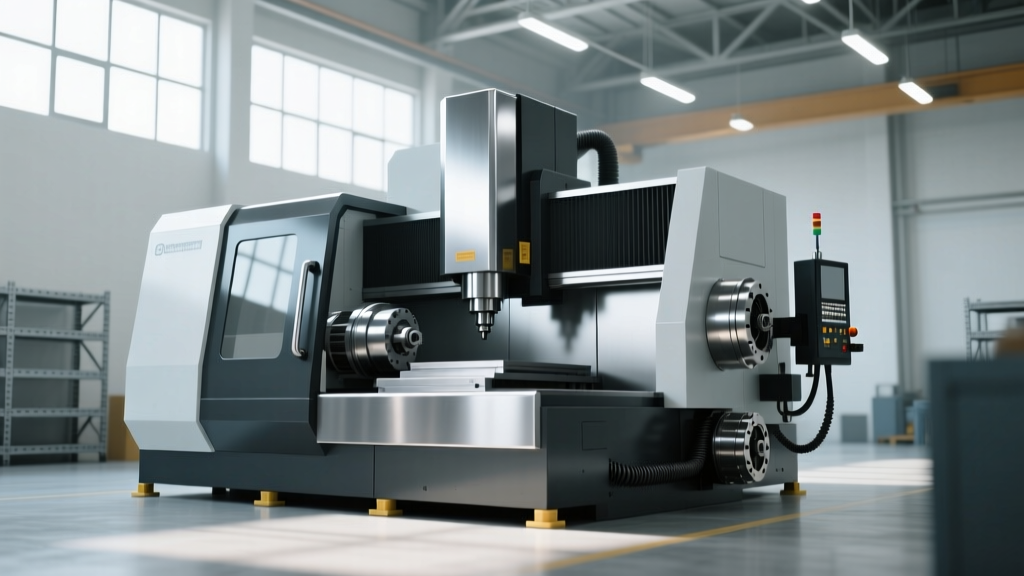
When evaluating CNC machine technical specifications, dimensions and weight are frequently overshadowed by spindle RPM, torque curves, and rapid traverse rates. However, the physical footprint, Z-axis height, and overall mass of a machining center directly dictate its natural resonant frequency and acoustic emission profile. A machine with a high center of gravity and a narrow base footprint will exhibit vastly different harmonic vibrations than a low-profile, wide-stance horizontal boring mill, even if both share identical spindle specifications.
Vibration in CNC operations manifests as chatter marks on finished surfaces, accelerated tool wear, and structural fatigue. Noise, conversely, is an airborne and structure-borne byproduct of these vibrations. According to OSHA's occupational noise exposure standards (1910.95), prolonged exposure to noise levels exceeding 85 dBA requires mandatory hearing conservation programs. High-speed CNC milling of hardened steels routinely generates 92 to 98 dBA at the operator station. Mitigating these issues requires selecting damping and acoustic alternatives that are mathematically matched to the machine's physical dimensions and mass.
Engineering Rule of Thumb: The natural frequency ($f_n$) of a machine-foundation system is calculated as $f_n = \frac{1}{2\pi} \sqrt{\frac{k}{m}}$. To prevent spindle-induced chatter, the system's natural frequency must be shifted at least 30% away from the dominant excitation frequencies generated by the spindle RPM and tooth-passing rates. Increasing mass ($m$) via inertia blocks or altering stiffness ($k$) via elastomeric pads are the primary levers for this adjustment.Comparing Foundation and Isolation Alternatives
The first line of defense against structure-borne vibration is the interface between the machine leveling pads and the facility floor. The choice of isolation material must account for the static load per pad, which is derived by dividing the machine's total weight by its footprint dimensions and adjusting for the center of gravity.
| Isolation Alternative | Material Composition | Cost (Approx. per sq. ft.) | Damping Coefficient | Best Application |
|---|---|---|---|---|
| Standard Neoprene Pads | Ribbed synthetic rubber | $1.50 - $3.00 | Low (0.05 - 0.10) | Light-duty routers, manual mills under 3,000 lbs |
| Polyurethane Elastomer (e.g., Sylomer) | Cellular polyurethane matrix | $12.00 - $18.00 | Medium (0.15 - 0.25) | VMCs and HMCs (5,000 - 15,000 lbs) requiring precise leveling |
| Pneumatic Air Mounts | Pressurized rubber bellows | $85.00 - $150.00 (per unit) | High (Variable, active tuning) | Jig grinders, diamond turning, ultra-precision 5-axis |
| Epoxy Granite Inertia Block | Poured epoxy/granite aggregate | $45.00 - $65.00 | Very High (Mass-based absorption) | High-speed machining centers requiring massive thermal/mass stability |
For standard vertical machining centers (VMCs), cellular polyurethane elastomers offer the highest return on investment. Unlike solid neoprene, which can bottom out under heavy dynamic loads, the cellular structure compresses predictably, providing consistent isolation across the machine's dimensional footprint. Detailed load-deflection curves for these materials are extensively documented in the Fabreeka technical library and similar manufacturer databases, allowing engineers to size pads precisely to the machine's leveling screw locations.
Acoustic Enclosure Sizing: Translating Specs into Noise Reduction
While isolation pads handle structure-borne vibration, airborne noise requires acoustic enclosures. Designing or purchasing an enclosure requires a strict analysis of the CNC machine technical specifications, dimensions regarding X/Y/Z travel limits, tool changer swing radius, and maintenance access panels.
Hard-Wall vs. Soft-Curtain Enclosures
- Hard-Wall Acoustic Cabins (Steel/Lead/Acoustic Foam):
- Noise Reduction: 15 to 25 dBA reduction.
- Dimensional Impact: Requires 36 to 48 inches of clearance on all sides for panel installation and door swing. Significantly increases the effective footprint of the cell.
- Cost: $12,000 to $35,000+ depending on automated door integration and HVAC requirements.
- Soft-Curtain Acoustic Barriers (Mass Loaded Vinyl/Fiberglass):
- Noise Reduction: 8 to 12 dBA reduction.
- Dimensional Impact: Can be mounted directly to the machine's existing sheet metal guard or suspended from ceiling tracks, adding virtually zero footprint overhead.
- Cost: $1,500 to $4,500 per cell.
According to NIOSH guidelines on occupational noise, a 3 dBA reduction halves the allowable exposure time, making even soft-curtain alternatives highly effective for compliance when hard-wall enclosures are dimensionally impossible due to shop floor constraints.
Active vs. Passive Vibration Damping Systems
As CNC machines have evolved to feature lighter, faster-moving gantries and higher acceleration rates, passive damping (relying solely on mass and elastomers) is sometimes insufficient. Active damping systems use piezoelectric sensors and actuators to detect and cancel vibrations in real-time.
Passive Damping
Mechanism: Dissipates kinetic energy as heat through material hysteresis (elastomers) or mass absorption (inertia blocks).
Latency: Instantaneous, but fixed tuning.
Limitation: Cannot adapt to changing workpiece masses or varying tool overhang lengths during a complex 5-axis cycle.
Active Damping
Mechanism: Accelerometers detect chatter; controllers drive actuators to inject counter-phase forces into the spindle housing or machine base.
Latency: Sub-millisecond response times.
Limitation: High capital cost ($25,000 - $60,000 retrofit); requires complex integration with the machine's CNC controller (e.g., Siemens Sinumerik or Fanuc 31i).
Applied Analysis: Haas VF-2 vs. DMG MORI CMX 600V
To illustrate how physical dimensions dictate damping strategies, consider two popular VMCs with distinctly different mass distributions.
Case 1: Haas VF-2
- Footprint Dimensions: 96' x 84' (approx. 2.4m x 2.1m)
- Weight: 6,500 lbs (2,948 kg)
- Center of Gravity: Relatively low, cast-iron C-frame design.
- Damping Strategy: Due to the compact footprint and manageable weight, a 1-inch thick pad of 50-durometer polyurethane elastomer, cut into 4x4 inch squares and placed at the four primary leveling points, is sufficient. The low Z-axis height minimizes the moment arm during heavy X-axis rapid decelerations, preventing 'rocking' that would otherwise break the seal on isolation pads.
Case 2: DMG MORI CMX 600V
- Footprint Dimensions: 110' x 90' (approx. 2.8m x 2.3m)
- Weight: 9,900 lbs (4,490 kg)
- Center of Gravity: Higher, due to integrated automation readiness and larger tool magazine mass.
- Damping Strategy: The increased mass and higher center of gravity require a broader isolation footprint. Utilizing continuous strips of Sylomer SR 110 under the entire perimeter of the leveling feet, combined with a poured epoxy granite sub-base (adding 2,000 lbs of dead mass), shifts the resonant frequency below 12 Hz. This ensures that high-speed spindle operations (up to 12,000 RPM) and rapid axis reversals do not excite the structural harmonics of the machine base.
Ignoring the Z-axis height dimension when spec'ing isolation pads is a common failure point. A machine with a tall column acts as a cantilever beam; if the isolation pads are too soft, the machine will physically sway during aggressive side-milling, causing tool deflection and poor surface finishes regardless of spindle quality.
Decision Framework for Facility Integration
When planning a new CNC cell, follow this sequential framework to align technical specifications with damping alternatives:
- Extract Dynamic Mass Data: Do not just use the shipping weight. Calculate the maximum operational weight (machine + maximum workpiece + full coolant tank + full tool magazine).
- Map the Footprint Load Distribution: Determine the load per square inch at each leveling pad location. If the load exceeds 75 psi, standard neoprene will permanently deform (compression set); upgrade to cellular polyurethane or steel spring mounts.
- Calculate Enclosure Clearance: Add 24 inches to the maximum X and Y travel dimensions, plus an additional 18 inches for operator access, to determine the minimum internal dimensions for a hard-wall acoustic enclosure.
- Verify Floor Resonance: If the facility floor is a suspended concrete slab or features long spans between support pillars, the floor itself may act as a sounding board. In these cases, active damping or localized inertia blocks are mandatory to prevent structure-borne noise from amplifying through the building.