Industrial vs Consumer: Types of Products Made With CNC Machines
Compare industrial and consumer CNC machines. Explore technical specs, tolerances, and the specific types of products made with CNC machines in both tiers.
The Physics of the Cut: Why Machine Tier Dictates Product Output
The divergence between a $3,000 garage CNC router and a $150,000 5-axis vertical machining center (VMC) is not merely a difference in speed or software features; it is a fundamental difference in physics. When engineers and shop owners evaluate the types of products made with CNC machines, they must first understand the mechanical limitations of the equipment. A machine's ability to hold tight tolerances under heavy cutting loads dictates whether it can produce aerospace titanium brackets or custom wooden signage.
In 2026, the CNC market is more segmented than ever. Prosumer machines have become remarkably capable for soft materials, while industrial machines have pushed into sub-micron precision. Understanding the technical specifications—frame rigidity, spindle torque curves, and axis drive systems—is critical for matching the right machine tier to your specific manufacturing requirements.
Frame Mass, Damping, and Harmonic Vibration
The most critical, yet frequently overlooked, specification in CNC machining is the damping coefficient of the machine frame. When an endmill engages with a workpiece, it generates harmonic vibrations. If the machine frame cannot absorb these vibrations, the energy transfers back into the cutting tool, causing chatter, poor surface finishes, and premature tool failure.
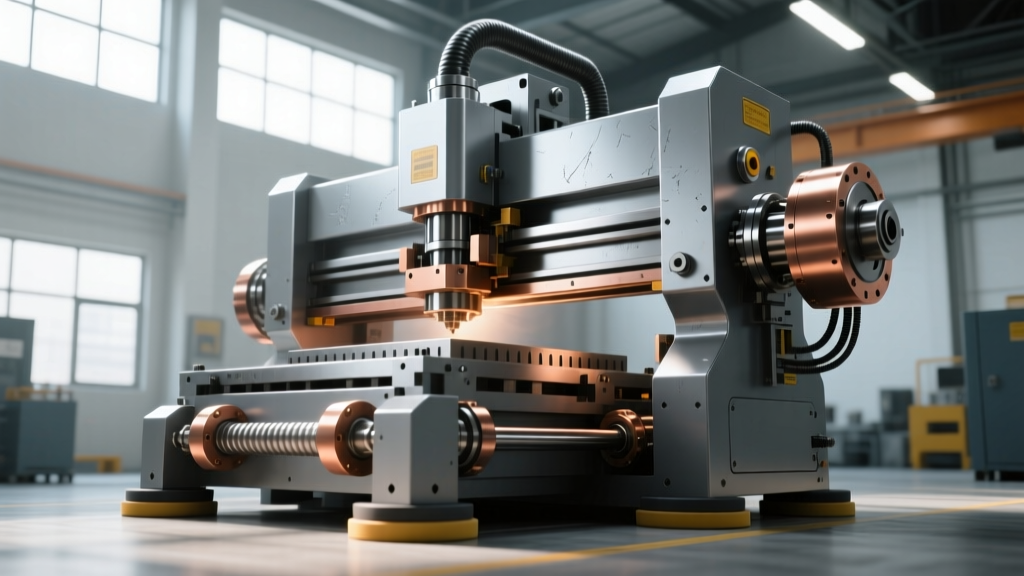
- Industrial Frames: Machines like the Haas VF Series utilize heavy, stress-relieved cast iron or polymer concrete bases. Cast iron has a high damping capacity, absorbing the high-frequency vibrations generated when roughing hard metals like Inconel or tool steel.
- Consumer Frames: Desktop and prosumer routers (e.g., Shapeoko, X-Carve) rely on extruded aluminum profiles and steel plates. While sufficient for cutting wood, plastics, and thin aluminum sheets, extruded aluminum lacks the mass to dampen the chatter caused by aggressive depth-of-pass (DOC) cuts in hard metals.
Expert Insight: Attempting to machine Ti-6Al-4V (Grade 5 Titanium) on an extruded aluminum frame will result in catastrophic tool deflection. The low mass of the gantry cannot resist the cutting forces, leading to work hardening of the titanium and immediate carbide endmill fracture.
Industrial CNC Specifications & Product Capabilities
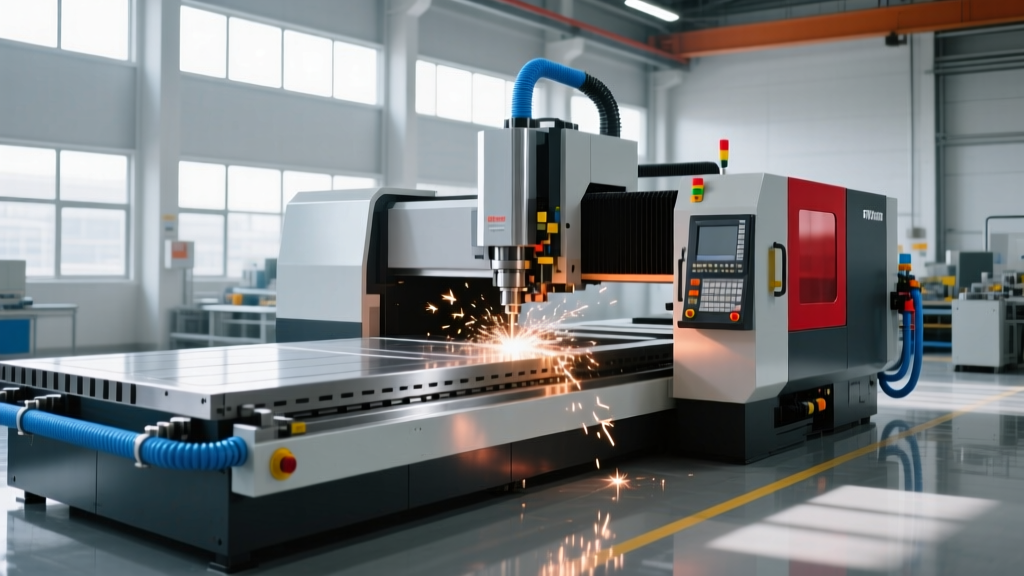
Industrial CNC mills are engineered for high material removal rates (MRR) and continuous 24/7 operation. They utilize high-pressure coolant systems, automatic tool changers (ATC) with 24+ pockets, and ground C3-class ballscrews for precise axis positioning.
Core Technical Specifications (Typical VMC)
- Spindle Taper: BT40 or CAT40 (provides high rigidity and torque transmission).
- Spindle Speed & Power: 8,000 to 12,000 RPM with 20 to 30 HP peak power.
- Positioning Accuracy: ±0.0002 inches (0.005 mm) per ISO 230-2 standards.
- Rapid Traverse Rates: 1,000 to 1,400 IPM (inches per minute).
Types of Products Made with Industrial CNC Machines
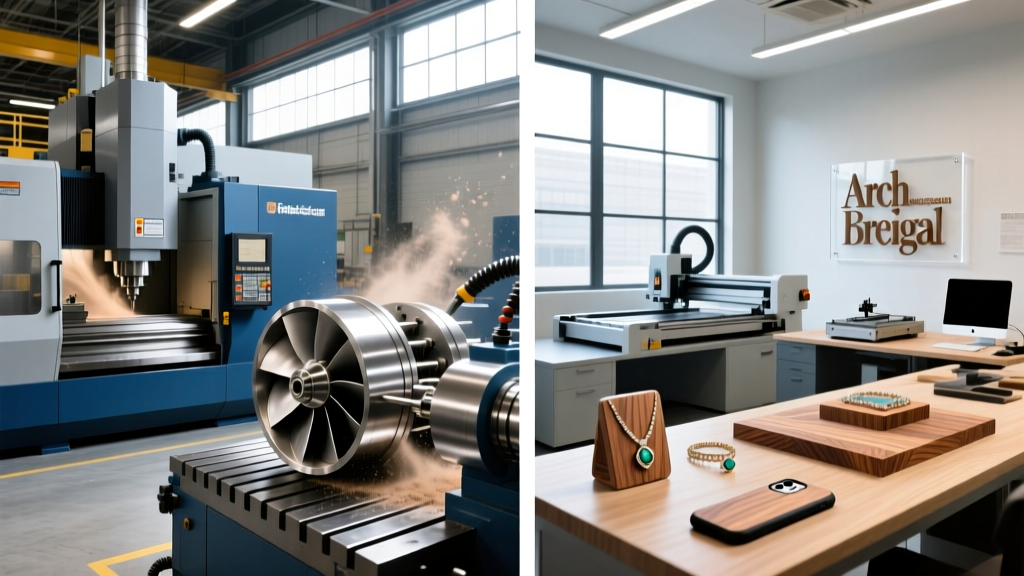
Because of their rigidity and thermal stability, industrial VMCs produce high-value, tight-tolerance components. Common products include:
- Aerospace Structural Ribs: Machined from 7075-T6 aluminum billets. Industrial machines use high-speed spindles (15,000+ RPM) and specialized toolpaths to remove 80% of the material while maintaining wall thicknesses down to 0.040 inches without vibration.
- Medical Orthopedic Implants: Knee and hip joints machined from Cobalt-Chrome or Titanium alloys. These require 5-axis simultaneous machining and strict surface finish tolerances (Ra 0.4 µm) to prevent biological rejection.
- Automotive Transmission Housings: High-volume production of cast aluminum housings requiring precise boring and tapping operations, where positional tolerances of ±0.0005 inches are mandatory for gear mesh alignment.
Consumer & Prosumer CNC Specifications & Product Capabilities
The consumer and prosumer CNC sector has evolved significantly. Machines like the Tormach PCNC 440 or the Carbide 3D Shapeoko 5 bridge the gap between hobbyist toys and entry-level industrial mills. However, their mechanical architecture limits the types of products they can reliably manufacture.
Core Technical Specifications (Prosumer Tier)
- Spindle Taper: ER11, ER20, or R8 (lower rigidity, suited for smaller tool shanks).
- Spindle Speed & Power: VFD-controlled router spindles running up to 24,000 RPM, but limited to 1.5 kW (2 HP) peak power.
- Positioning Accuracy: ±0.002 to ±0.005 inches (0.05 to 0.12 mm), heavily dependent on belt tension or rolled C7 ballscrew backlash.
- Axis Drive: Neoprene reinforced belts (routers) or rolled ballscrews (benchtop mills).
Types of Products Made with Consumer CNC Machines
Consumer machines excel at low-volume production, prototyping, and machining soft materials. Typical products include:
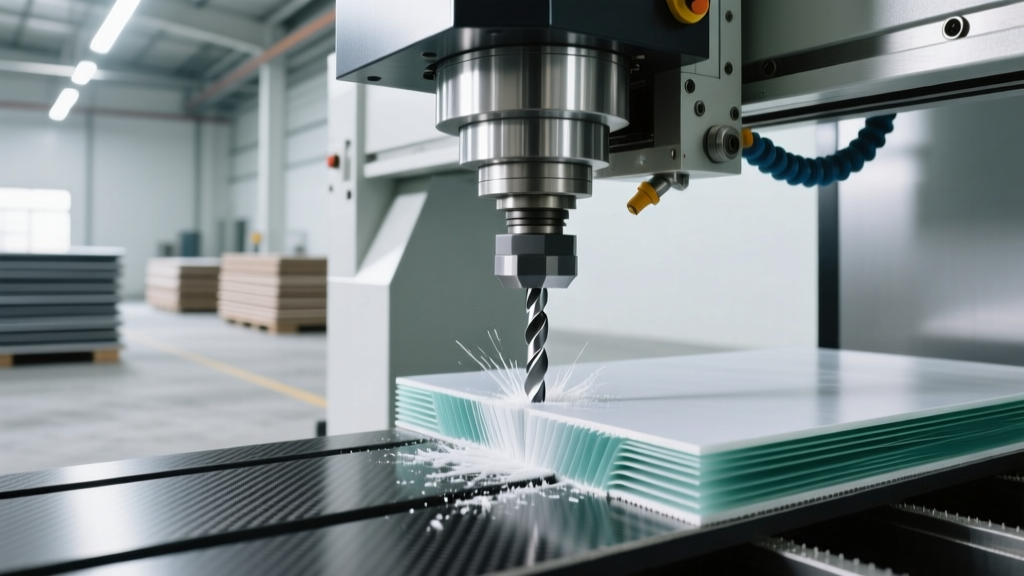
- Custom Drone and RC Frames: Machined from 3K carbon fiber sheets or 6061-T6 aluminum. The high RPM and low torque of router spindles are perfect for slicing through composite materials cleanly.
- Front Panels and Enclosures: Machined from Delrin (POM), acrylic, or polycarbonate for electronics housings. These materials require sharp, high-rake tools and low cutting forces, which perfectly match the capabilities of a belt-driven gantry.
- PCB Isolation Routing: Engraving copper-clad boards using 0.1mm V-bits. This requires high spindle speeds but virtually zero cutting force, making it ideal for desktop CNCs.
Many hobbyists purchase consumer CNC routers to machine 6061-T6 aluminum. While technically possible, it requires severe compromises. You must limit your depth of cut (DOC) to 0.020 inches per pass and use single-flute 'O-flute' endmills to clear chips. Attempting to use a standard 3-flute carbide endmill with a 0.100 inch DOC will stall a 1.5kW router spindle and break the tool.
Drive Systems: Ground vs. Rolled Ballscrews and Linear Guides
The method by which the CNC controller translates rotational motor movement into linear axis movement drastically affects the types of products made with CNC machines. This is defined by the ballscrew grade and the linear guide mechanism.
| Component | Industrial VMC | Prosumer Benchtop Mill | Consumer CNC Router |
|---|---|---|---|
| Ballscrew Grade | Ground C3 (±0.0003 in/ft) | Rolled C7 (±0.002 in/ft) | N/A (Timing Belts) |
| Linear Guides | Preloaded Linear Rails (THK/Hiwin) | Dovetail Ways or Linear Shafts | Delrin V-Wheels on Aluminum |
| Backlash Compensation | Hardware eliminated via preloading | Software compensation required | Highly variable, belt stretch |
| Best Suited For | 3D contouring, boring, tapping | 2.5D profiling, light drilling | 2D cutting, engraving, V-carving |
When machining products that require precise circular interpolation—such as bearing seats or valve bodies—the backlash inherent in rolled C7 ballscrews and belt drives will result in out-of-round geometries. Industrial machines use preloaded linear guideways and ground ballscrews to ensure zero mechanical play, allowing for perfect circular toolpaths under heavy lateral cutting forces.
Thermal Stability and Product Consistency
As a CNC machine operates, friction from the spindle bearings and axis drives generates heat. In consumer machines built from aluminum and steel, this heat causes uneven thermal expansion. An aluminum gantry will expand at a different rate than the steel linear rails it rides on, leading to axis skew.
For products like custom wooden furniture or acrylic signs, a 0.010-inch thermal shift over an 8-hour run is irrelevant. However, if you are manufacturing hydraulic manifold blocks where port alignments must be held within 0.0005 inches, thermal growth will scrap the entire batch. Industrial machines mitigate this through thermally symmetric frame designs, spindle chiller units, and real-time thermal compensation algorithms embedded in the CNC controller.
Decision Matrix: Selecting the Right Machine Tier
Use the following framework to determine which machine tier is required for your specific product line, referencing industry-standard CNC machining guidelines for material and tolerance matching.
- Choose Consumer/Prosumer if: Your products are 2D or 2.5D, made from woods, plastics, or soft non-ferrous metals (aluminum, brass). Your tolerance requirements are looser than ±0.005 inches, and your batch sizes are under 50 units.
- Choose Industrial if: Your products require 3D surface contouring, are made from ferrous metals (steel, stainless, titanium), require tapped holes with strict pitch tolerances, or demand positional accuracies tighter than ±0.001 inches.
Ultimately, the types of products made with CNC machines are constrained by the mechanical reality of the equipment. Investing in an industrial VMC is unjustified if your primary output is polycarbonate faceplates, just as attempting to machine aerospace turbine blades on a belt-driven router is a recipe for catastrophic failure. Match the physics of the machine to the physics of the cut.