CNC Drilling Machine Troubleshooting for Composite Material Cutting
Troubleshoot delamination, tool wear, and spindle runout on your CNC drilling machine when cutting CFRP and GFRP composites. Expert repair guide.
The Anisotropic Challenge: Why Composites Destroy Standard Drills
Machining Carbon Fiber Reinforced Polymers (CFRP) and Glass Fiber Reinforced Polymers (GFRP) is fundamentally different from cutting metals. Metals are isotropic; composites are anisotropic and highly abrasive. When utilizing a CNC drilling machine for composite material cutting, the primary failure modes are not built-up edge or thermal softening, but rather catastrophic delamination, fiber pull-out, and rapid abrasive wear. A standard 118-degree split-point HSS or uncoated carbide drill will delaminate the exit ply of a CFRP aerospace panel within 5 to 10 holes and lose its cutting edge entirely within 25 holes.
⚠️ CRITICAL WARNING: Coolant ContaminationNever use flood coolant or water-soluble synthetic coolants when operating a CNC drilling machine on raw CFRP. Carbon fiber matrices (especially bismaleimide and epoxy resins) are susceptible to moisture absorption, which lowers the glass transition temperature (Tg) and compromises structural integrity. Always use dry machining with high-velocity dust extraction, or minimal quantity lubrication (MQL) with a volatile, aerospace-approved alcohol-based mist if thermal management is strictly required.
Diagnostic Matrix: Symptom to Root Cause Mapping
Use this decision matrix to isolate the exact mechanical or parameter-driven failure occurring on your shop floor.
| Symptom | Root Cause | Machine Adjustment | Tooling / Hardware Fix |
|---|---|---|---|
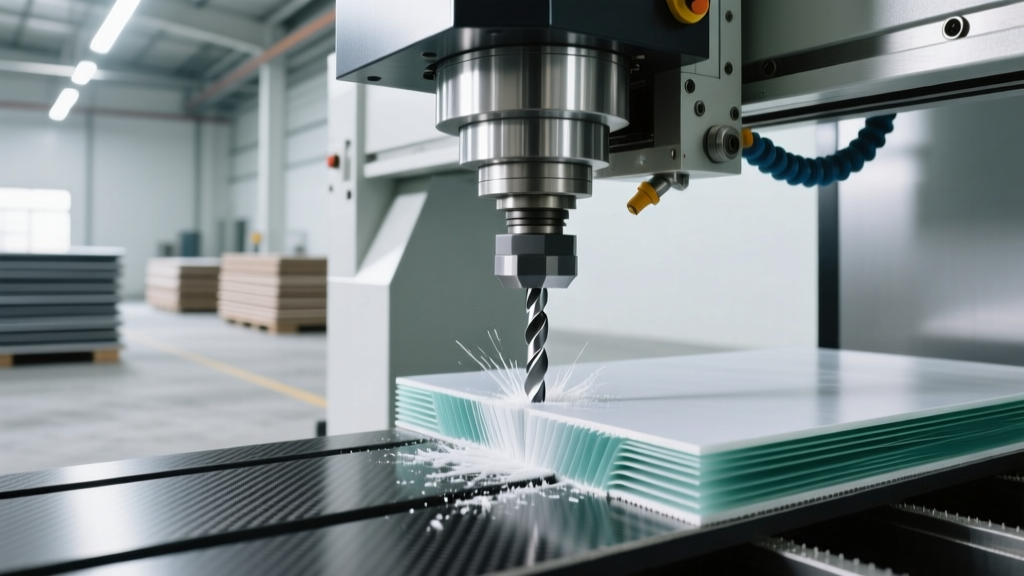
| Exit Ply Delamination (Push-out) | Thrust force exceeds interlaminar shear strength at breakthrough. | Reduce feed rate at 80% depth; implement peck drilling cycle. | Switch to a candlestick (dagger) drill or add sacrificial backer. |
| Entry Ply Fraying (Peel-up) | Flute helix angle pulls fibers upward before shearing. | Ensure entry surface is perfectly perpendicular to spindle Z-axis. | Use a brad-point drill or a 90-degree chamfer mill to score first. |
| Hole Oversizing / Out of Tolerance | Spindle runout or tool deflection acting as a grinding wheel. | Verify spindle bearings; reduce RPM to limit centrifugal vibration. | Check TIR; upgrade to hydraulic or shrink-fit toolholders. |
| Rapid Flute Wear / Edge Chipping | Abrasive carbon fibers micro-chipping carbide grain boundaries. | Increase feed rate to reduce rubbing; ensure 150+ CFM vacuum. | Upgrade to CVD Diamond-coated or PCD-tipped drills. |
Deep Dive 1: Eliminating Exit Delamination (Push-Out)
Push-out delamination is the most costly defect in composite assembly. As the drill tip exits the bottom ply, the remaining uncut material thickness drops to near zero, drastically reducing its resistance to the Z-axis thrust force. According to Sandvik Coromant's composite machining guidelines, maintaining thrust force below the critical delamination threshold—typically between 120N and 180N for thin aerospace laminates—is mandatory.
Thrust Force Calibration & Peck Cycles
Standard G83 peck drilling cycles used in aluminum are often detrimental in composites because the retraction of the flutes can catch and fray the entry hole. Instead, program a "slow-in, slow-out" feed override. Reduce the Z-axis feed rate by 50% when the drill tip is within 2.0 mm of the exit ply. If your CNC drilling machine lacks dynamic feed override capabilities in the Z-axis macro, you must rely on mechanical fixturing.
Sacrificial Backing Selection
To artificially maintain interlaminar support during breakthrough, clamp a sacrificial backer board to the exit side of the workpiece.
- Phenolic LE (Linen/Epoxy): Best for high-volume production. Dense enough to support the exit ply, but won't rapidly dull PCD tooling.
- Medium-Density Fiberboard (MDF): Acceptable for low-cost prototyping, but generates excessive secondary dust and degrades after 50-100 holes.
- Aluminum 6061-T6: Used in automated aerospace cells. Requires the CNC drilling machine to have rigid tapping and thrust-limiting capabilities to avoid breaking the drill tip upon hitting the metal backer.
Deep Dive 2: Spindle Runout and Abrasive Wear
Carbon fiber acts exactly like a vitrified grinding wheel. If your CNC drilling machine has excessive Total Indicator Runout (TIR), the drill will not cut cleanly; it will orbit and grind the hole wall. This results in a 0.250-inch drill producing a 0.258-inch hole, instantly scrapping the composite part for fastener interference fit requirements.
"In CFRP drilling, a spindle runout of just 0.001 inches will reduce PCD tool life by up to 40% and guarantee microscopic fraying on the hole wall. Precision is not optional; it is the baseline requirement for composite survival."
Measuring and Correcting TIR
Mount a high-precision dial indicator (resolution 0.0001") against the tool shank and the cutting edge. For composite cutting, maximum allowable TIR at the tool tip is 0.0005 inches (0.0127 mm). If TIR exceeds this:
- Inspect the spindle taper for embedded composite dust. Carbon dust is electrically conductive and can cause micro-arcing or galvanic corrosion in the taper.
- Clean the taper with a lint-free cloth and isopropyl alcohol.
- Replace standard ER collets with shrink-fit holders or hydraulic chucks. Shrink-fit holders provide TIR consistently below 0.0002" and eliminate the mechanical runout introduced by collet nuts.
Tooling Economics: Carbide vs. PCD for CNC Drilling Machines
Upgrading your tooling requires capital expenditure, but the cost-per-hole in composite manufacturing heavily favors advanced superabrasives. Data from Kennametal's aerospace applications research consistently demonstrates that Polycrystalline Diamond (PCD) and Chemical Vapor Deposition (CVD) diamond coatings are mandatory for profitable CFRP machining.
Solid Carbide (Uncoated)
- Tool Cost: $35 - $60
- Hole Life (CFRP): 20 - 40 holes
- Cost Per Hole: ~$1.25
- Verdict: Unacceptable for production. High risk of delamination after hole 15.
CVD Diamond Coated Carbide
- Tool Cost: $80 - $120
- Hole Life (CFRP): 300 - 500 holes
- Cost Per Hole: ~$0.28
- Verdict: Excellent for GFRP and low-to-medium volume CFRP.
PCD-Tipped / Brazed Drill
- Tool Cost: $180 - $350
- Hole Life (CFRP): 3,000 - 5,000+ holes
- Cost Per Hole: ~$0.06
- Verdict: Mandatory for high-volume aerospace/automotive CFRP cells.
Preventative Maintenance Checklist for Composite Shops
Composite dust is insidious. It is highly abrasive, electrically conductive, and microscopic. A CNC drilling machine not specifically sealed for composites will suffer catastrophic linear guide and ball screw failure within 6 months if maintenance is neglected.
- Way Cover Inspection (Weekly): Check telescopic steel way covers and bellows for micro-tears. Carbon dust will bypass standard wipers and embed in the ball screw recirculation channels, acting as lapping compound.
- Spindle Air Purge Verification (Daily): Ensure the spindle labyrinth air purge is functioning at the correct PSI (usually 30-40 PSI). This positive pressure prevents conductive carbon dust from entering the spindle bearings and shorting out the internal encoder.
- VFD and Cabinet Sealing (Monthly): Inspect cabinet door gaskets and cooling fan filters. Conductive carbon dust settling on Variable Frequency Drive (VFD) circuit boards will cause phase-to-phase short circuits, resulting in $5,000+ drive replacements.
- Vacuum Shoe Calibration (Daily): Verify the dust extraction vacuum shoe maintains a maximum gap of 2.0 mm from the workpiece surface. Airflow must exceed 150 CFM at the spindle nose to capture hazardous respirable fibers before they settle on the machine ways.